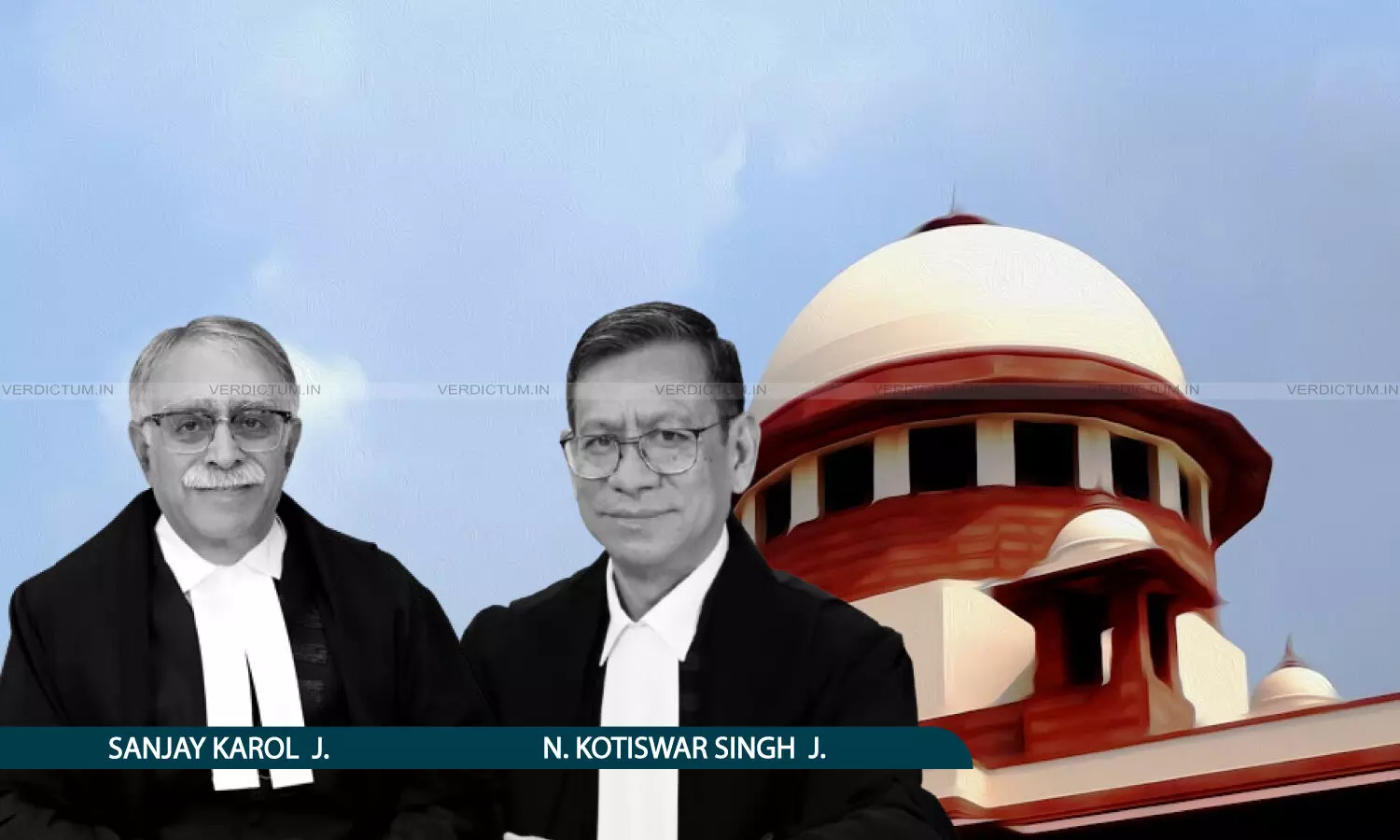
Justice Sanjay Karol, Justice N. Kotiswar Singh, Supreme Court
‘Voluntary’ Aspect Mandated By Order XXIII Rule 3 CPC Not Established: Supreme Court Upholds Setting Aside Of Compromise Decree After 25 Years
 |
|The Supreme Court was considering an appeal filed by the legal heirs of the original plaintiffs and co-sharers challenging the dismissal of a civil revision.
The Supreme Court has upheld an order setting aside a compromise decree where the counsel acted without seeking a clear approval from the client. The Apex Court held that the ‘voluntary’ aspect mandated by Order XXIII Rule 3 of the Code of Civil Procedure, 1908, which is essential for a compromise decree, could not be established.
The Apex Court was considering an appeal filed by the Appellants (legal heirs of the original plaintiffs and other co-sharers) who were aggrieved by the dismissal of the civil revision, which was directed against the order whereby the petition for setting aside the decree on the basis of a compromise was allowed.
The Division Bench of Justice Sanjay Karol and Justice Nongmeikapam Kotiswar Singh held, “In the present case, there is no express authorisation by defendant no.5 allowing Mr. Mehta to sign the compromise on his behalf, nor is there anything on record to demonstrate the exigent circumstances which prompted the counsel to act without seeking a clear approval from defendant no.5. In absence of the aforesaid, the ‘voluntary’ aspect mandated by Order XXIII Rule 3 of the Code of Civil Procedure, 1908, which is essential for a compromise decree cannot be established on the record. As such, the requirements of Rule 3 have not been complied with. The resulting compromise is contrary to law.”
AOR Anisha Upadhyay represented the Appellant while Advocate Arun Maitri represented the Respondent.
Factual Background
The plaintiff filed a partition suit against the predecessors of the respondent, seeking a 1/4th share in the total property of the common ancestor by the name of Thakur Ojha. Chaturbhuj Chaudhary (fifth Defendant), the abovesaid predecessor of the respondents, appeared through counsel on summons in the suit. During the pendency, a compromise petition was filed by the plaintiffs and defendants jointly ’, which was accepted by the Sub-Judge and a final decree was prepared in terms of the compromise petition.
All appeared fine for approximately a quarter of a century, but in 2022, the fifth defendant, represented through LRs - the respondents, filed a Miscellaneous Case before the concerned Court seeking setting aside of the aforesaid compromise decree on the ground that the same had been obtained by fraud and without the signatures of the fifth defendant. The same was allowed by the Trial Court, and the appeal thereagainst was dismissed by the High Court. It was in such circumstances that the appeal came to be filed before the Apex Court.
Reasoning
The Bench referred to Order XXIII which is titled ‘Withdrawal and Adjustment of Suits’, and Rule 3, which provides for compromise of suit. Referring to various decisions of the Apex Court, including Gurpreet Singh v. Chatur Bhuj Goel (1988) and Som Dev v. Rati Ram (2005), the Bench observed that prior to the 1976 Amendment to the CPC, a compromise could be either oral or written, and the Court could decide the same on the basis of general evidence by the parties. It was further noted that after the amendment, it has been clarified that a compromise must be in writing and must be signed by the Parties.
The Bench also reaffirmed that the objective of the amendment is to prevent false pleas of compromise having been entered into between the parties, and a compromise decree being signed by all parties, is a mandate of the law.
Further referring to the decisions in Baldevdas Shivlal v. Filmistan Distributors (India) (P) Ltd. (1969) and Navratan Lal Sharma v. Radha Mohan Sharma (2024), the Bench reiterated that a consent decree, which is the conclusion of a compromise, does not operate as res judicata for it does not meet Section 11 (CPC) requirements. The only remedy available against a compromise decree is a recall application, and a fresh suit or an appeal is not maintainable against this kind of decree.
On a perusal of the facts of the case, the Bench noted that the compromise that was furnished to the Court by the respondents along with the written submissions recorded that there was no objection on behalf of the fifth defendant, Chaturbhuj Chaudhary, and the said statement had come through his counsel, Ram Krishna Mehta, whose vakalatnama was dated August 27, 1992. The Bench found the resulting compromise to be contrary to law as the ‘voluntary’ aspect mandated by Order XXIII Rule 3 of the Code of Civil Procedure, 1908, which is essential for a compromise decree, could not be established on the record.
Dealing with the aspect of delay, i.e. the prima facie gap between 1994 and 2022, the Bench noted that although the compromise was not signed by the fifth defendant, his rights in the property were directly affected by the compromise. “It is for the aforenoted reasons that the delay of 25 years has to be given a go-by in the facts of this case. It is not in all cases that such large delay can be set aside. Whether or not a particular case warrants taking such a view is to be determined after a detailed examination of the record in each case”, it added.
Holding that the compromise decree had been correctly set aside and dismissing the appeal, the Bench stated, “In fact, we are of the view that the issues of the partition suit require to be adjudicated in a full trial. While we acknowledge the difficulty that may arise in 1989 suit being taken to trial 37 years later, but it is not possible to decide the rights of the parties without the due process of collection and weighing of evidence, whatever may be available.”
Cause Title: Krishna Kumar Ojha Jitendra Chaudhary & Ors. (Neutral Citation: 2026 INSC 662)
Appearance
Appellant: AOR Anisha Upadhyay
Respondent: Advocate Arun Maitri, AOR Rabin Majumder, Advocates Radhika Chandrasekhar, Mousumi Roy, Shivam Majhi