Bank Acquiring Non-Performing Secured Loan From Entity Outside SARFAESI Act Can Recover It Under It: Supreme Court
 |
|The Court held that borrowers cannot avoid SARFAESI recovery merely because the original lender was not governed by the Act when the loan was created, if the loan later comes to be held by a bank covered by the Act.
The Supreme Court has held that when a bank covered by the Securitisation and Reconstruction of Financial Assets and Enforcement of Security Interest Act, 2002 acquires a non-performing secured loan account from an entity outside the Act, the loan account becomes a secured debt recoverable under the SARFAESI Act.
The Court was hearing connected civil appeals concerning whether Kotak Mahindra Bank Limited could invoke the SARFAESI Act to recover loan accounts assigned to it by City Financial Consumer Finance Limited, a non-banking financial company which was not a “financial institution” under Section 2(1)(m) of the SARFAESI Act when the loans were created.
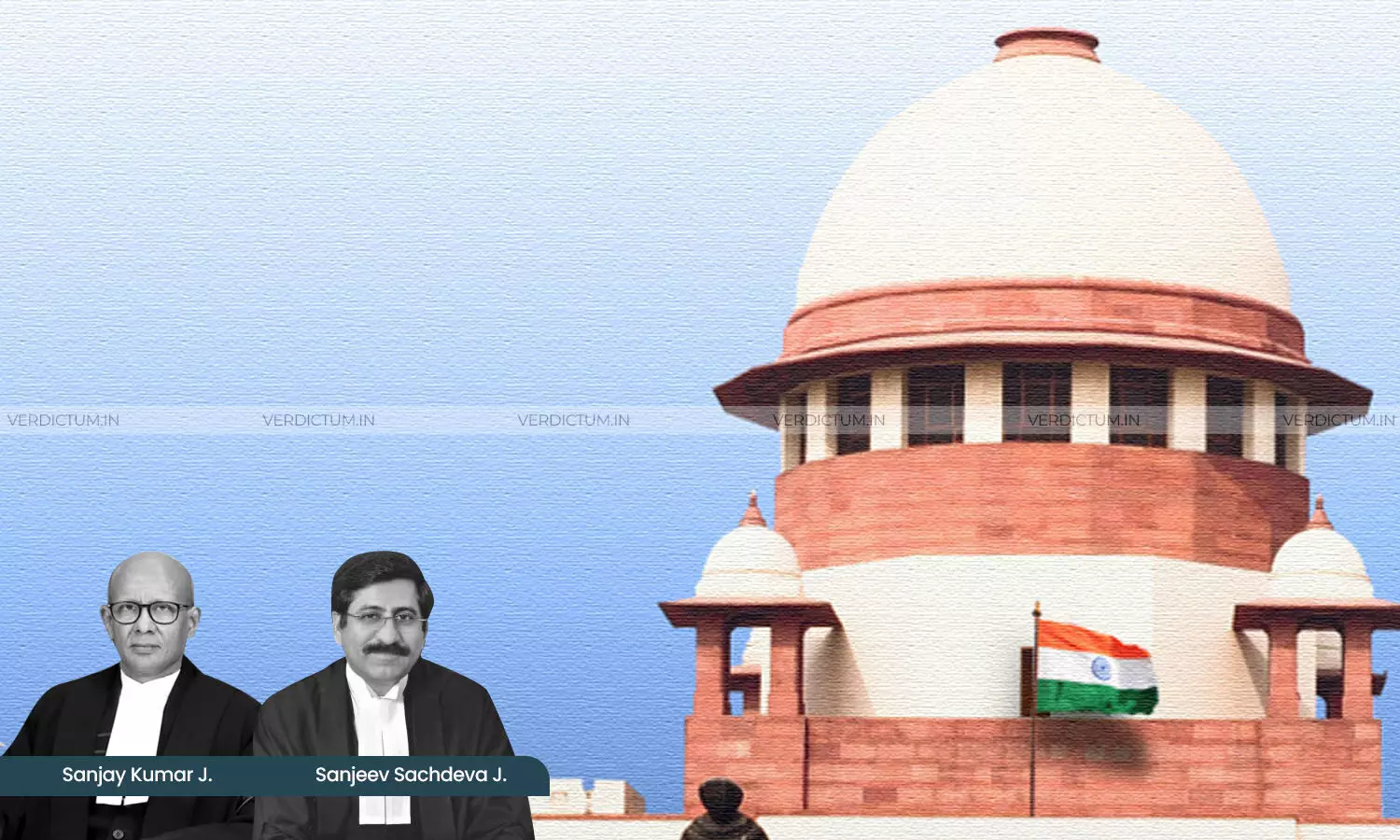
A Bench of Justice Sanjay Kumar and Justice Sanjeev Sachdeva observed: “The decisions in M.D. Frozen Foods (supra) and Indiabulls (supra), therefore, put it beyond the pale of doubt that once a claim is ‘live and owing’ as on the date of coming into force of the SARFAESI Act, the provisions thereof would be available, as and when it becomes applicable to the institution holding that loan account. By the same logic, when the institution is one to which the SARFAESI Act is already applicable, acquisition of a non-performing secured loan account by such institution from an entity, that does not come within the ambit of the SARFAESI Act, would immediately clothe the said loan account with the attributes of a ‘secured debt’ covered by the provisions of the SARFAESI Act.”
The Bench added: “In essence, it makes no difference as to whether it is the loan/debt along with the institution that comes within the ambit of the SARFAESI Act, as in the earlier two decisions, or it is the loan/debt alone which comes within the ambit thereof, by virtue of it being taken over by a ‘bank’ to which the SARFAESI Act is already applicable. In both cases, the provisions of the SARFAESI Act would be available for effecting recovery of the loan/debt.”
Background
In the first appeal, Kotak Mahindra Bank Limited had taken over a home loan account from City Financial Consumer Finance Limited. After default, it issued a demand notice under Section 13(2) of the SARFAESI Act and later obtained an order under Sections 13(4) and 14 for taking possession of the secured asset.
The borrowers challenged the measures before the Debts Recovery Tribunal, contending that Kotak Mahindra Bank Limited could not invoke the SARFAESI Act because the original lender was not covered by the Act when the debt was created. The Debts Recovery Tribunal accepted the contention, the Debts Recovery Appellate Tribunal dismissed the bank’s appeal, and the Bombay High Court affirmed that view.
In the connected matters, similar questions arose where borrowers challenged SARFAESI measures initiated by Kotak Mahindra Bank Limited after it had acquired loan accounts from the same non-banking financial company. In one matter, the Bombay High Court dismissed the borrowers’ writ petition by holding that the issue stood covered by M.D. Frozen Foods Exports Private Limited and others v. Hero Fincorp Limited (2017) and Indiabulls Housing Finance Limited v. Deccan Chronicle Holdings Limited and others (2018).
Before the Supreme Court, the borrowers argued that banks and financial institutions governed by the SARFAESI Act could not acquire non-performing assets of entities outside the Act and then enforce those security interests under its recovery mechanism. The Reserve Bank of India stated that it had no objection to banks purchasing non-performing assets from financial institutions and non-banking financial companies, and submitted that restrictive interpretation would prevent assignee banks from enforcing security interests.
Court’s Observations
The Court framed the issue as whether a bank, as defined under Section 2(1)(c) of the SARFAESI Act, could take recourse to the Act for recovery of a debt assigned to it or taken over by it from a financial entity that was not governed by the Act at the time of creation of the debt.
The Bench observed: “Presently, the issue is whether a loan/debt secured by a mortgage in favour of a NBFC which was not, at that point of time, a ‘financial institution’ under Section 2(1)(m) of the SARFAESI Act, would get converted into a ‘secured debt’ thereunder if the said loan/debt is acquired by a ‘bank’ under Section 2(1)(c) thereof and whether the said bank could, thereupon, initiate measures under the SARFAESI Act for recovery of that loan/debt.”
The Court noted that City Financial Consumer Finance Limited was not a “financial institution” under Section 2(1)(m) when it advanced the loans, and was notified as such only later. Kotak Mahindra Bank Limited, however, was already a “bank” under Section 2(1)(c) when it took over the loan accounts.
The Court referred to M.D. Frozen Foods Exports Private Limited and others v. Hero Fincorp Limited (2017), where the issue was whether a non-banking financial company could invoke SARFAESI after being notified as a “financial institution” even though the loan had been granted earlier.
The Court recorded: “Further, this Court held that the definition clauses clearly conveyed the legislative intent that the SARFAESI Act applied to all existing loan agreements, irrespective of whether or not the lender was a notified ‘financial institution’ on the date of execution of the agreement with the borrower.”
It also referred to Indiabulls Housing Finance Limited v. Deccan Chronicle Holdings Limited and others (2018), where the successor-in-interest to a loan was held entitled to invoke the SARFAESI Act even if the original lender was not covered by the Act at the relevant time.
The Court noted: “This Court observed that M.D. Frozen Foods (supra) made it clear that a successor-in-interest would be entitled to take recourse to the SARFAESI Act even if the original lender was not a ‘financial institution’ covered by the Act at the relevant time.”
The Court rejected the borrowers’ attempt to avoid the SARFAESI mechanism on the ground that the original lender was outside the Act.
The Bench observed: “The SARFAESI Act facilitates liquidation of non-performing assets and bad debts by ‘banks’ and ‘financial institutions’ so as to aid in the growth of the economy. No doubt, it provides for harsh measures in that regard, minimizing the scope of judicial intervention to a great extent. However, the objective of the enactment cannot be lost sight of.”
The Court further observed that if the borrowers’ argument were accepted, borrowers from non-banking financial companies not covered by Section 2(1)(m) would enjoy greater freedom to default, since recovery would have to proceed through ordinary civil processes.
The Bench added: “There can be no deviating from this legal and moral obligation of a borrower, irrespective of the mode of recovery in the event of default by such borrower in repaying the loan.”
Applying M.D. Frozen Foods (2017) and Indiabulls (2018), the Court held that the purposive interpretation of the definitions under Section 2(1) of the SARFAESI Act foreclosed the borrowers’ objections.
The Bench held: “Further, in the light of the earlier decisions of this Court, it is not open to the borrowers to dissect and nit-pick the definitions in Section 2(1) of the SARFAESI Act to claim that their loans/debts cannot be subjected to recovery measures thereunder.”
It added: “The purposive interpretation of such definitions by this Court in the earlier judgments forecloses any such argument being advanced once again.”
The Court held that the Bombay High Court had erred in affirming the Debts Recovery Tribunal and Debts Recovery Appellate Tribunal in favour of the borrowers in the first appeal.
The Bench observed: “On the above analysis, we find that the Bombay High Court was not correct in taking the view that it did in the case of the Mehtas.”
Since other factual and legal issues raised in the securitisation application had not been considered on merits, the Court restored the application for adjudication after directing an additional deposit.
In the appeal concerning the Sables, the Court held that Kotak Mahindra Bank Limited was legally entitled to invoke Section 14 of the SARFAESI Act to take physical possession of the secured property. The Court noted that their securitisation application had already been dismissed on the ground of delay.
In the appeal concerning Poorti Rent a Car and Logistics Private Limited, the Court held that the Bombay High Court was justified in treating the issue as covered by M.D. Frozen Foods (2017) and Indiabulls (2018). It also noted that the secured property had already been sold.
Conclusion
The Supreme Court allowed Civil Appeal No. 8531 of 2015, set aside the Bombay High Court judgment and the underlying decisions, and restored the securitisation application for consideration in accordance with law.
The borrowers in that matter were permitted to deposit a further ₹25 lakh with Kotak Mahindra Bank Limited within eight weeks, without prejudice to their rights and contentions, with the deposit to abide by the final decision in the securitisation application.
The Court dismissed the other two appeals. It also dismissed the pending impleadment and intervention applications, and directed parties to bear their respective costs.
Cause Title: Kotak Mahindra Bank Limited v. Trupti Sanjay Mehta and others with connected appeals (Neutral Citation: 2026 INSC 943)