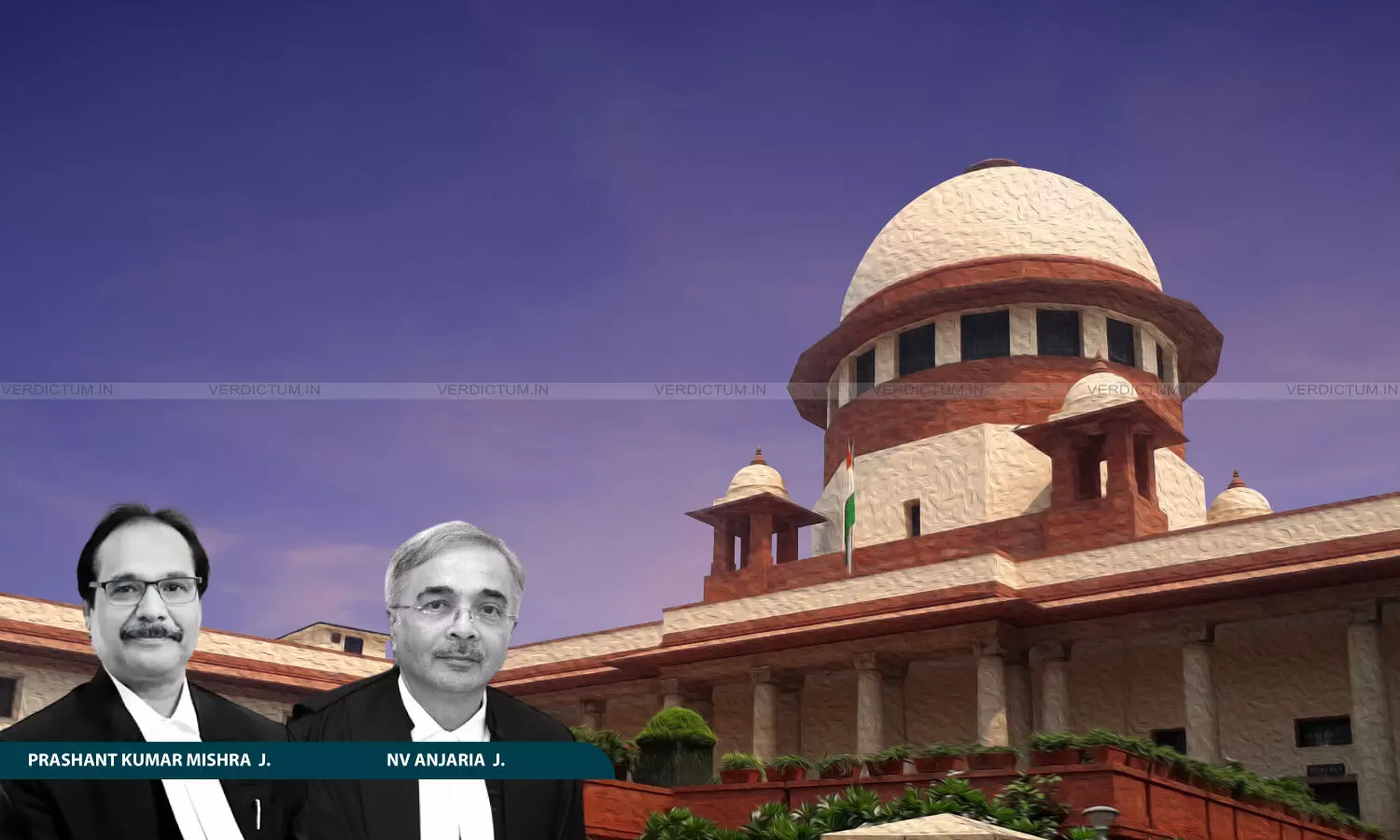
Supreme Court, Justice Prashant Kumar Mishra, Justice N.V. Anjaria
Sentencing Must Be Proportionate To Factual Matrix & Degree Of Criminality: Supreme Court Reduces Sentence In Revenue Document Forgery Case
 |
|The Supreme Court was considering a criminal appeal arising out of a judgment affirming the sentence and conviction of the accused.
The Supreme Court has reduced the sentence imposed upon a convict to the period of incarceration already undergone by him in a case of using forged revenue documents for furnishing surety in judicial proceedings. The Apex Court noted that the alleged misuse did not ultimately culminate in any irreversible pecuniary or proprietary consequence and further observed that sentencing must remain proportionate to the overall factual matrix and the degree of criminality reflected in the case.
The Apex Court was considering a criminal appeal arising out of the judgment passed by the Madhya Pradesh High Court affirming the judgment of conviction and sentence of the accused under Sections 420, 467, 468 and 471 of the Indian Penal Code, 1860. The accused was sentenced to imprisonment for five years on each count along with fine of Rs.1,000 under each head, with the substantive sentences directed to run concurrently. The proceedings before the Apex Court were confined only to the issue relating to the sentence imposed upon the appellant.
The Division Bench of Justice Prashant Kumar Mishra and Justice N.V. Anjaria stated, “The prosecution’s case essentially pertains to the use of a forged revenue document for furnishing surety in judicial proceedings. The present case is not one involving organized criminal activity, large-scale economic fraud, systematic forgery affecting public institutions, or recurring acts of deception causing widespread financial loss. While the offence cannot be treated lightly, sentencing must ultimately remain proportionate to the overall factual matrix and the degree of criminality reflected in the case.”
AOR Sarvam Ritam Khare represented the Appellant while Additional Advocate General Amit Sharma represented the Respondent.
Factual Background
The case dates back to the year 2014, when the appellant appeared before the Court for the purpose of furnishing surety/bail on behalf of an accused person namely Mukesh Dahiya and, in support thereof, produced a Bhu Adhikar Rin Pustika (Land Rights and Loan Book) allegedly issued in relation to agricultural land. The said document purportedly reflected agricultural land standing in the name of Naimuddin Khan son of Allauddin Khan along with other co-sharers. According to the prosecution, during scrutiny of the said document in the course of the bail proceedings, the Judicial Magistrate noticed certain irregularities in the land rights documents, particularly with regard to the sequence and pagination of its pages, thereby creating suspicion regarding the genuineness of the document.
On the appellant’s failure to satisfactorily explain the anomaly, a communication was addressed directing inquiry and appropriate action in the matter. An FIR thus came to be registered for offences punishable under Sections 420, 466, 467, 468 and 471 of the IPC on the allegation that the appellant/accused had produced a forged Bhu Adhikar Rin Pustika before the Court and had used the same as a genuine document for securing bail. The Trial Court acquitted the co-accused Ashish Garg but convicted the appellant. The High Court, by the impugned judgment dismissed the appeal and affirmed the conviction and sentence imposed by the Trial Court.
Reasoning
The Bench, at the outset, explained that offences involving forgery and the use of forged documents in judicial proceedings are serious in nature. “Sections 467, 468 and 471 of the IPC deal with the offences which undermine the authenticity and sanctity attached to public and legal documents. Use of forged documents before a Court of law cannot be viewed lightly”, it added.
On a perusal of the facts of the case, the Bench noted that the occurrence pertained to the year 2014 and the appellant had remained under the shadow of criminal proceedings for more than a decade. It was further noticed that no material had been placed before the Court indicating that the appellant was a habitual offender or that he was involved in similar criminal activity either prior to or after the occurrence.
“It is also relevant to notice that the disputed document was detected during scrutiny at the threshold stage itself during the bail proceedings and the alleged misuse did not ultimately culminate into any irreversible pecuniary or proprietary consequence. Though that by itself does not dilute the seriousness of the offence, it nevertheless constitutes a relevant circumstance while considering the question of proportionality of sentence”, it added.
Considering that the appellant had undergone over two years of incarceration, the Bench partly allowed the appeal while maintaining the conviction of the appellant for offences punishable under Sections 420, 467, 468 and 471 of the IPC, and reducing the substantive sentence imposed upon him to the period already undergone. “The appellant shall be released forthwith, if not required in any other case….”
Cause Title: Israfil @ Pappu @ Naimuddin Khan v. State of Madhya Pradesh (Neutral Citation: 2026 INSC 654)
Appearance
Appellant: AOR Sarvam Ritam Khare, Advocates Shweta Chaurasia, Kushagra Sharma, Anuj Agrawal, Akarsh Khare
Respondent: Additional Advocate General Amit Sharma, Advocate Rajan Kumar Chourasia, AOR Mrinal G. Elkar, Advocate Mrigna Shekhar