Supreme Court Asks High Courts To Complete Co-Option Of Women Members Within Two Weeks, State Bar Councils To Notify Newly Elected Members
 |
|The Court fixed schedules for completing the co-option of women members, notifying newly elected State Bar Councils, and involving top law officers in BCI policy decisions.
The Supreme Court has requested Chief Justices of the High Courts to complete the co-option of two women members within two weeks, directed State Bar Councils to notify their final composition within one week thereafter, and mandated the election of office bearers and BCI representatives within two weeks of notification.
The Court was hearing the matter on the core issue concerning the constitution and composition of the State Bar Councils and the Bar Council of India (BCI) under Section 4 of the Advocates Act, 1961.
Additionally, the Bench recorded that the Attorney General and Solicitor General of India will be actively associated with all major policy decisions during the transition period.
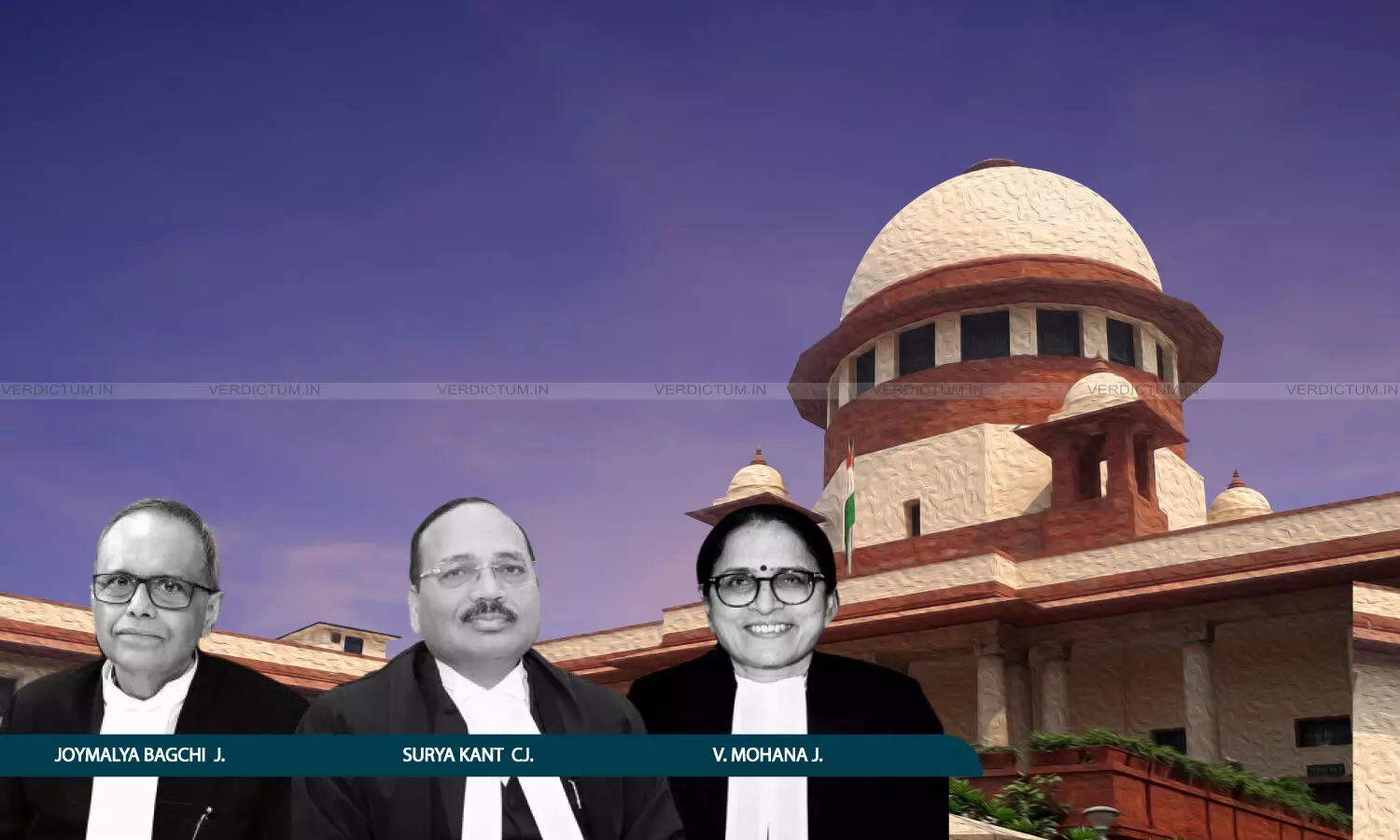
The Bench comprising Chief Justice Surya Kant, Justice Joymalya Bagchi and Justice V Mohana directed, "It goes without saying that once the co-option exercise is complete, the composition of the State Bar Councils shall stand notified...In order to rule out any uncertainty, we therefore deem it appropriate to request all the Chief Justices to complete the exercise of co-option within a period of two weeks...The State Bar Councils are directed to notify the constitution of the newly elected State Bar Councils thereafter within one week."
Senior Advocates Madhavi Divan, CU Singh, Gopal Sankaranarayanan and Shobha Gupta appeared for the Petitioner, while Senior Advocates Maninder Singh, Manan Kumar Mishra appeared for the Respondents
It was further directed, "It goes without saying that each State Bar Council shall thereafter be required to elect its Chairperson, Vice-Chairperson, other office bearers, as well as, "one member by each State Bar Council from amongst its members", for nomination as a member of the Bar Council of India, under Section 4(1)(c) of the Advocates Act, 1961...These elections, therefore, are also required to be conducted at the earliest."
The core issue that arose for consideration was regarding the constitution and composition of the State Bar Councils and the Bar Council of India in accordance with the provisions of the Advocates Act, 1961, and the rules framed thereunder.
Previously, the Court directed that there shall be 30% representation for women members of the Bar in every State Bar Council. Out of that 30% representation, 20% were to be directly elected, whereas 10% were to be co-opted, were decided to be co-opted.
Regarding the issue of manner and modalities of co-option that arose, the court has earlier directed that the Chief Justices of the jurisdictional High Courts shall, in consultation with the newly elected members of the respective State Bar Councils, will nominate two women members, preferably from amongst the former women judges of the said High Court or senior women members of the Bar.
The Court ordered, "Consequently, there shall be a direction to the newly constituted State Bar Councils to elect their statutorily prescribed office bearers, including their representative in the Bar Council of India, within a period of two weeks from the date of notification of their composition...All the State Bar Councils are directed to send a compliance report. On receipt of these compliance reports, the issue regarding constitution of the Bar Council of India under Section 4 of the Advocates Act, 1961, shall be considered."
It was added, "Meanwhile, Sir, Mr. Manan Kumar Mishra, learned Senior Counsel representing the Bar Council of India and its office bearers, has fairly stated that the learned Attorney General of India and the Solicitor General of India shall be actively associated before taking any policy decision...Post these matters to await the first compliance regarding completion of the co-option exercise and constitution of the State Bar Councils..."
The Counsel appearing for the petitioners expressed grave concerns over the financial management and administrative decisions taken during the interim period by the outgoing BCI leadership. They argued that the outgoing office bearers were functioning in a pro tem capacity and urged the Court to appoint an interim committee, or alternatively, mandate the active oversight of the Attorney General and Solicitor General on all major policy and financial decisions to prevent any arbitrary action.
Conversely, Senior Advocate Maninder Singh, representing the Bar Council of India, opposed the prayer for an interim administrative committee and rejected the insinuations made against the Council. He submitted that the statutory scheme already included the Attorney General and Solicitor General as ex-officio members. He assured the Court that the BCI had no objection to involving the top law officers in policy decisions and agreed to seek their active association without the need to alter the statutory framework.
In September 2024, the Court issued notice in the public interest litigation (PIL), raising concerns over the under-representation of women, queer individuals, persons with disabilities, and marginalised communities in the Bar Council of India (BCI) and State Bar Councils. The petitioner, also a member of the Supreme Court Bar Association (SCBA), Yogamaya M.G., urged the court to take cognizance of this issue and address the lack of proportional representation in these bodies.
Cause Title: M Varadhan v. Union of India [W.P.(C) No. 1319/2023], Yogamaya MG v. Union of India [W.P.(C) No. 1092/2026]