Private Investigation Remains Unregulated Despite Concerns: Supreme Court Urges Law Ministry, Law Commission To Examine Issue
 |
|The Apex Court flagged the absence of a regulatory framework for private investigators while dealing with photographs and videos allegedly collected in a matrimonial maintenance dispute.
The Supreme Court has observed that private investigation remains an “area sans regulation” and that a mechanism is needed to address evolving methods of evidence collection, including photographs and videos allegedly procured through private investigators or detectives.
The Court made the observations while dealing with electronic material placed in a matrimonial maintenance dispute, where a large number of photographs and videos were relied upon to allege that a spouse was pursuing a relationship outside marriage.
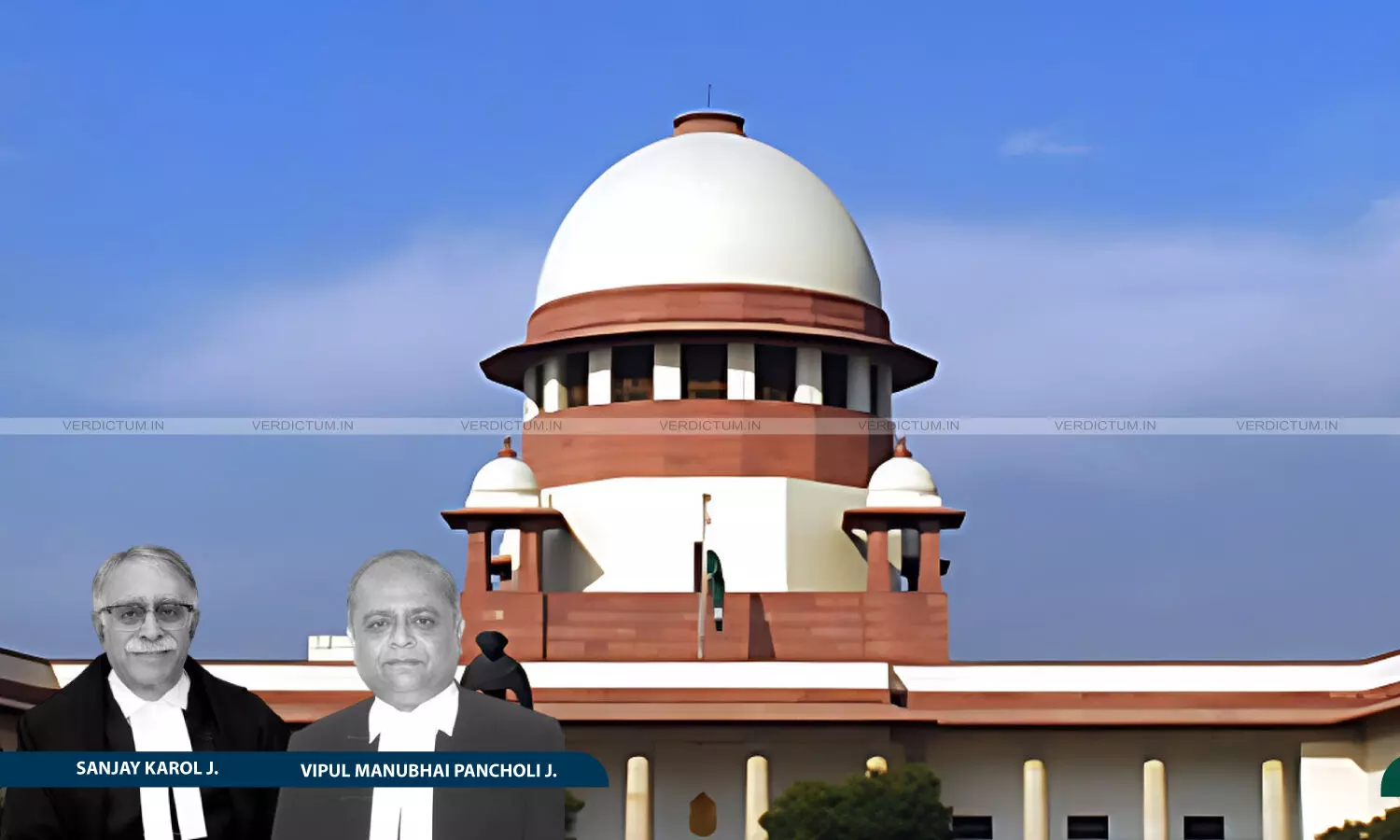
A Bench of Justice Sanjay Karol and Justice Vipul M. Pancholi directed that a copy of the judgment be sent to the Secretary, Ministry of Law and Justice, Government of India, and the Chairman, Law Commission of India, for an appropriate view on the regulation of private investigation.
The Bench observed: “There has to be a mechanism in place to deal with the evolving methods of evidence collection. Verification within the meaning of Section 65B of the Evidence Act, 1872 or its equivalent in the BSA, 2023, is not the only issue. Checks and measures are perhaps required, drawn from the areas of the law, law enforcement, privacy experts, etc., that can deal with issues arising out of such endeavours, including acting as a grievance redressal forum for any individual who may be aggrieved by the actions of the private investigator having overstepped professional bounds and gone into violating the rights of the individual.”
Advocate Prabhjit Jauhar appeared for the appellant, while Additional Advocate General Shiv Mangal Sharma appeared for the State and Advocate Preeti Singh appeared for the respondent-wife.
Background
The case arose from maintenance proceedings in which the appellant placed photographs and other electronic material on record to support allegations of an extramarital relationship. The Court noted that the material included a large volume of photographs and videos, and that the manner in which they were placed on record suggested possible involvement of private investigators or detectives.
The Court did not decide the evidentiary value of the material itself. Instead, while remanding the Section 125(4) application for decision on merits, it used the occasion to flag larger concerns about who collects such material, whether collection is authorised, how it is stored, how authenticity is verified, and how privacy rights are protected.
Court’s Observations
The Supreme Court noted that the photographs appeared to have been received from a third party and raised serious questions about source, authorisation, storage, authenticity and privacy.
The Court observed: “On the record of this case, the appellant has placed a large number of photographs allegedly of Respondent no. 2 pursuing a relationship outside of marriage. The manner of the photographs leads us to believe that the same may have been procured through private investigators/detectives. What furthers this belief is that the appellant states to have ‘received’ these photographs after a particular date when an application was filed. The implication is that they have been received from a third party.”
The Bench then posed the wider evidentiary and rights-based concerns: “A question arose as to the value of these pictures/videos since there is a statement in the file that approximately 92 videos along with 237 photographs have been furnished before the court below. Who took these pictures? Did they have any authorization to do so? What is the procedure for storing these pictures once taken? Whether these pictures sought to be adduced as evidence are in fact genuine pictures or are doctored using technological advancements; do they present an accurate picture or have they been morphed to suit the narrative sought to be built by the parties? What are the implications for the right of privacy of individuals, protection of their personal data, etc.? Obviously, these are concerns that need to be addressed.”
The Court said that if private collection of evidence is a factual reality, the law must also consider limits on such activity, safeguards for investigators, and remedies for persons whose rights are violated.
The Bench stated: “It appears, though, that there is no body existing currently that could undertake these issues. If such collection of evidence is a reality, there also has to be some limitation to what these individuals can do in pursuit of their profession, some protections for them against allegations such as 354C IPC (voyeurism) and regulation of the data/photographs procured by the investigator.”
The Supreme Court referred to the Private Detective Agencies (Regulation) Bill, 2007, which had been introduced in the Rajya Sabha and contemplated regulatory boards, licensing requirements, suspension and cancellation of licences, maintenance of records, and restrictions on investigations falling within the domain of statutory or regulatory authorities.
The Court noted: “A perusal of the Statement of Objects and Reasons appended to the Bill reveals that the need to bring a bill in this regard arose from the perspective of business since there was an increasing reliance on private investigators to gather information. While that may be true, we believe that regulation and accountability are equally important in the sphere of private investigation.”
The Court relied on Navinchandra N. Majithia v. State of Meghalaya (2000), where the Supreme Court had observed that the Code of Criminal Procedure does not recognise private investigating agencies.
The Bench quoted: “The Code does not recognise private investigating agency. If any person is interested in hiring any such private agency, he may do so at his own risk and cost, but such investigation would not be regarded as investigation made under law. Any evidence collected in such private investigation and any conclusion reached by such investigators cannot be presented by Public Prosecutor in any trial. Of course it may be possible for the defence to present such evidence.”
The Court also reproduced the distinction between investigation and prosecution from R. Sarala v. T.S. Velu (2000): “Investigation and prosecution are two different facets in the administration of criminal justice. The role of a Public Prosecutor is inside the court, whereas investigation is outside the court. Normally the role of a Public Prosecutor commences after the investigating agency presents the case in the court on culmination of investigation.”
The Court said that, leaving aside the non-recognition of private investigation, admissibility of such material would have to be tested through evidentiary standards.
Referring to R.M. Malkani v. State of Maharashtra (1973), the Court recalled the three-fold test for tape-recorded conversations: relevance, identification, and accuracy.
The Court quoted: “Tape recorded conversation is admissible provided first the conversation is relevant to the matters in issue; secondly, there is identification of the voice; and, thirdly, the accuracy of the tape recorded conversation is proved by eliminating the possibility of erasing the tape record.”
The Bench added that “‘Identification of the voice’ in current terms can be read as verifying the source of the information or in this case, photographs/videos.”
The Court then turned to Section 65B of the Indian Evidence Act, 1872 and referred to Arjun Panditrao Khotkar v. Kailash Kushanrao Gorantyal (2020).
It quoted Justice V. Ramasubramanian’s formulation: “As a result, Section 65-B places admissibility as the first or the outermost checkpost, capable of turning away even at the border, any electronic evidence, without any enquiry, if the conditions stipulated therein are not fulfilled.”
The Bench added that, for accuracy too, the Section 65B certificate “could perhaps go a long way.”
The Supreme Court concluded that the need to develop a mechanism for private investigation and evidence collection “cannot be underscored enough.” It said the legislature would have to examine relevant issues and frame rules or regulations in accordance with prevailing norms, while also considering models from other jurisdictions.
The Court held: “In light of the questions posed by us above, the need to develop our mechanism for dealing with these scenarios cannot be underscored enough. The legislature would obviously need to undertake its own examination of all relevant issues and frame rules/regulations in accordance with the prevalent norms and conditions, but can also make reference to other jurisdictions where laws of similar nature exist, for example, the State of Queensland in Australia, the Province of Ontario and Canada, the Netherlands, Singapore, etc.”
Conclusion
The Supreme Court directed that a copy of the judgment be sent to the Secretary, Ministry of Law and Justice, Government of India, and the Chairman, Law Commission of India, to take an appropriate view on the issue of private investigation.
Cause Title: HC v. State of Rajasthan & Anr. (Neutral Citation: 2026 INSC 778)
Appearances
Appellant: Advocates Prabhjit Jauhar, Tulika Bhatnagar and S.S. Jauhar, AOR
Respondent: Shiv Mangal Sharma, Additional Advocate General, with Advocates Saurabh Rajpal, Shalini Singh, Nidhi Jaswal, AOR, Preeti Singh, AOR, Sunklan Porwal, Anuradha Anand, Sakshi Trivedi, Anoushka Bajpai and Pooja