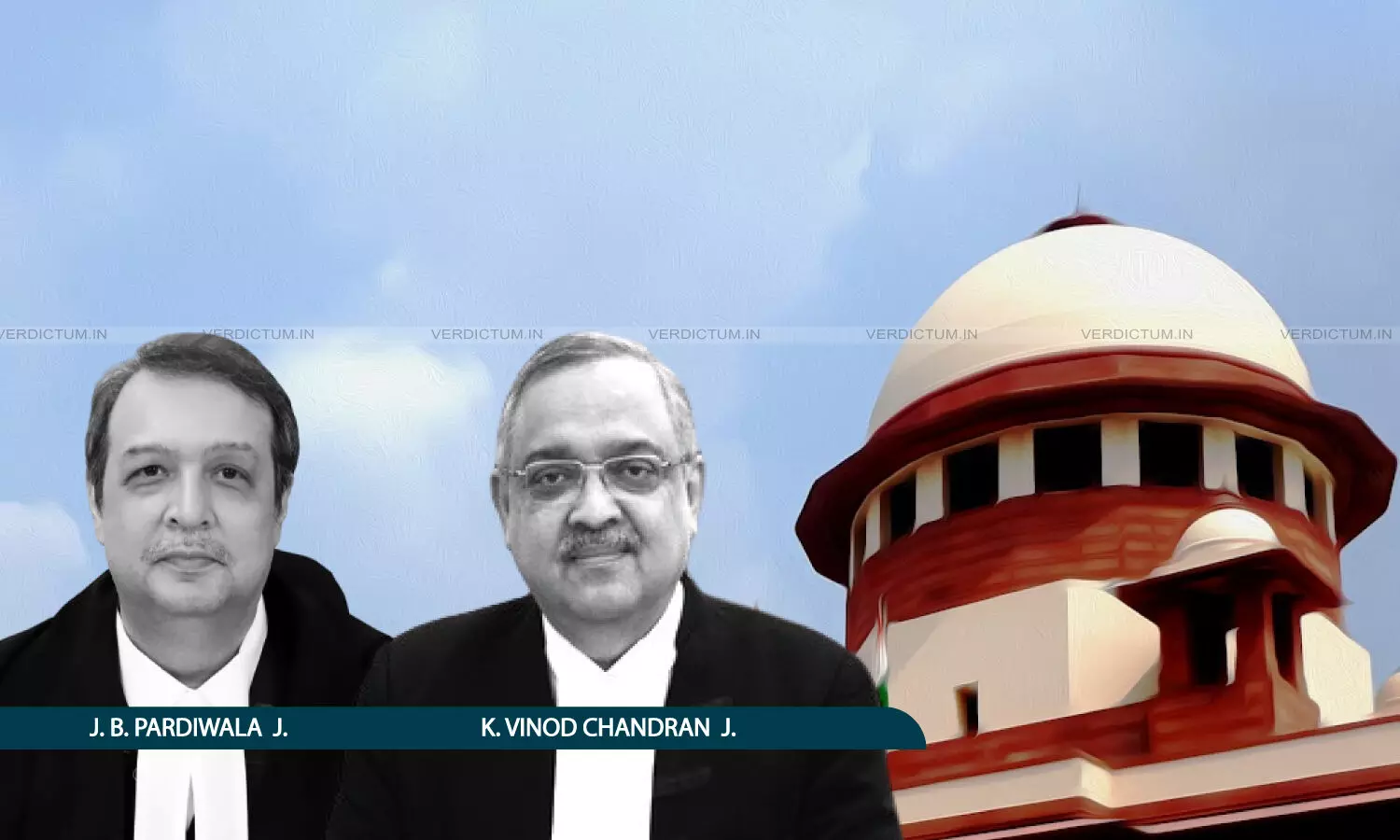
Justice J. B. Pardiwala, Justice K. Vinod Chandran, Supreme Court
Supreme Court Restores Congress Candidate's Election Petition Challenging Assam BJP MP Kripanath Mallah's Election to Lok Sabha
 |
|The Apex Court held that a defective Form-25 affidavit relating to corrupt practices does not by itself require dismissal of the entire election petition under Section 86 of the Representation of People Act, 1951.
The Supreme Court has restored the election petition filed against Assam BJP MP Kripanath Mallah, the successful candidate from the Karimganj Parliamentary Constituency in the 2024 Lok Sabha elections, and directed the High Court to verify whether Form-25 was duly attested in the original record.
The Court was hearing a civil appeal challenging the High Court’s order under Section 86 of the Representation of People Act, 1951, by which the election petition had been rejected on the ground of improper attestation of copies served on the returned candidate.
A Bench of Justice J.B. Pardiwala and Justice K. Vinod Chandran observed: “Admittedly in the present case Form-25 was affirmed before a Commissioner of Affidavits as available in the original before Court. Suffice it to request the High Court to verify and if due attestation of the affirmation on oath, is available, proceed with the matter on merits and if not available, not to permit the allegation of corrupt practises to be urged and proceed with the consideration on the merits of the other grounds, if any are pleaded. We, hence, find absolutely no reason to sustain the order of the High Court and reverse the same. We restore the Election Petition to the files of the High Court for consideration as required herein above.”
Senior Advocate Harin Pravinkant Raval appeared for the appellant, while Advocate-on-Record Wajeeh Shafiq appeared for the respondent.
Background
The appeal arose from an election petition challenging the election of Kripanath Mallah from No. 7 Karimganj Parliamentary Constituency, Assam, in the 2024 Lok Sabha elections.
Before the High Court, the returned candidate raised three objections. He contended that the copy of the Form-25 affidavit served on him did not show notarisation or attestation, that some pages of the election petition bore different attestation stamps, and that certain pages were missing from the copy served.
The High Court found the attestation of the petition copies improper, did not discuss the Form-25 notarisation issue, and rejected the missing-pages objection as an afterthought. The election petitioner then approached the Supreme Court.
Court’s Observations
The Supreme Court held that the High Court’s finding on attestation could not be sustained, since Section 81(3) of the Representation of People Act only requires copies to be attested by the election petitioner under his own signature as true copies.
The Court observed: “All that the provision requires is that the copies should be attested by the petitioner to be true copy of the petition under his own signature, taking responsibility for the copy served to be a true copy of the original petition and no particular form of attestation is prescribed.”
Referring to the different rubber stamps used on different portions of the copies, the Court held: “We respectfully concur with the findings in F.A. Sapa and reverse the finding to the contrary in the impugned judgment since the different rubber stamps employed convey the same meaning.”
On Form-25 under the Conduct of Elections Rules, 1961, the Court noted that the affidavit must be signed by the election petitioner and attested by the prescribed authority.
The Court observed: “Form-25, as we see, under the Conduct of Elections Rules, 1961, has to be signed by the Election Petitioner and attested by a Magistrate of the First Class, a Notary or a Commissioner of Oaths, as solemnly affirmed before him on such and such date.”
The Court recorded that the copies placed before it did not show such attestation, stating: “No attestation is seen therein, not even a printed affirmation with space left for the signature to be affixed, of the Commissioner of Affidavits and the blank space for the date; as seen from Form-25 in the Conduct of Elections Rules, 1961.”
The Court examined the line of precedent in F.A. Sapa (1991), Dr Shipra (1996), T.M. Jacob (1999), T. Phungzathang (2001), Murarka Radhey Shyam Ram Kumar (1963) and National Insurance Co. Ltd. v. Pranay Sethi (2017).
It held that even where Form-25 is defective, the consequence is not automatic dismissal of the entire election petition under Section 86 of the Representation of People Act.
The Court observed: “The three Judge Bench in Dr Shipra (Smt.) found that this is not the correct position in law and held that if Form-25 read with Rule 94A is not in conformity with the requirement, then those parts of the petition which contain allegations of corrupt practices alone are required to be struck off and other independent grounds, if any, are required to be tried and decided on merits.”
It added: “Obviously, the defect under Section 83 does not entail peremptory dismissal under Section 86 of the RoP Act.”
The Court held that the High Court must verify whether due attestation of the affirmation on oath exists in the original Form-25 filed before it.
The Court observed: “The verification of the corrupt practices, having been made in the original, by a Commissioner of Affidavits, as prescribed, if at all, the copy did not contain that endorsement, it does not necessarily mislead the Returned Candidate but only entails a verification by the Court as to whether the same is available in the affidavit filed before Court.”
Conclusion
The Supreme Court allowed the appeal, reversed the High Court’s order, and restored the election petition to the High Court.
It directed the High Court to verify the original Form-25. If due attestation is available, the matter must proceed on merits. If it is not available, allegations of corrupt practices cannot be urged, but the High Court must still consider other pleaded grounds, if any, on merits.
Cause Title: Hafiz Rashid Ahmed Choudhury v. Kripanath Mallah & Ors. (Neutral Citation: 2026 INSC 915)
Appearances
Appellant: Senior Advocate Harin Pravinkant Raval, Advocate-on-Record Adeel Ahmed, Advocates Raja Chatterjee, Gaurav Pathak, Imran Choudhary, Urmi H Raval, Siddharth H Raval, Shrestha Narayan, Shreya Bansal, Qazi Muhammad Farhan, Taqdees Fatima, Azizul Hoque and Arijeet Barooah
Respondents: Advocate-on-Record Wajeeh Shafiq with Advocates Shagufta Ansari and Rahul Yadav; Advocate-on-Record Prateek Kumar with Advocate Devansh Rai