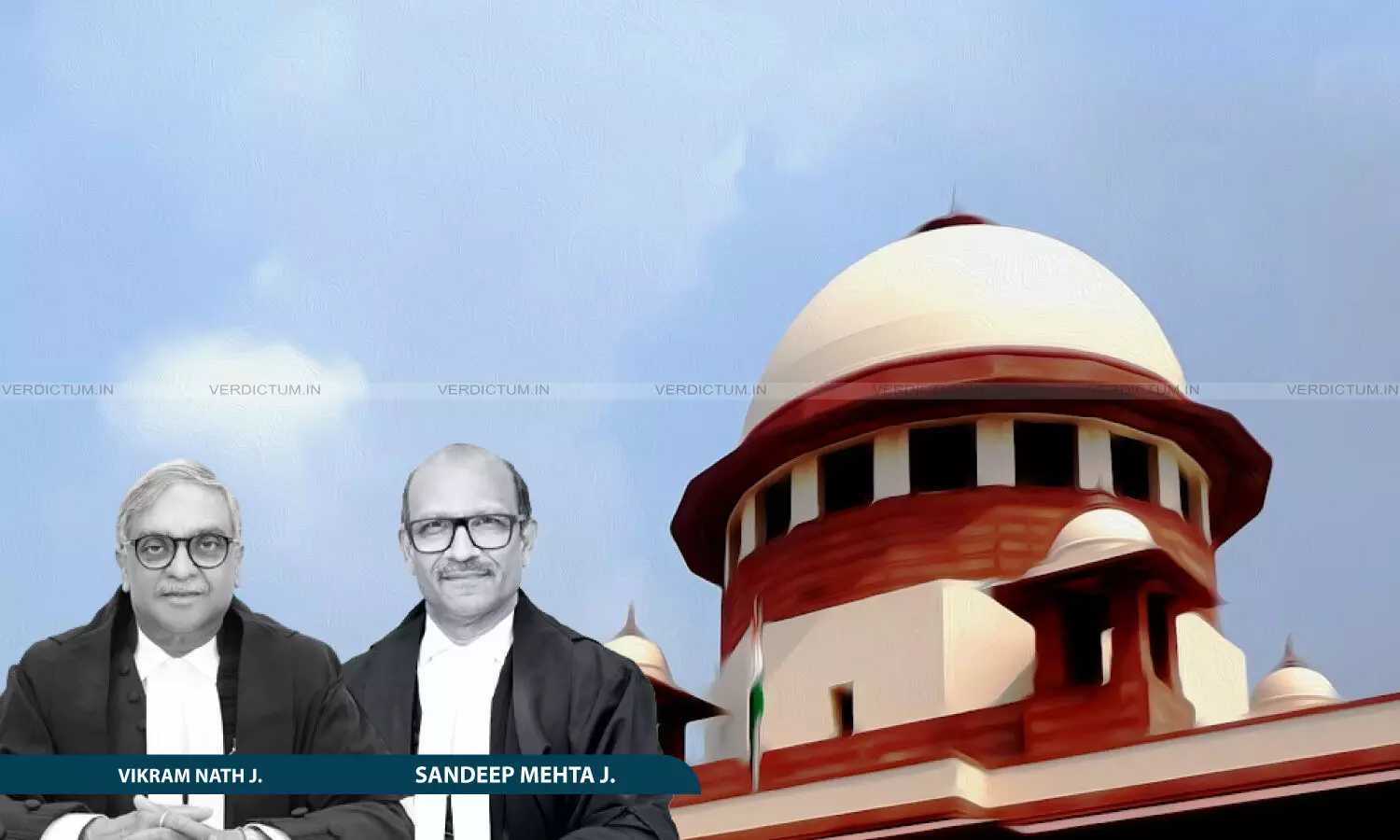
Justice Vikram Nath, Justice Sandeep Mehta, Supreme Court
Habeas Corpus Petition For Custody Can't Be Dismissed Solely Due To Alternative Remedy Before Family Court: Supreme Court
 |
|The Court observed that the availability of statutory relief under Section 7(1)(g) of the Family Courts Act does not preclude the court from evaluating allegations of illegal detention on their merits.
The Supreme Court observed that mere availability of a remedy before the Family Court under Section 7(1)(g) of the Family Courts Act, 1984 could not, by itself, warrant disposal of the habeas corpus petition.
An appeal was filed assailing the judgment passed by the Karnataka High Court, whereby a writ petition filed by the appellant seeking a writ of habeas corpus for production and custody of his minor son was disposed of, leaving the parties at liberty to agitate their contentions before the appropriate forum.
The Court set aside an order of the Karnataka High Court that had dismissed a father's writ petition seeking a writ of habeas corpus for the custody of his minor son.
The Bench of Justice Vikram Nath and Justice Sandeep Mehta observed, "In the facts and circumstances of the case, the High Court ought to have examined the allegation of illegal custody on its merits. The mere availability of a remedy before the Family Court under Section 7(1)(g) of the Family Courts Act, 1984 could not, by itself, warrant disposal of the habeas corpus petition. The appellant had raised a specific grievance regarding the removal of his minor son from his custody. This grievance had to be considered in the backdrop of the earlier order of the High Court and the circumstances in which the minor subsequently came into the custody of Respondent Nos. 6 to 10."
Advocate Amit Pai appeared for the Appellant-father, while Additional Advocate General Nishant Patil appeared for the State
Brief Facts of the Case
The appellant's wife passed away in 2020, leaving behind a son and a daughter. At the relevant time, both children were minors and were in the custody of the maternal relatives (Respondents).
It was the case of the Appellant-father, Respondents thereafter took the minor son and daughter away from his custody. The appellant's daughter subsequently lodged a complaint in 2026 against the appellant, which was challenged by him before the High Court. The said proceedings are pending, and the investigation has been stayed by order.
Thereafter, the Appellant submitted a complaint to the Station House Officer alleging that his minor son and major daughter were being illegally detained at Mangalore by their maternal uncles. As no action was taken on the complaint, the appellant approached the High Court by way of a habeas corpus petition, seeking production of his minor son and restoration of his custody.
The High Court had observed that there was no element of illegal detention warranting exercise of habeas corpus jurisdiction. It had further observed that the question of custody of a minor child falls within the jurisdiction contemplated under Section 7(1)(g) of the Family Courts Act, 1984, and relied upon the order passed in the earlier habeas corpus proceedings, whereby the parties had been left at liberty to approach the appropriate forum for determination of their rights about custody.
Contentions of the Parties
The appellant submitted that Respondents were in illegal custody of the minor son, who is under the guardianship of the appellant-father, being his natural guardian. It was submitted that the minor could not have been removed from the custody of the appellant without authority of law and that any claim to custody or guardianship by the Respondents had to be pursued before the competent forum under the Guardians and Wards Act, 1890.
Per contra, the State submitted that the appellant had an efficacious remedy before the Family Court under Section 7(1)(g) of the Family Courts Act, 1984, which specifically deals with matters relating to the custody of, or access to, any child. It was submitted that the case does not involve illegal detention and that no substantial question of law arises for consideration by this Court.
Findings/Observations of the Court
The Court noted that Section 6 of the Hindu Minority and Guardianship Act, 1956 recognizes the father as the natural guardian of a Hindu minor, subject to the provisions contained therein. The appellant, being the father, asserts his right to the custody of his minor son and alleges that the child was removed from his custody without authority of law. Since the daughter has attained majority, the present proceedings concern only the custody of the minor son.
Regarding the impugned order, the Court observed, "The High Court, however, did not examine these aspects and instead relegated the appellant to the remedy before the appropriate forum. In doing so, the High Court fell in error and failed to consider the effect of its earlier order restoring custody of the children to the appellant and the subsequent removal of the minor son from his custody. These were material circumstances bearing directly upon the allegation of illegal custody and could not have been left unexamined. The failure to consider them renders the impugned order unsustainable and warrants interference by this Court."
Accordingly, the appeal was allowed, and the impugned order was set aside. The matter was remanded to the High Court for fresh consideration of the habeas corpus petition on its merits and in accordance with law.
Cause Title: Suryakanth M Raikar v. State of Karnataka & Ors. [SLP (Crl.)No.8172 of 2026]
Appearances:
Appellant: Advocates Amit Pai, Pankhuri Bhardwaj and Ananya Mehrotra
Respondents: AAG Nishant Patil, AOR Sanchit Garga, Advocates Kunal Rana, Shashwat Jaiswal and Diksha Arora