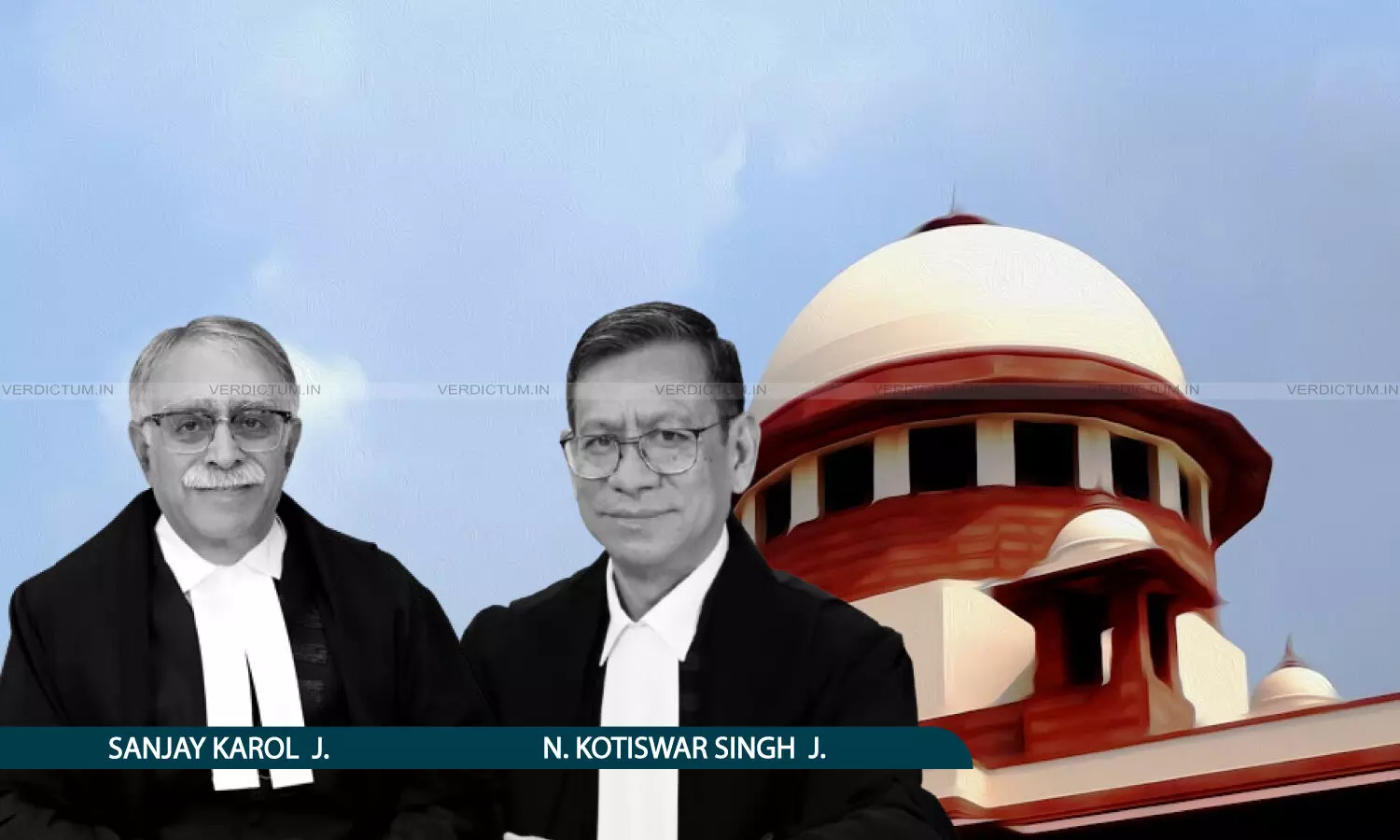
Justice Sanjay Karol, Justice N. Kotiswar Singh, Supreme Court
Appointees Need Not Suffer On Account Of Irregularity By Officials: Supreme Court Directs Cooperative Society To Consider Appointments Afresh
 |
|Observing that no allegations existed regarding the validity of the advertisement, conduct of interviews, or eligibility of selected candidates, the Court directed the cooperative society to reconsider the appointments through a properly constituted Board of Directors.
The Supreme Court directed the Thanesar Cooperative Marketing-cum-Processing Society to reconsider the appointments of employees who were removed from service after their appointments were invalidated for procedural irregularities in the approval process.
The Court observed that candidates appointed through a duly advertised recruitment process cannot be deprived of their appointments merely because of irregularities committed by officials at the stage of approval of appointments.
The Court was hearing appeals against a judgment of the Punjab and Haryana High Court which had upheld orders annulling the appointments of employees appointed in 2014 as Clerk-cum-Salesmen and Peon-cum-Chowkidars in the Cooperative Society.
A Bench of Justice Nongmeikapam Kotiswar Singh and Justice Sanjay Karol observed: “We, thus find force in the submission made on behalf of Appellants that for the irregularity committed by the officials, the Appellants ought not be made to suffer, as no allegations had been made as regards the validity of advertisement or the manner in which interview was conducted or that any ineligible candidates were recommended/appointed. Therefore, even if there be any deficiency in the meeting of the BOD because of the absence of the official members, nothing prevents the society to convene a fresh meeting where these official members would be present so that decision taken to appoint to the services various categories in the societies is in consonance with Rule 3.”
Advocate Shrey Kapoor, AOR, appeared for the appellants, while Dr Hemant Gupta, Additional Advocate General, appeared for the respondents.
Background
The dispute arose from a recruitment process initiated by the Thanesar Cooperative Marketing-cum-Processing Society after obtaining permission from the Registrar, Cooperative Societies, Haryana, to fill three posts of Clerk-cum-Salesman and four posts of Peon-cum-Chowkidar. Pursuant thereto, a public advertisement was issued inviting applications from eligible candidates. A corrigendum was later issued requiring applications to be submitted in a prescribed format.
Thereafter, interviews were conducted, and the Board of Directors approved the appointments of the appellants on a regular basis. The selected candidates joined service and continued to discharge their duties from 2014 onwards. Significantly, there was no allegation that any of the appellants lacked the prescribed qualifications or had secured appointment through fraud, impersonation, malpractice or manipulation.
The appointments were subsequently challenged by two members of the cooperative society under the Haryana Cooperative Societies Act, 1984. The principal allegation was that the appointments had been approved in violation of amended Rule 3 of the Primary Cooperative Marketing-cum-Processing Societies Limited Staff Service Rules, 2003, which required the presence and concurrence of the Assistant Registrar Cooperative Societies, Inspector Cooperative Societies and District Manager, HAFED while taking decisions relating to appointments.
It was alleged that none of these officials were present when the Board of Directors approved the appointments. Certain other objections relating to medical fitness certificates, reservation compliance, sanctioned strength and recruitment procedure were also raised.
The Additional Registrar Cooperative Societies accepted the challenge and set aside the appointments. The order was affirmed by the Additional Chief Secretary, Cooperation Department, the Single Judge of the High Court and subsequently by the Division Bench. Although the High Court granted liberty to the employees to participate in future recruitment processes with age relaxation, it upheld the annulment of their appointments.
Aggrieved thereby, the employees approached the Supreme Court.
Court's Observations
The Supreme Court began by examining the nature of public recruitment and observed that certain foundational requirements must invariably be satisfied, including issuance of a proper advertisement, conduct of a fair and transparent selection process, and appointment by a competent authority. The Court found that the recruitment process in the present case substantially complied with these requirements.
The Court noted that the vacancies had been publicly advertised through newspapers, thereby ensuring an opportunity for eligible candidates to apply. It rejected the contention that the advertisement was defective merely because a specific last date was not mentioned, observing that the advertisement clearly stipulated that applications were to be submitted within twenty-one days of publication.
The Court also found no merit in the argument that publication in the Delhi edition of a newspaper rendered the process illegal, particularly in the absence of any allegation that eligible candidates were denied notice of the vacancies.
The Bench emphasised that there was no challenge to the fairness of the interview process or to the eligibility of the selected candidates.
The Court observed: “There is no allegation that any unqualified candidate who does not fulfil the eligibility criteria, qualifications, age etc. had been recommended and appointed. There was also no allegation about any kind of fraud or manipulations, or any such irregularity being practiced in the process of interview. There is no allegation that the selection had been made by not considering the academic record, professional experience including the technical experience in the respective field, or the general merits of the candidates as contemplated under Rule 15.”
The Court further noted that no unsuccessful candidate had challenged the selection process and that no finding had been recorded by any authority suggesting that the interviews were improperly conducted or tainted by mala fides.
According to the Supreme Court, the entire recruitment process could be divided into three stages: advertisement of vacancies, conduct of recruitment through interviews, and final approval of appointments by the competent appointing authority. The Court found that the first two stages did not suffer from any fundamental defect. The only issue arose at the third stage, when the Board of Directors approved the appointments without the presence of certain officials contemplated under Rule 3.
The Bench observed: “Having considered the rival contentions and materials on record, what this Court has noted is that in the entire recruitment process, beginning with advertisement/public notice, till the conduct of the interview, there was no fundamental defect which could go to the root of the recruitment process. The only defect pointed out was at the stage of taking the formal decision to make appointment by the BOD in their meeting held on 13.08.2014.”
The Court examined Rule 3 and acknowledged that the requirement regarding the presence and concurrence of specified officials served an important purpose. It was observed that such officials were expected to scrutinise the recruitment process and ensure compliance with the rules. However, their role was essentially supervisory in nature. Consequently, their absence did not automatically invalidate an otherwise lawful recruitment process.
The Bench held: “In our view, the said provision under Rule 3 is salutary in nature, in as much as the final authority to give appointment to various categories of service in the society lies with the BOD... Hence, in our opinion, even if the presence of these official members has been made compulsory in the meeting of BOD for finalising the appointments to the services in the cooperative society, their absence will not render the appointments illegal as their role is essentially supervisory in nature.”
The Court further observed: “We are of the view that though the requirement of Rule 3 in making the presence of the official and their concurrence compulsory, it is for the salutary reason that these official members of the BOD would be the best persons to make the necessary scrutiny and verification of the recruitment process to ensure that the recruitment had taken place by conforming to all the relevant requirements under the Rules. Infraction of Rule 3 in our opinion thus, cannot render the entire recruitment process illegal which does not otherwise suffer from any fundamental error or defect.”
The Supreme Court held that the alleged irregularity was confined to the final stage of the recruitment process and was therefore capable of being cured without disturbing the earlier stages.
The Court observed: “We are of the view that the third stage of the recruitment process is severable and can be separated from the early two phases without affecting the validity of the earlier two stages. Even if there was any defect in the third phase, it will not necessarily vitiate the earlier two phases of the recruitment. The rectification of the third phase does not involve the candidates and can be done without affecting the earlier two phases and hence, if there be any defect in the third phase, the concerned BOD can review the same, as in our opinion such a defect is a curable one.”
The Court also took note of the fact that the employees had continued in service for more than ten years and observed that invalidating their appointments solely because of an irregularity attributable to officials would be inequitable.
Conclusion
Allowing the appeal, the Supreme Court set aside the judgment of the Punjab and Haryana High Court and directed the Thanesar Cooperative Marketing-cum-Processing Society to reconvene a meeting of the Board of Directors in the presence of the Assistant Registrar Cooperative Society, Inspector Cooperative Society and District Manager, HAFED, for reconsideration of the appointments.
The Court clarified that the Board would not be entitled to reopen the validity of the advertisement or the interview process and would be confined to examining the final stage of appointment, including the eligibility and qualifications of the selected candidates.
The Court further directed that if, upon fresh reconsideration, the appellants are found eligible and not disqualified, they shall be re-appointed to their respective posts. Their past service shall be counted for all purposes. However, they shall not be entitled to arrears of pay or allowances for the period during which they remained out of service.
Cause Title: Gaurav Mehla & Ors. v. State of Haryana & Ors. (Neutral Citation: 2026 INSC 641)
Appearances
Appellants: Shrey Kapoor, Advocate-on-Record.
Respondents: Dr. Hemant Gupta, Additional Advocate General; Akshay Amritanshu, Advocate-on-Record; Sachin Gupta, Advocate; Sachin Jain, Advocate & Others