
Aggrieved Individuals Can Always Approach: Supreme Court Affirms Quashing Of FIR Against Chandrababu Naidu In Andhra Pradesh Land Pooling Case
 |
|The Court held that the quashing of the lesser penal charges is a natural consequence of the primary corruption charges being quashed, and thus calls for no interference.
The Supreme Court disposed of Special Leave Petitions filed by MLA Alla Rama Krishna Reddy challenging the High Court’s quashing of criminal proceedings against N. Chandrababu Naidu in connection with the alleged large-scale irregularities, criminal conspiracy, and fraud in the implementation of the Land Pooling Scheme.
On June 15, 2026, the Andhra Pradesh High Court quashed the criminal proceedings against Naidu in a case arising from the acquisition of land under the land pooling scheme introduced by the Andhra Pradesh Capital Region Development Authority Act, 2014 (‘the APCRDA Act’), enacted to establish a new capital city for the State of Andhra Pradesh.
The Court also remarked that since the primary corruption charges under the PC Act had already been quashed and upheld by the top court, pursuing lesser offences under the IPC amounted to an impermissible second bite at the cherry.
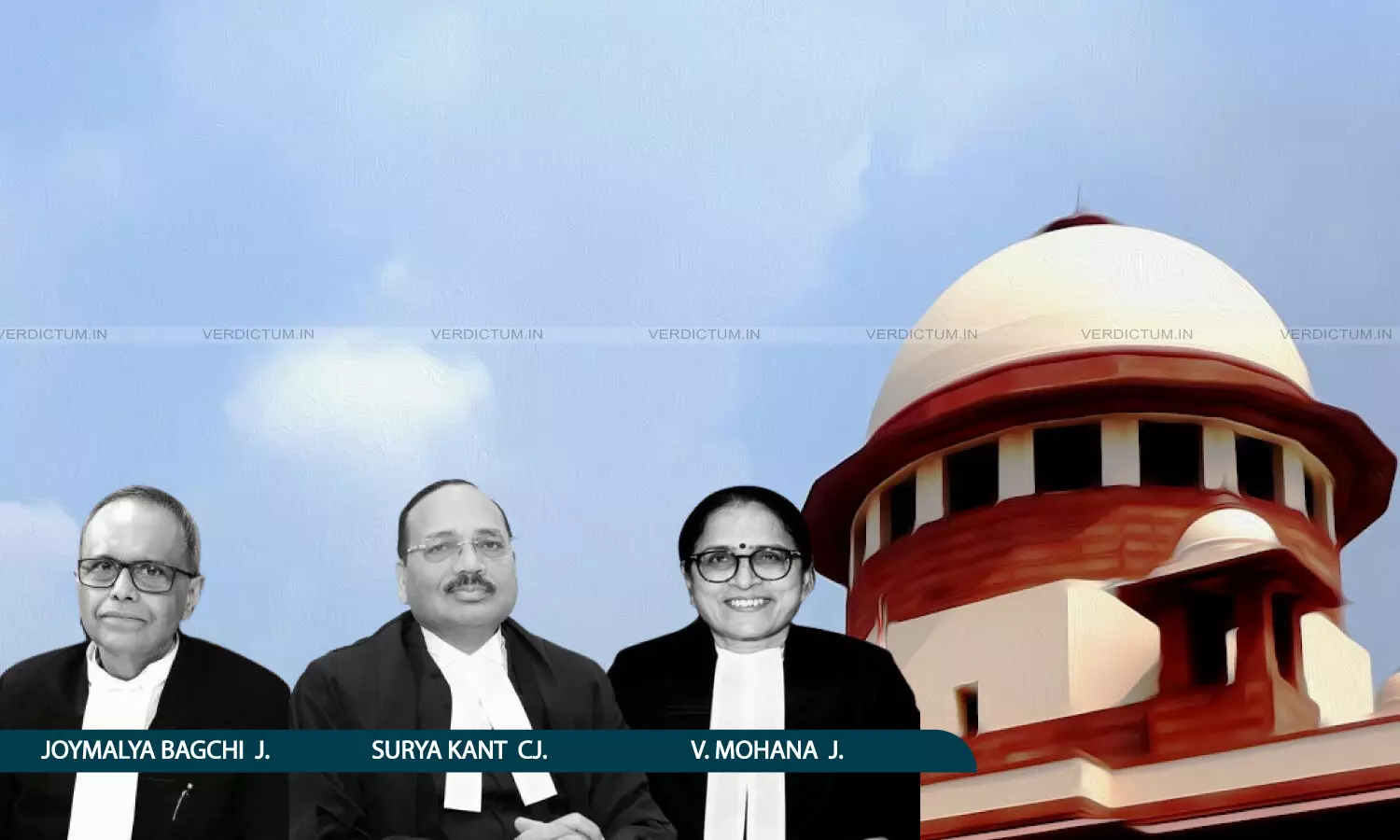
The Bench of Chief Justice Surya Kant, Justice Joymalya Bagchi and Justice V Mohana ordered, "The High Court has quashed the criminal proceedings under Section 13(1)(b) read with Section 13(2) of the Prevention of Corruption Act, 1988. That judgment was subsequently upheld by this Court in State of Andhra Pradesh v. Chekka Guru Murali Rahul & Ors...It appears to us that the quashing of the lesser penal charges is a natural consequence of the primary corruption charges being quashed, and thus calls for no interference by this Court...However, it is clarified that the impugned judgment of the High Court and our present order are rendered in the context of the specific facts and legal constraints of this case, and shall have no bearing on other connected or pending cases, which shall be decided by the competent court strictly on their own merits and in accordance with law."
Senior Advocates Abhishek Manusinghvi and Ranjith Kumar appeared for Alla Rama Krishna Reddy.
The proceedings arose out of petitions filed under Section 482 of the Code of Criminal Procedure, 1973, seeking the quashing of the First Information Report. The said FIR was registered by the Crime Investigation Department (CID) on a complaint lodged by Alla Rama Krishna Reddy, sitting Member of the Legislative Assembly (MLA) belonging to the ruling party.
The de facto complainant alleged large-scale irregularities, criminal conspiracy, and fraud in the implementation of the Land Pooling Scheme under the Andhra Pradesh Capital Region Development Authority Act, 2014 (APCRDA Act).
It was alleged that the petitioners—who were then holding the high constitutional offices of Chief Minister and Minister for Municipal Administration and Urban Development—had misused confidential information and issued G.O.Ms.No. 41 dated 17.02.2016 to unlawfully benefit their close associates and dispossess landholders, particularly those belonging to the Scheduled Castes and Scheduled Tribes.
Singhvi submitted, "there is a public land pooling policy; it cannot be misused by creating a subcategory. Kindly see the second aspect—legal malice. Fear was created among the SC/ST villagers that they would not receive compensation, thereby coercing them to give away their lands at throwaway prices."
He referred to the statements of Mr. Sudhakar Rao which specifically stated that the then Minister Narayana and Minister Devineni visited the villages and informed the villagers that patta lands were being acquired without offering any clarity regarding assigned lands. He asserted that various statements have been recorded by the High Court at the stage of Section 482 petition.
He added, "Once evidence is recorded, the High Court cannot entertain a petition under Section 482 of the Cr.P.C...a trial can be fast-tracked instead. See the next allegation regarding the acquisition of land through benamids. Witness No. 3, Police Sudhakar Rao, states that he sold one acre of assigned land to Mrs. Lakshmi Shetty Sujata...for each item, approximately ₹16 crores were routed through another benami educational trust, as set out in item number four. Then, coming to item number five. My submission, My Lords, is that Your Lordships do not permit such issues to be decided except by way of a full-fledged trial; a mini-trial cannot be conducted in proceedings under Section 482."
He said that if the facts demonstrate evidence, then the mere fact that the complainant is a political rival should not matter. The Court will look at the merits of the complaint, not the identity of the complainant.
Chief Justice Surya Kant said, "It is not merely about the complainant. When you come to power, you get the case registered. This is how it usually unfolds...That PC Act case was quashed by the High Court, the matter came to this Court, and this Court upheld that judgment. After that, what survives?"
Senior Advocate Kumar submitted, "I have a slightly different point to urge. Two things: First, the investigation was stayed by the High Court after a preliminary report; it did not culminate in a final report or charge-sheet being filed. That is one aspect. Secondly, see the Government Order (G.O.) setting out what transpired. I only wish to highlight those specific words and nothing more...This pertains to an amendment made to the Land Pooling Scheme. Kindly refer to the wording."
CJI Kant said. "Mr. Kumar, if there is a variation in the Land Pooling Scheme resulting in loss or profit to any individual, these are purely civil issues. Individuals who are aggrieved can always approach the appropriate forum. The law is very clear—affected individuals cannot be prejudiced, and they can seek appropriate remedies. However, when a person approaches the Court purely on political grounds, using or misusing the judicial platform, that is not something this Court will entertain."
Kumar highlighted Category 4 of the amended rules, which provided that all assigned lands alienated to "others" were deemed to have been resumed by the State Government.
He submitted that the term "others" was intentionally left undefined to extend illegal benefits to private purchasers who had acquired assigned lands through agreements to sell in violation of statutory prohibitions, fully aware of the upcoming capital city project. He argued that this amendment was executed without statutory authority, thereby constituting a cognizable offence.
Chief Justice Surya Kant said to this, "This allegation you are making—was this not the basis on which the proceedings under the Prevention of Corruption Act were initiated?"
Ranjit Kumar said, "Those proceedings were not with respect to this aspect"
To which Justice Joymalya Bagchi said, "They were not independent. They related to the illegal transfer of land and purchase of such land by certain individuals to obtain wrongful gain. Now, look at the offences under Sections 166 and 167 of the IPC—they fall under the same genus as the corruption charges. When the primary charge of corruption has been quashed by a final order, initiating an inquiry under Section 166 is akin to seeking a second bite at the cherry after the major charge has already been quashed. There may be certain areas that required examination, but the graver charges in collateral proceedings have already concluded in quashment, which has been affirmed by the Supreme Court."
The Bench noted that once the primary and graver charges under the PC Act stood quashed by a final order of the High Court—which was subsequently affirmed by the Supreme Court—initiating an inquiry into lesser IPC offences amounted to seeking an impermissible second bite at the cherry.
The Bench further observed that the High Court had already examined the record and found no material to demonstrate that the policy amendment lacked legal authority.
The High Court observed that the capital city project was initiated following the statutory bifurcation of the State. The selection of the capital location was founded upon the recommendations of an Expert Committee constituted under Section 6 of the A.P. Reorganisation Act, 2014, which were subsequently endorsed by the Cabinet and unanimously ratified by the State Legislative Assembly.
The Court noted that the implementation of the Land Pooling Scheme had witnessed voluntary participation by over 25,000 farmers who entered into land pooling agreements. It was further observed that G.O.Ms.No. 41 was issued in exercise of subordinate rule-making power and continued to enjoy the full presumption of legislative validity, having never been declared invalid by any competent court.
Accordingly, the Supreme Court disposed of the proceedings.
Cause Title: Alla Rama Krishna Reddy v. State of Andhra Pradesh [SLP(Crl) No. 14193/2026] and [SLP(Crl) No. 14578/2026]