
It Is Creation Of An Offence Because Boundaries Of Culpability Are Being Changed: Supreme Court To Begin Hearing Of Pleas Seeking Criminalization Of Marital Rape
 |
|The Court has scheduled final hearings on petitions challenging the constitutional validity and scope of the marital rape exception under the Indian Penal Code and Bharatiya Nyaya Sanhita.
The Supreme Court will set a schedule to finally hear the batch of petitions challenging the constitutional validity of the Marital Rape Exception contained in Exception 2 to Section 63 of Bharatiya Nyaya Sanhita, 2023 (BNS) and the corresponding provision in the erstwhile Indian Penal Code.
During the hearing, the Court remarked that the Constitution cannot be seen in silos. It added that when it comes to a right under Article 21, it equally impacts the right under Article 20 and similarly, when we see penal laws, we have to factor in the questions of mens rea, culpability, and the way we interpret the Constitution.
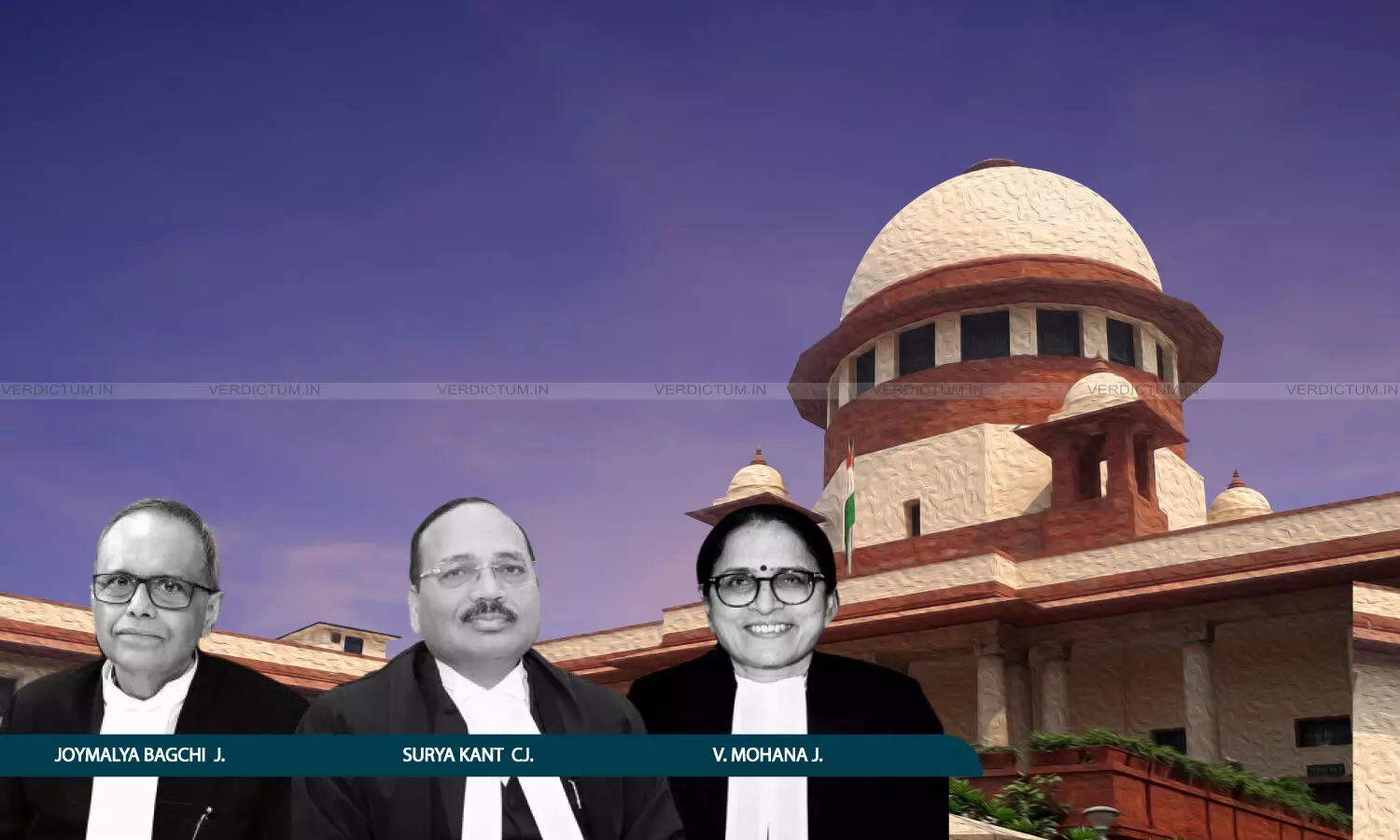
The Bench comprising Chief Justice Surya Kant, Justice Joymalya Bagchi and Justice V Mohana ordered, "In the criminal appeals specifically arising out of from the Karnataka High Court and various writ petitions/PILs which have been subsequently tagged thereto, revolve around the issue of reading down Exception 2 to Section 375 of the IPC, as well as the constitutionality of that provision and Section 63, Exception 2 of the BNS, coming into force upon the repeal of the Indian Penal Code. Some allied or related issues also arise for consideration...Learned Solicitor General of India states that the counter-affidavit filed by the Union of India in the lead case, that is the SLP/Petition, may be treated as the reply in the connected matters as well. He states that copies thereof shall be supplied to all the learned counsel in the connected cases within two days. We are informed that other pleadings are complete. The pleadings, convenience compilation, as well as the citations of the judgments to be relied upon may be exchanged... exchanged within two weeks...Post these matters for final hearing on so-and-so date, on a Wednesday/Thursday."
Senior Advocates Indira Jaising, Siddharth Dave, Karuna Nundy, Jayna Kothari, N. S. Nappinai and Gopal Sankarnarayanan appeared for the various parties, while Solicitor General Tushar Mehta appeared for the Union
Nundy submitted, "There is no new creation of offence here. The only thing that is being done is that the immunity... because offence is defined...only a class that was... that is being exempted. The offence is not changing."
The Court remarked, "That itself is a creation of an offence because the boundaries of culpability are being changed. It's a question of an individual when it comes to crime...We can't see the Constitution in silos. When it comes to right under Article 21, it equally impacts right under Article 20. When we see penal laws, we have to factor in the questions of mens rea, culpability, and the way we interpret the Constitution so that we do not spring surprises on our citizens."
Justice Bagchi said, "These are situations which the entire history of the Penal Code, defining the minimum age of rape, comes from Phulmani Raur where a young girl 8, 9, or 11 was subjected to brutal sexual experience, and resulted in bleeding and ultimately death...Our query to you is this: Until we take a call on the constitutional vires of the exception, can a prosecution be maintained under?"
Jaising submitted that her arguments will be centred on interpreting existing provisions of the law rather than challenging their constitutional validity. She sought to uphold the judgment of the Karnataka High Court, which had allowed prosecution under Section 375, arguing that the factual matrix justified such an interpretation notwithstanding the statutory exception.
She submitted, "So, the question will be: How is the exception to be interpreted? I am grateful for the Phulmani example. The question will be: Would the Phulmani example be prosecutable or not under Section 375? Therefore, the question—and also, by the way, the age of consent has been raised from 16 to 18. So now, even consensual sex between 16 and 18 is prosecutable, which it was not for 180 years. So things have really gone a bit haywire...I do not propose to address the Court on the constitutional validity of the exception, as my other colleagues here will do that. My concern is how to interpret the existing law."
In contrast, the opposing counsel urged that penal provisions with express statutory exceptions could not be interpreted widely to include an offense without violating Art. 20, Clause 1 of the Constitution. Counsel Karuna Nundy also stressed that the question whether the statutory provisions could be read down or construed narrowly would be one for the Court to consider. Statutory interpretation and constitutional scrutiny are not mutually exclusive, but overlap procedurally.
The Court also referred to international precedents, including decisions of the South African Supreme Court, where legislative bodies were granted a specified timeframe to align statutes with constitutional guarantees before judicial declarations of ultra vires took effect.
The Bench said, "So, that is one part. We don't want to pronounce on that without going to the next question with respect to constitutionality. So, rest assured that all of you will be heard. We will examine the question, and let the first matter be Mr. Dhave, Mr. Gopal... and then we will immediately take up the next set of writ petitions where the constitutionality issue comes, and then we'll call upon the Solicitor to respond to that."
Justice Bagchi remarked, "What is constitutional morality and what is social morality? When people speak, it speaks through its representatives...What we do is test it on the anvil of the constitutional scheme. So for us to come and say that this is natural, unnatural, it's for the people...as its leaders make it, its constituents make it, as illiberal as its constituents and leaders make it."
Accordingly, the nodal counsel were directed to compile the pleadings, prepare a convenience compilation, and assemble a separate set of relied-upon judgments and formulated questions of law. The Court granted three weeks for parties to exchange these compilations and pleadings, and directed the Registry to list the matters for final hearing on a fixed date.
Background
The Court on May 10, 2022, had issued notice on the SLP challenging the judgment of the Karnataka High Court refusing to quash an FIR registered at the instance of a wife against the husband alleging marital rape. Justice M Nagaprasanna of the Karnataka High Court had held that Exception 2 to Section 375 of IPC, which exempts sexual acts between a husband and wife from the definition of rape, is regressive.
The Delhi High Court had also delivered a split verdict in the batch of cases challenging the exemption to sexual acts between a man and his wife under Section 375 of the IPC, thereby seeking criminalisation of marital rape. Justice Rajiv Shakdher has struck down the impugned provisions. The declaration will operate only from the date of the decision, the Judge held. The Judge also held that the husband would not fall under the definition of relative. He granted the certificate of leave to appeal. He noted that two High Courts have already expressed their view. Justice C Hari Shankar, however, declined the challenge but granted leave to appeal.
Later, in May 2022, an appeal was filed in the Supreme Court challenging the Delhi High Court's split verdict on the issue of criminalisation of marital rape. In September 2022, the Supreme Court said it would hear the pleas arising out of the Delhi High Court's split verdict.
The Court had also issued notice in a Public Interest Litigation (PIL) challenging the Marital Rape Exception (MRE) contained in Exception 2 to Section 63 of Bharatiya Nyaya Sanhita, 2023 (BNS).
In July 2023, the Court said that a three-judge bench will hear a batch of petitions pertaining to these matters.
The Court on October 17, 2024, started hearing a batch of petitions.
The Centre had defended the legal exception decriminalizing marital rape in an affidavit, arguing that striking down Exception 2 of Section 375 of the Indian Penal Code (IPC) would have far-reaching consequences for the institution of marriage. In its affidavit, the Centre had emphasized that criminalizing marital rape could severely affect conjugal relationships and lead to significant disturbances within the institution of marriage.
It had expressed concern that such a change could be misused and create challenges in proving consent within marital relationships. "The misuse of the amended provisions cannot be ruled out, as it would be difficult and challenging for a person to prove whether consent was there or not," the Centre had stated, cautioning that the issue has far-reaching socio-legal implications that require careful consideration.
The PIL filed by the All India Democratic Women Association (AIDWA) through AoR Ruchira Goel also contests the constitutionality of Section 67 of the BNS. This Section imposes a penalty ranging from two to seven years for a married man's commission of the offence of rape on his separated wife- a penalty lower than the mandatory minimum ten-year sentence otherwise applicable to the offence of rape under Section 64 of the BNS.
Cause Title: Hrishikesh Sahoo v. State of Karnataka, & All India Democratic Women Association (AIDWA) v. Union of India [W.P. (C) No. 250/2019, SLP (Crl) No. 4063-4064/2022 & W.P. (C) No. 326/2024]