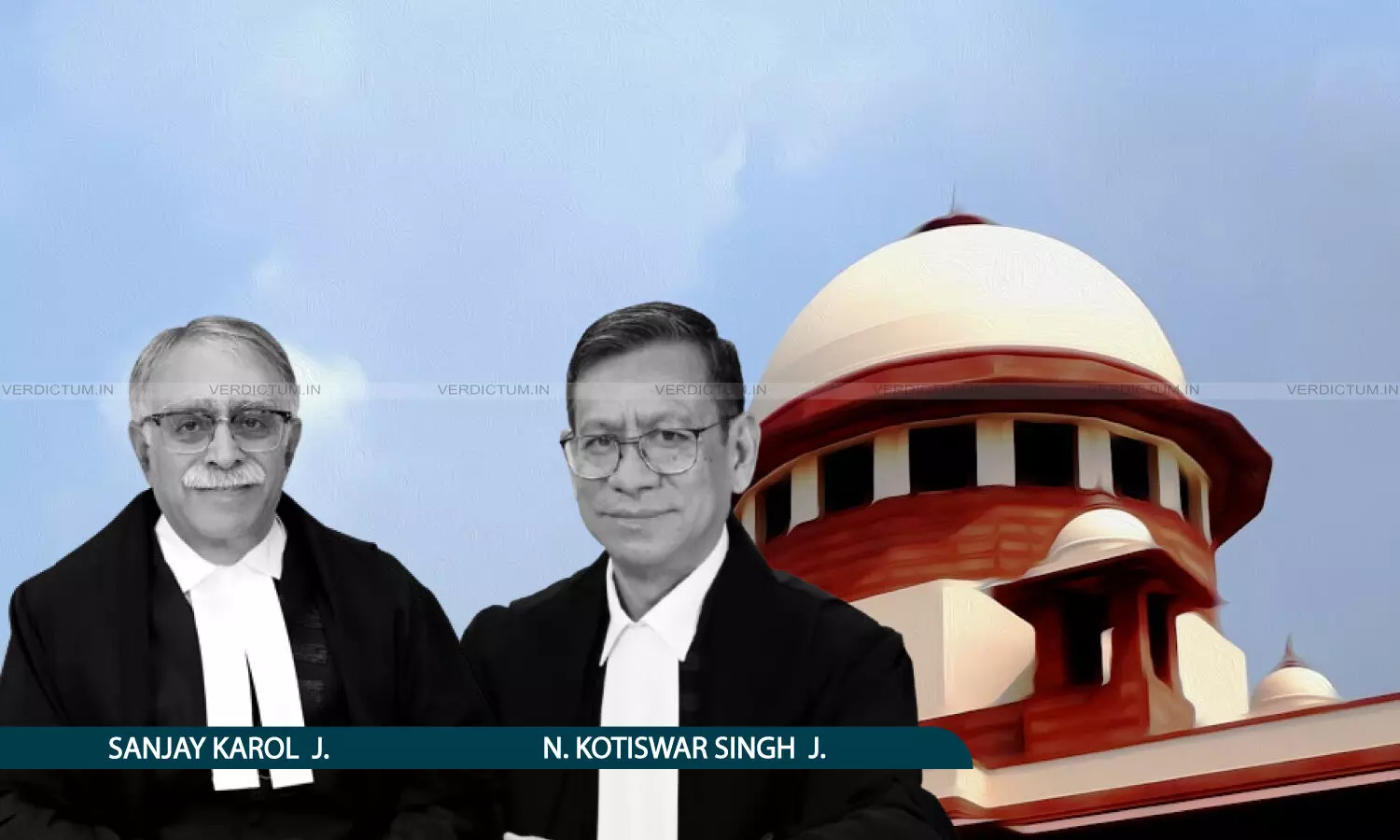
Justice Sanjay Karol, Justice N. Kotiswar Singh, Supreme Court
Section 498A IPC Covers Live-In Relationships That Qualify As "Relationships In Nature Of Marriage" Between Consenting Adults With Intent To Marry: Supreme Court
 |
|The Apex Court held that Section 498A IPC can apply to live-in relationships qualifying as relationships in the nature of marriage, but restricted the ruling to consenting adults and added that intent to marry must be established because the provision carries criminal consequences.
The Supreme Court has held that Section 498A IPC is not confined only to legally valid marriages, and can extend to a live-in relationship that bears the attributes of marriage, provided the relationship is between consenting adults and the intent to marry is established as an intrinsic part of it.
The Court was hearing appeals against the Karnataka High Court’s refusal to quash criminal proceedings initiated under Section 498A IPC and other provisions, where the accused disputed the existence of a valid marriage and argued that Section 498A could not apply unless the complainant was a legally wedded wife.
A Bench of Justice Sanjay Karol and Justice Nongmeikapam Kotiswar Singh held: “Section 498A is held to be applicable to 'live-in relationships' that qualify as 'relationships in the nature of marriage' with the intent to marry being established as an intrinsic part thereof”.
The Bench added: “The 'live-in relationships' protected by Section 498A, it is stated for ample clarity, are those that are between two consenting adult individuals.”
Senior Advocate Anand Sanjay M. Nuli appeared for the appellants, while Additional Solicitor General Brijender Chahar appeared for the State. Advocate Hetu Arora Sethi appeared for the complainant. Additional Solicitor General Aishwarya Bhati and Advocate Nina R Nariman assisted the Court as Amici Curiae.
Background
The Court was considering whether proceedings under Section 498A IPC could continue where the accused disputed the very existence of marriage and contended that the provision applied only to a husband in a valid marriage.
The complainant alleged that she and the accused had married according to Hindu customs and later lived together, while the accused denied the marriage. The Karnataka High Court had refused to quash the criminal proceedings, holding that the expression “husband” in Section 498A IPC could not be read in an unduly technical manner where the relationship had the attributes of marriage.
Court’s Observations
The Supreme Court, at the outset, rejected the argument that Section 498A, being a penal provision, must be confined only to a legally married husband. It held that the object of the provision was to deter cruelty in a domestic setting, and that the interpretation of the provision must remain alive to its social purpose.
The Court observed: “Keeping the judicial development of the Section in view, as captured above, we now deal with the appellant’s contention that Section 498A being a penal provision has to be interpreted strictly, confined only to a husband married to a woman in the traditional sense. This contention is rejected. The purpose of penalising cruelty by a husband and his relatives was to introduce a factor of deterrence against the reprehensible behaviour that was exhibited by such family members toward a married woman, which was not addressed by the existing laws at the time. The objective, quite obviously, was reformative, cloaked with punishment.”
The Bench added: “The interpretation given to this penal provision must be an interpretation which keeps in view the reformative objective, or else its mandate will be defeated.”
The Court distinguished a broad live-in relationship from a narrower “relationship in the nature of marriage”. It clarified that not every live-in relationship would attract Section 498A.
The Court stated: “The DV Act, which provides civil remedies and reliefs for domestic violence as defined in detail thereunder, applies to this kind of relationship. Although in colloquial terms, the two phrases may be used interchangeably, the law perceives a difference between them. As per the principles enunciated in the decisions referred to above, “live-in relationship” is a wider category and “relationship in the nature of marriage” is a subset thereunder, which though may have eight indicators, illustrative but not exhaustive.”
The Union argued that women in such relationships already had remedies under the Domestic Violence Act. Rejecting that submission, the Court held that the DV Act is primarily civil in character and cannot be treated as a substitute for penal protection under Section 498A.
The Court observed: “The conclusion of the above discussion is that although the DV Act provides for a widely worded ambit of domestic violence which includes various forms within it, the overall nature of the legislation is to provide for a remedy under the civil law, save and except Section 31 which provides for penalty and imprisonment in the event that a protection order is violated. No other aspect thereof involves any penal punishment. As such, to say that the DV Act provides for adequate protection to women in ‘relationships in the nature of marriage’ would be a misstatement of law.”
The Court also examined the issue through the lens of constitutional equality and personal choice. It held that denying protection merely because a couple chose to live together before marriage would create an artificial distinction.
The Bench remarked: “In all cases, A and B chose each other and decided to live life together. The only difference is that in the first case they are married and in the other two they are not. Why should there be any difference in the protection that is given to a woman if she faces cruelty at the hands of the husband/partner or his family members? The law fairly well recognises the right and freedom of an individual to choose the person they want to be with as an inextricable part of dignity and personal liberty.”
It further held: “This distinction between “married' and 'live-in relationship in the nature of marriage', inasmuch as it relates to the protection envisaged by Section 498A, has no rational nexus with the object of preventing domestic violence and is as such offensive to Article 14 of the Constitution of India.”
Since Section 498A is penal in nature, the Court narrowed the protection by requiring proof of intent to marry. It said this requirement would separate relationships protected under the DV Act from those attracting criminal liability under Section 498A.
The Court underscored: “When the intent is absent, a question beckons as to why such relationship needs to be equated with marriage for the purposes of invoking penal provisions. In our view, it does not. Those relationships that are in the nature of marriage and also have the requisite intent to marry are the closest to marriage itself, and it is those relationships that shall be entitled to the protection of this Section.”
The Court added that the initial burden would lie on the woman seeking the protection of the law.
The Court was conscious of misuse concerns surrounding Section 498A. It directed the strict application of safeguards laid down in Arnesh Kumar (2014), particularly where Section 498A is invoked in the context of a relationship in the nature of marriage.
The Bench stated: “We may only underscore the need for strict compliance therewith in cases where recourse to the law is taken by a female in a ‘live-in relationship in the nature of marriage’.”
On the facts of the matter being heard, the Court refused to quash the proceedings. It said the allegations, if taken at face value, disclosed a prima facie case and therefore required trial.
The Court observed: “The allegation in the FIR is that the appellant had suppressed the factum of his prior marriage, he, along with his family members, had harassed respondent no.2 for dowry and also caused physical injury to her, because of which she received burns on her leg. Whether or not this actually happened is a matter of trial. When the allegations are taken at face value, it cannot be said that they do not prima facie constitute an offence, not disclosing a cognizable offence.”
Conclusion
The Supreme Court disposed of the appeals, holding that the case was not fit for quashing and that the Trial Court would be free to proceed in accordance with law. It clarified that the extended interpretation was limited only to Section 498A IPC and would not affect any other provision.
Cause Title: Dr Lokesh B.H. & Ors. v. State of Karnataka & Anr. (Neutral Citation: 2026 INSC 784)