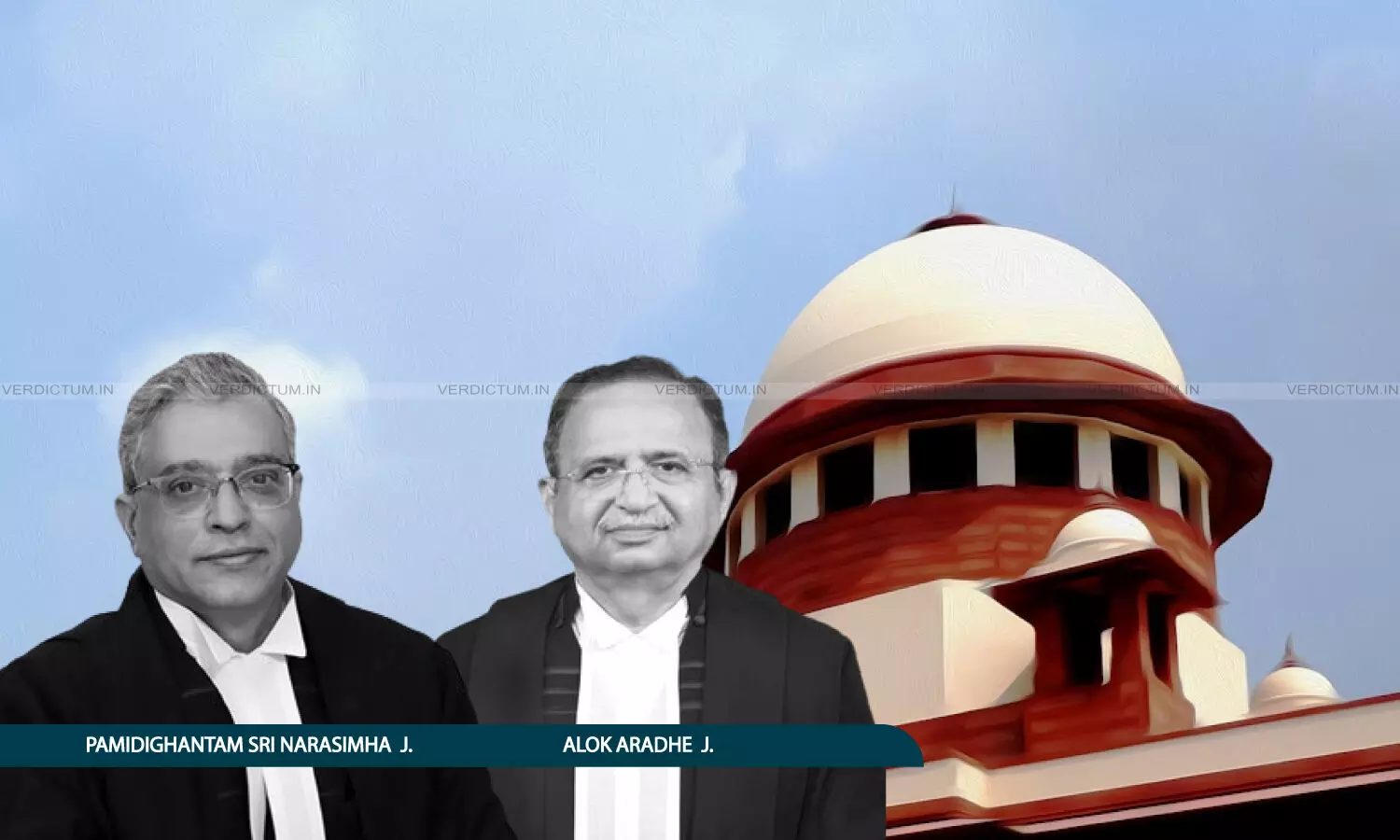
Justice Pamidighantam Sri Narasimha and Justice Alok Aradhe, Supreme Court
Absence Of Name In Register Entry Not Conclusive Of “Member” Status For Purpose Of Sections 397 & 398 Companies Act: Supreme Court
 |
|The Court held that the expression “member” in oppression and mismanagement proceedings must be construed in light of the broader statutory framework, and not restricted to the technical requirements of entry in the register of members.
The Supreme Court has held that the absence of entry of a person’s name in the register of members is not conclusive in determining “member” status for Sections 397 and 398 of the Companies Act, 1956, and that such status must be assessed in light of the broader definition under Section 2(27) and the surrounding statutory framework.
The Court was hearing civil appeals arising from judgments of the High Court affirming the orders of the Company Law Board, which had treated the respondent as a “member” entitled to maintain a petition alleging oppression and mismanagement.
A Bench of Justice Pamidighantam Sri Narasimha and Justice Alok Aradhe observed: “A conjoint reading of Sections 397, 398 and 399 indicates that the expression 'member cannot be construed in isolation or confined to the technical formulation contained in Section 41(2). Rather, the broader definition embodied in Section 2(27) assumes significance in determining whether a person is entitled to invoke the remedies contemplated under the Act”.
“The expression “member”, when employed in the context of remedies under Sections 397 and 398, must therefore be construed with reference to the wider definitional framework provided in Section 2(27) and allied provisions governing the rights of members”, the Bench added.
Shyam Mehta, Senior Advocate, represented the appellants, while Shailesh Madiyal, Senior Advocate, represented the respondents.
Background
The dispute arose out of a company engaged in operating a hospital, where the respondent had infused substantial funds into the company pursuant to an arrangement under which he was appointed as Managing Director and was to be allotted shares.
According to the respondent, a significant number of shares were allotted to him against share application money, though the appellants disputed the same and contended that his name was never entered in the register of members.
The respondent instituted company petitions under Sections 397 and 398 alleging acts of oppression and mismanagement, including failure to issue share certificates and dilution of his shareholding.
The appellants raised a preliminary objection to the maintainability of the petitions, contending that the respondent lacked locus standi as he was not a “member” within the meaning of Section 41 of the Act.
The Company Law Board rejected the objection and granted relief, which was affirmed by the High Court, leading to the present appeals.
Court’s Observation
At the outset, the Court framed the core issue as whether a person whose name is not entered in the register of members could nonetheless be regarded as a “member” for Sections 397 and 398.
The Court undertook a detailed analysis of the statutory framework, beginning with Section 2(27), which defines “member” in broad terms, and Section 41, which prescribes modes of acquisition of membership.
It was observed that Section 2(27) employs “language of wide amplitude” and is not confined to a narrow or technical meaning, whereas Section 41 operates in a distinct field by laying down procedural modes of acquiring membership.
The Court clarified that the requirement of entry in the register under Section 41 is not the sole or exclusive mode of establishing membership, noting that “the requirement… was intended to ensure reliable proof of consent… and not to impose entry in the register as the sole or exclusive mode of acquiring membership.”
Emphasising the nature of jurisdiction under Sections 397 and 398, the Court held that these provisions are equitable in character and designed to protect minority shareholders from oppression and mismanagement.
In this context, the Court observed, “the equitable foundation of Sections 397 and 398 must be a guiding factor to not construe the expression ‘member’ in an unduly restrictive or technical manner,” thereby underscoring the need for a purposive interpretation.
The Court further held that the determination of maintainability must be anchored in Section 399, which governs eligibility, rather than a rigid application of Section 41(2).
It noted that “the relevant enquiry… must centre on whether the applicant satisfies the conditions prescribed under Section 399,” thereby shifting focus from technical compliance to substantive entitlement.
The Court relied upon judicial precedents, including World Wide Agencies Pvt. Ltd. v. Margarat T. Desor (1990) and decisions of various High Courts, to hold that the absence of formal entry does not necessarily defeat membership where proprietary interest is otherwise established.
It also referred to decisions recognising that “where substantial funds… are accepted and utilised… such conduct constitutes strong evidence of recognition of the investor’s proprietary stake,” thereby treating conduct as a relevant factor.
Applying these principles to the facts, the Court examined the cumulative circumstances relied upon by the High Court and Company Law Board, including correspondence describing the respondent as a “co-owner”, his appointment as Managing Director, utilisation of his investment, and acknowledgement of his entitlement to shares.
The Court noted that these circumstances demonstrated consistent recognition of the respondent’s proprietary interest in the company.
It held that “the conclusion treating respondent no. 1 as a member was founded upon a consistent and cumulative chain of factual circumstances demonstrating recognition of his proprietary interest,” thereby affirming the concurrent findings.
Conclusion
The Court held that the respondent was entitled to be treated as a “member” for the purposes of maintaining proceedings under Sections 397 and 398 of the Companies Act, 1956, despite the absence of a formal entry in the register of members.
Accordingly, the appeals were dismissed, and the findings of the High Court and the Company Law Board were affirmed. The amount deposited before the Court, along with accrued interest, was directed to be released in favour of the respondent.
Cause Title: Dr Bais Surgical And Medical Institute Pvt. Ltd. & Ors. v. Dhananjay Pande (Neutral Citation: 2026 INSC 447)
Appearances
Appellants: Shyam Mehta, Senior Advocate; Advocates Gagan Sanghi, Farah Hashmi, Varad Kilor, Rameshwar Prasad Goyal
Respondents: Senior Advocates Shailesh Madiyal, Haripriya Padmanabhan; Advocates Utsav Trivedi, Mugdha Pande, Vikash Shukla, Anchit Singla, Vineeth Prasad, Madhav, Kadam Hans, Harsh, Ayushman Agarwal, Anushka Rawal, Prina Gupta, Shiv Vinayak Gupta, Himani Singh, Bina Gupta, Deepak Sabharwal, Anurya Sabharwal, Snigdha Jha, Tungesh