Other Employees Of State Can't Claim Parity With Judicial Officers: Supreme Court Directs Consenting States To Raise Judges' Retirement Age To 62
 |
|The Court observed that the need of the hour is to ensure that the attrition of experienced judicial talent is arrested for access to justice.
The Supreme Court has directed consenting states to amend service rules and raise the superannuation age of district judges from 60 to 62 years, subject to High Court performance assessments, while asking non-consenting states to reconsider their stance within two weeks to retain experienced judicial talent and curb systemic vacancies.
The bench was hearing a petition seeking uniform enhancement of the retirement age of district judiciary judges from 60 to 62 years across the country.
The Court observed that the concern of the States regarding an enhanced financial burden is misconceived; on the contrary, if experienced members of the judicial cadre are permitted to continue in service till the age of 62, the additional burden of bearing such post-retiral dues would stand correspondingly postponed.
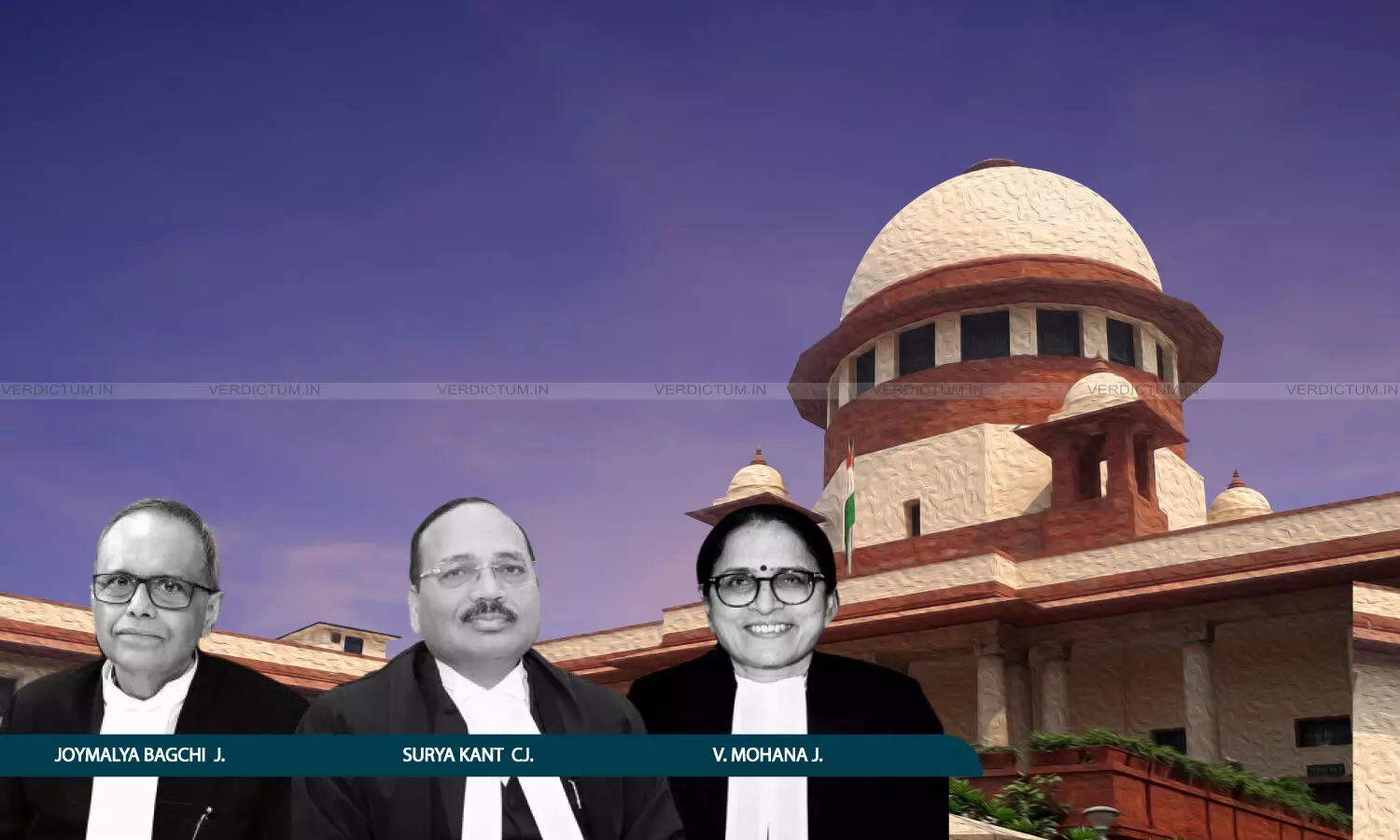
The Bench of Chief Justice Surya Kant, Justice Joymalya Bagchi and Justice V Mohana held, "As other employees of the State cannot claim parity with members of the judicial service, it would be wholly untenable in law to withhold the enhancement of the age of superannuation on the plea of an unjustified and petulant demand raised by other employees of the State. The concern of the States regarding an enhanced financial burden is, in our view, clearly misconceived. Were members of the judicial cadre to superannuate at the age of 60 instead of 62, the State would stand burdened with the responsibility of paying the post-retiral dues of such superannuated officers, in addition to the salary of those newly appointed in their place. On the contrary, if experienced members of the judicial cadre are permitted to continue in service till the age of 62, the additional burden of bearing such post-retiral dues would stand correspondingly postponed."
Senior Advocate Siddharth Bhatnagar was the Amicus Curiae, Senior Advocate Shivaraju H.B. appeared for the Petitioners, while Attorney General for India R. Venkataramani appeared for the Union of India
The Court directed, "The States which have consented to the enhancement of age of the Judicial Officers, namely, Chhattisgarh, Karnataka, Madhya Pradesh, Maharashtra, Sikkim, Tamil Nadu, West Bengal, are directed to amend the service rules and enhance the age of superannuation in the judicial service to 62 years, subject to the suitability assessment of the concerned Judicial Officer, on their attainment of the age of 60 years, by the High Court. Such amendments shall be carried out as early as possible, preferably within two months...Pending amendment of the rules, no judicial officer in the aforesaid States who has attained the age of 60 years shall superannuate until he attains the age of 62 years, subject to an assessment of his suitability and performance by the High Court concerned..."
The Court directed that the Judicial officers in the aforesaid States who have superannuated on or after 31.03.2026 shall be given an option to re-join the judicial office, if they have not already obtained subsequent employment or have been appointed to any other office of profit under the Union Government or any State Government. In the event they exercise such option in the affirmative, they shall be reappointed with all consequential benefits of pay, seniority, and continuity in service, subject to their suitability assessment and their performance by the High Court, and surrender of post-retirement benefits, if any already granted.
While the retirement age of Supreme Court judges is 65, the High Court judges superannuate at the age of 62 years. The issue arises against the backdrop of the top court’s 2002 judgment declining to accept the recommendation of the Justice K Jagannatha Shetty Commission, which had proposed raising the retirement age of district judges to 62 years.
The Court further directed that States/UTs of Andhra Pradesh, Arunachal Pradesh, Assam, Bihar, Goa, Gujarat, Haryana, Himachal Pradesh, Jharkhand, Keralam, Manipur, Meghalaya, Mizoram, Nagaland, Odisha, Punjab, Rajasthan, Telangana, Tripura, Uttarakhand, Uttar Pradesh, NCT of Delhi, Jammu and Kashmir, and Puducherry and to reconsider their decision within two weeks and submit a compliance report.
All the High Courts were ad idem that the age of superannuation of judicial officers be enhanced from 60 years to 62 years. Some High Courts, however, recommended that continuation in service beyond the existing age of superannuation be made subject to an assessment of performance.
On the other hand, the responses of the State Governments/UT Administrations were varied. While some of them have agreed to the recommendations of the High Courts to enhance the age of superannuation, others have either sought time for further consideration or demurred, primarily on the grounds that it would be an additional burden on the State exchequer or such enhancement in age would cause heartburn amongst other employees in the service of the State. States have also flagged the concern that such enhancement would affect legitimate aspirations of the young entrants in judicial services.
States of Assam, Bihar, Haryana, Meghalaya, Punjab, Uttarakhand, and Uttar Pradesh have disagreed with the proposal.
In this regard, the Court has observed, "It bears no gainsaying that the appointment and conditions of service of judicial officers are matters falling within the direct control of the respective High Courts under Articles 233 and 235 of the Constitution. Other employees of the State cannot, therefore, claim parity with members of the judicial service. In these circumstances, the apprehension expressed by the States regarding heartburn amongst other categories of employees is wholly unfounded. Equally misplaced is the apprehension of additional financial burden; on the contrary, an increase in the age of superannuation would enable the State to retain the services of experienced officers, while simultaneously effecting substantial savings on the post-retirement benefits that would otherwise become payable upon their superannuation."
The Court observed that the crying need of the hour is to ensure that the attrition of the experienced judicial talent be arrested so that the gap between the sanctioned and the working strength in the judicial service is reduced, and access to justice does not remain a mere chimaera due to unfilled posts.
Consequently, the Court asked the High Courts and States to reconsider the issue with regard to enhancement of age of superannuation in the district judiciary, whose conditions of service are to be governed by rules framed on their recommendation.
On July 22, 2026, the Court had asked the states and union territories to consider raising the age of superannuation of judicial officers from 60 to 61 years.
Observing that states cannot cite financial burden to oppose raising the retirement age of judicial officers, the Court had again asked state governments to revisit the issue of enhancing the age of superannuation of judges and decide within two weeks.
Accordingly, the Court listed the matter for further consideration on October 01, 2026.
Cause Title: All India Judges Association and Ors. v. Union of India and Ors. [Writ Petition(s)(Civil) No(s).1022/1989]
Appearances:
Amicus Curiae: Senior Advocate Siddharth Bhatnagar
Petitioners: Senior Advocate Shivaraju H.B., Advocate on Record Akhilesh Kumar Pandey, Advocate on Record Rakesh Dahiya, Advocate on Record A. Venayagam Balan, Advocate on Record Abhijit Sengupta, Advocate on Record Pravir Kumar Jain, Advocate on Record Amita Gupta, Advocate on Record Kaustubh Shukla, Advocate on Record Sanjay Kumar Dubey, Advocate on Record Harisha S.R., Advocate on Record Deepak Goel, Advocate on Record Nishant Singh and others.
Respondents: Attorney General for India R. Venkataramani, Additional Solicitor General K.M. Nataraj, Advocate General Dammalapati Srinivas, Advocate General A. Sudarshan Reddy, Advocate General Anup Kumar Rattan, Advocate General Maninderjit Singh Bedi, Advocate General Indraneel Chowdhury, Advocate General Pawan Kumar Mutneja, Advocate General Amit Kumar, Advocate General Lenin Singh Hijam, Advocate General Ajay Kumar Misra, Advocate General S.D. Sanjay Bihar, Advocate General K.N. Balgopal, Advocate General Vijay Narayan, Advocate General Pitambar Acharya, Advocate General K. Jaju Babu, Advocate General Vivek Sharma, Advocate General Biswajit Deb, Law Secretary Papi Reddy, Senior Additional Advocate General Lokesh Sinhal, Additional Advocate General Vivek Jain, Additional Advocate General Dr. Hemant Gupta, Additional Advocate General Mohammad Ali Khan, Additional Advocate General Shiv Mangal Sharma, Additional Advocate General Vikrant Rana, Additional Advocate General Prashanto Chandra Sen, Additional Advocate General Sridhar Potaraju, Additional Advocate General Manisha T. Karia, Deputy Advocate General Kartikeya Rastogi, Deputy Advocate General Talha Abdul Rehman, Deputy Advocate General Rajeev Bisht, Deputy Advocate General Rudraditya Khare, Senior Advocate B.H. Marlapalle, Senior Advocate Vikas Singh, Senior Advocate Aman Gupta, Senior Advocate Jaideep Gupta, Senior Advocate S.N. Babulkar, Senior Advocate Ashish Giri, Senior Advocate B.L. Verdrajan, Senior Advocate K.S. Kulkarni, Senior Advocate Pradeep Kumar Rai, Senior Advocate Maninder Acharya, Senior Advocate Jana Kalyan Das, Senior Advocate Ramesh Babu, Senior Advocate Vibha Datta Makhija and others.