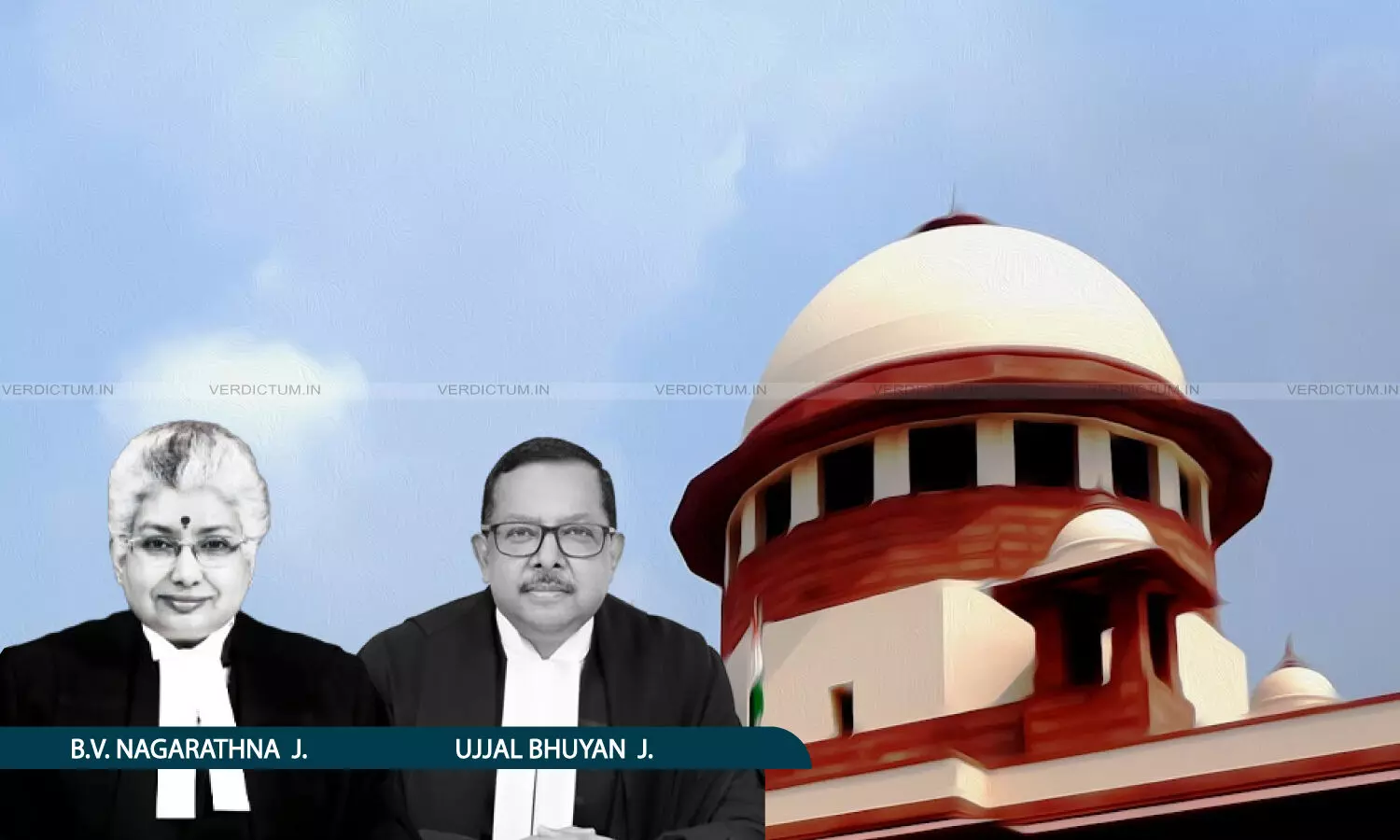
Justice B.V. Nagarathna, Justice Ujjal Bhuyan, Supreme Court
Supreme Court Upholds Judgment Which Holds Directors Liable For Cheque Bounce Despite Company’s IBC Resolution
 |
|The Court refused to entertain a special leave petition challenging the order passed by the Bombay High Court highlighting key features related to Section 138 of the NI Act.
The Supreme Court upheld the order passed by the Bombay High Court, which held that the Directors of the Company remain liable under Section 138 of the NI Act, even if the Company’s debt is resolved under the Insolvency and Bankruptcy Code, 2016 (IBC/IB Code).
The High Court had summarized various important principles with respect to Section 138 of the Negotiable Instruments Act, 1881 (NI Act).
The Bench of Justice BV Nagarathna and Justice Ujjal Bhuyan observed, "We have heard learned counsel for the petitioners and learned counsel for the respondents at length. We do not find any reason to interfere with the impugned order. Special Leave Petition is hence, dismissed. It is needless to observe that all other contentions on both sides are left open to be advanced before the trial court."
Advocate on Record Nitin Bhardwaj appeared for the Petitioners, while Advocate on Record Vatsalya Vigya appeared for the Respondents.
The brief facts of the case were that the Petitioners/accused took a loan of Rs. 15,00,000/- from Respondent No.1 /complainant, and allegedly repaid the amount through a post-dated cheque. The cheque was signed by Petitioner No.1 in his capacity as a director and authorized signatory of respondent No.2 company (of which Petitioner No.2 herein is also a director). This cheque was dishonoured, and Respondent No.1 filed a complaint under Section 138 of the NI Act.
In April, 2019, an order of liquidation was passed against Respondent No.2 company (accused No.1). The petitioners subsequently filed an application for discharge, which was allowed by the Trial Court by order. The Trial Court observed that since the petitioners had lost their positions as directors of respondent No.2/company post liquidation, they could not be liable.
Aggrieved, Respondent No.1 filed a Criminal Writ Petition before the Bombay High Court. By the impugned order, the High Court allowed the Writ Petition, observing that liability under S.138 of the NI Act would subsist despite the initiation of proceedings under the Insolvency and Bankruptcy Code, 2016. The order discharging the petitioners was quashed and set aside. Aggrieved, the petitioners have preferred the Special Leave Petition.
The High Court had culled out the following key features: (i) Section 138 NI Act proceedings are not recovery proceedings.
(ii) The Directors of the Company remain liable under Section 138 of the NI Act, even if Company’s debt is resolved under the Insolvency and Bankruptcy Code, 2016 (IBC/IB Code).
(iii) A resolution plan approved under the IB Code does not automatically extinguish the criminal liability of Directors under Section 138 of the NI Act. Also Read - Deletion Of Defendant Under Order 1 Rule 10 CPC Does Not Amount To Abandonment Of Claim: Bombay High Court.
(iv) Section 138 of the NI Act proceedings are penal in nature, aimed at maintaining the integrity of commercial transactions and not just compensating.
(v) The approval of a resolution plan under Section 31 of the IB Code does not automatically discharge the signatory/ Directors from the liability under Section 138 of the NI Act.
(vi) Section 32A protects the corporate debtor, but, not individuals responsible for Company’s conduct.
(vii) The IB Code and the NI Act serve different purposes and do not conflict with each other.
Accordingly, the Apex Court dismissed the petition.
Cause Title: Abhaykumar Anandkumar Bhambore & Anr. v. Ortho Relief Hospital and Research Centre & Anr.
Appearances:
Petitioners: Advocate on Record Nitin Bhardwaj.
Respondents: Advocate on Record Vatsalya Vigya, Advocate Saahiil Dewani, Advocate Shakul R. Ghatole, Advocate Shyam Dewani, Advocate Sachet Makhija, Advocate Dashang Doshi.