Breaking: Supreme Court Sets Aside High Court's Interim Direction Placing Kerala Waqf Board Under Joint Secretary's Supervision
 |
|The Court modified the Kerala High Court's interim order, ruling that restricting policy decisions and capital expenditure was sufficient while directing an expeditious hearing on July 22.
The Supreme Court sets aside an interim direction of the Kerala High Court that had placed the administration of the Kerala State Waqf Board under the supervision of the Joint Secretary to the State Government.
The Court said that since the High Court had already restrained the Board from making major policy decisions or incurring capital expenditure without leave, placing it under bureaucratic oversight was unnecessary.
Clarifying that the Joint Secretary would continue to act solely as an ex-officio member of the Board, the apex court directed the High Court to decide the batch of Public Interest Litigations (PILs) challenging the Board's constitution expeditiously after hearing all parties.
A Special Leave Petition was filed assailing the order passed by the Kerala High Court, in which it was observed prima facie that the Board was not constituted in conformity with Section 14 due to the absence of two non-Muslim members and adequate Shia representation. The High Court also restrained the Board from taking any policy decisions or incurring capital expenditure without its express permission.
Furthermore, the High Court directed that, for the time being, the Board would function under the supervision of the Joint Secretary to the State Government dealing with Waqf matters.
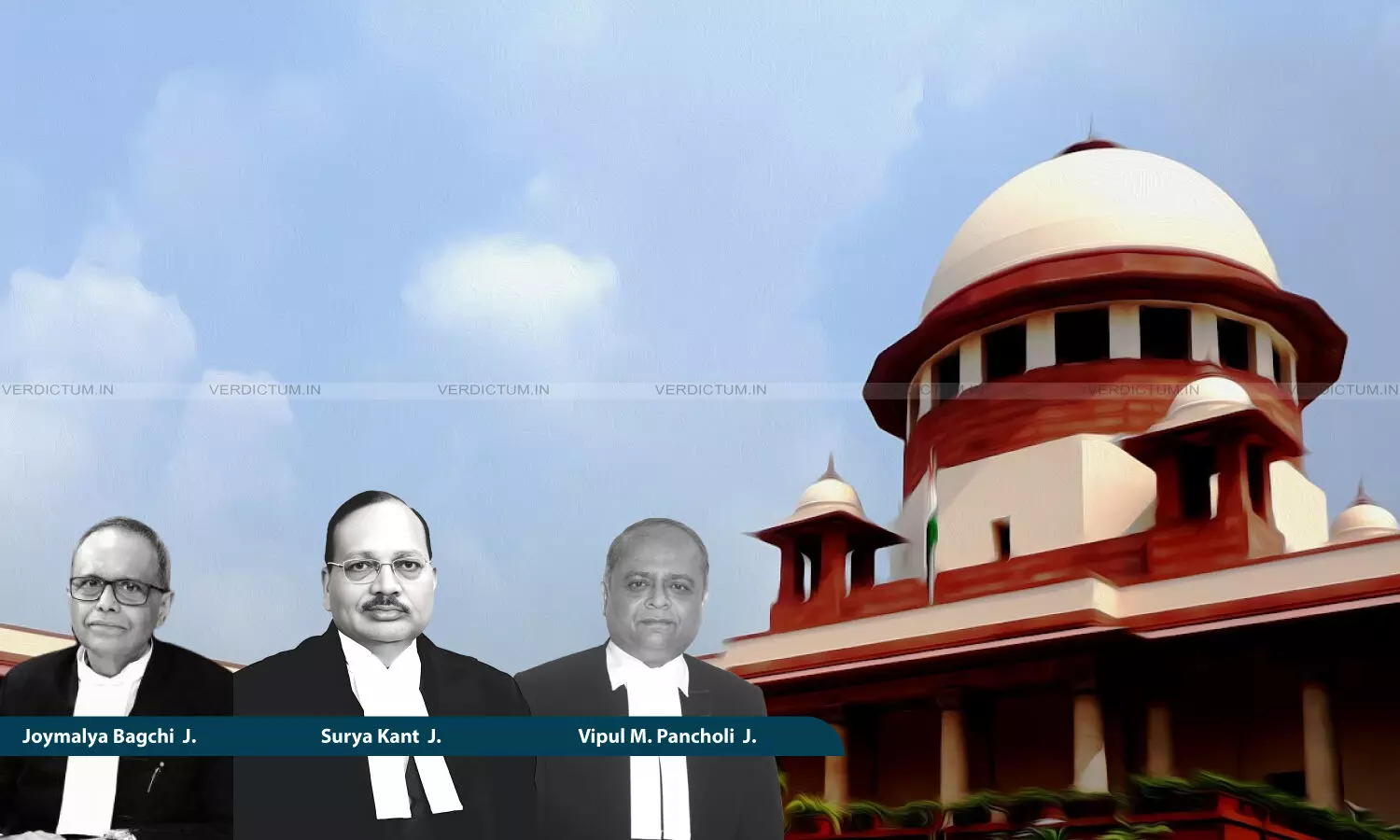
The Bench of Chief Justice Surya Kant, Justice Joymalya Bagchi and Justice Vipul M Pancholi ordered, "We have heard learned counsel for both sides. In view of the opening lines of paragraph 6, whereunder the Board has been directed not to take any policy decision or incur any capital expenditure without express leave of the court, we are satisfied that there is no necessity for the retention of the last line of paragraph 6 of the interim order. Consequently, the further direction issued by the High Court to the effect that "the Board shall, for the time being, function under the supervision of the Joint Secretary to the State Government dealing with Waqf matters" is hereby deleted. The Joint Secretary, being an ex-officio member of the Waqf Board, shall continue to function in that capacity. As may be seen from paragraph 8 of the interim order, the matter is coming up for hearing before the High Court tomorrow. We request the High Court to decide the matter expeditiously after giving a fair opportunity to the parties to file their claims and counter-claims, and after affording them a hearing. It is clarified that we have not expressed any opinion on the merits of the case."
Senior Advocate Huzefa Ahmadi appeared for the Petitioner, while Senior Advocate Jaideep Gupta appeared for the State of Kerala, and Senior Advocate K Parmeshwar appeared for the Respondents.
The matter has arisen from the ongoing disputes surrounding the constitution of the Kerala State Waqf Board under Section 14 of the United Waqf Management, Empowerment, Efficiency and Development Act, 1995 (as amended in 2025). A batch of Public Interest Litigations (PILs) were filed before the High Court of Kerala challenging the validity of notifications issued by the State Government on February 4, 2026, and March 13, 2026.
Appearing for the Waqf Board, Senior Advocate Huzefa Ahmadi argued that an extraordinary ad-interim order had been passed behind the Board's back without giving them a copy of the State's statement or a fair opportunity to respond. He emphasized that under Section 14 of the Act, a temporary vacancy does not render the entire Board defunct or justify stripping its authority. He further submitted that nine members had already been appointed for a five-year term under an earlier notification and alleged that political interests were attempting to force a fresh reconstitution.
Senior Advocate Jaideep Gupta, appearing for the State, and Senior Advocate K. Parameshwar, appearing for the respondents, noted that the main PILs were listed before the High Court the very next day. They maintained that the interim order addressed serious statutory non-compliance issues regarding the representation of non-Muslim and Shia members.
"What the present government wishes to do is to make that determination and thereafter, my lord, make the appointment. And this is different, my lord, from the first matter. There are four matters...In the first matter, it is only, the two non-Muslims. In the other matters, my lord, the ratio of Shias will have to be determined. And then, my lord, other various, my lord, segments have to be decided. Different segments have to be taken. My lord, kindly see the undertaking given by the state before the High Court. We are not opposing. We are not saying that 14 should not be given effect. We wish to give effect to it", he said.
The Bench focused primarily on Paragraph 6 of the High Court's order. While the Board objected to being placed under the administrative command of a government officer, Justice Joymalya Bagchi questioned why the Board’s day-to-day operations should stand handicapped by administrative oversight, observing that any perceived prejudice could be addressed through modifications.
Addressing the Board's grievances, the Supreme Court modified the High Court’s interim direction. The Bench observed that since the opening lines of Paragraph 6 already restrained the Board from taking major policy decisions or incurring capital expenditures without court leave, there was no necessity to keep the Board under government supervision.
Consequently, the Supreme Court deleted the direction requiring the Board to function under the supervision of the Joint Secretary, clarifying that the Joint Secretary should continue to act solely in their capacity as a regular member of the Board. Noting that the High Court was scheduled to hear the matter the following day, the Supreme Court requested the High Court to decide the case expeditiously after giving all parties a fair opportunity to file their respective claims and counter-claims.
On June 11, 2026, the Kerala High Court heard a PIL seeking an interim restraint against the Kerala State Waqf Board from functioning until two non-Muslim members were nominated to the body as mandated by Section 14(1) of the amended Act. The State sought time to seek instructions, following which the court adjourned the matter directing the State to file an affidavit.
On July 15, 2026, the High Court took on record a statement filed by the State, which conceded that the Waqf Board needed to be reconstituted in strict compliance with Section 14 of the Act.
The petitioners contended that the current Board was invalidly constituted, citing the total absence of two non-Muslim members, the lack of representation from the Shia community, and the improper appointment of the Secretary.
In response, Standing Counsel for the Waqf Board argued that non-Muslim appointments had been kept on hold due to pending litigation before the Supreme Court. However, the Additional Solicitor General of India, appearing for the Union of India, opposed this defence, pointing out that the Supreme Court’s September 15, 2025, judgment in Writ Petition (Civil) No. 276 of 2025 had not stayed or interdicted Section 14.
Agreeing with the Union, the High Court observed prima facie that the Kerala State Waqf Board had not been constituted in conformity with Section 14.
The High Court had passed interim directions, "Under the circumstances, the present Board shall not take any policy decision or incur any capital expenditure without the express leave of this Court. The State must ensure that the representative of the Government is appointed in accordance with the provisions of the Act of 1995. The Board shall, for the time being, function under the supervision of the Joint Secretary to the State Government dealing with Waqf matters."
Cause Title: The Kerala State Waqf Board v. Shone George and Ors. [SLP(C) No. 24194/2026]