Supreme Court Seeks Response From Centre On Plea Challenging Gender Discrimination In Muslim Inheritance Laws
 |
|The Court will examine whether Shariat provisions regarding property succession violate the fundamental right to equality.
The Supreme Court issued a notice to the Union Government in response to a writ petition challenging the Muslim Personal Law (Shariat) Application Act, 1937.
The Court was hearing a plea which contended that the current inheritance provisions are unconstitutional because they grant Muslim women fewer rights than men, thereby violating the fundamental right to equality. It was argued that inheritance is a civil right rather than an essential religious practice protected under Article 25. It was asserted that the 1937 Act creates artificial discrimination and should be tested against the anvil of Article 14, much like the practice of "triple talaq" was in the Shayara Bano case.
Previously, the Court raised concerns regarding a "legal vacuum" that could arise if the Muslim Personal Law (Shariat) Application Act of 1937 is struck down without a statutory replacement.
The Bench of Chief Justice Surya Kant, Justice Joymalya Bagchi and Justice Vipul M Pancholi issued notice in the plea.
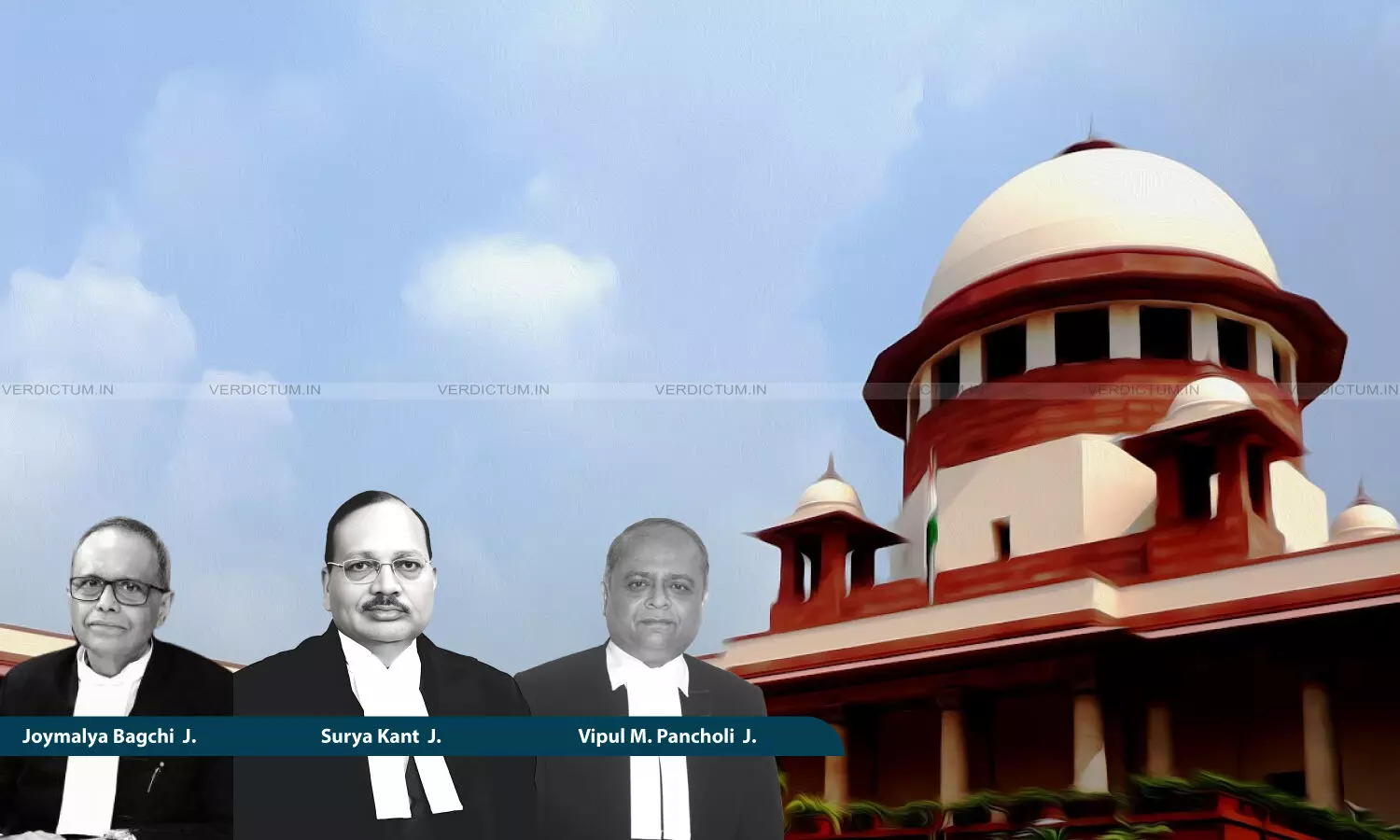
Advocate Prashant Bhushan appeared on behalf of the Petitioners.
Advocate Prashant Bhushan, representing the petitioners, argued that Section 2 of the 1937 Act is unconstitutional because it enforces Shariat inheritance rules that discriminate against women. He pointed out that under these rules, Muslim women often receive only half the inheritance of their male counterparts, which violates Article 14 (Right to Equality). He requested the court to declare that inheritance is a purely civil matter and not an "essential religious practice" protected under Article 25.
Bhushan submitted, "Muslim women are discriminated against as a result of this Shariat Application Law—specifically Section 2 of the Shariat Application Act of 1937. It says that Shariat law will apply regarding intestate succession and, unfortunately, My Lord, under Shariat law, Muslim women are discriminated against. They receive half, or sometimes even less, of what their male counterparts receive; therefore, we are saying that this is discriminatory. This is violative of Article 14...If Your Lordship strikes this down, then Your Lordship can do one of two things."
To avoid a legal vacuum if the Shariat provisions are struck down, Bhushan suggested two paths, 1. the court could "read down" the specific exclusion of Muslims from the Indian Succession Act, allowing a gender-neutral law to govern instead. Following legal precedent, the court could apply the principles of "justice, equity, and good conscience" in the absence of a specific statute.
Chief Justice said, "Someone will argue that it is a question of personal law."
Bhushan replied, "Yes, it may be a question of personal law, but it is not an essential religious practice protected under Article 25. In the absence of that protection, My Lord, it is certainly subject to Article 14. If it is subject to Article 14, then My Lord, it is ex facie discriminatory. If it is discriminatory, My Lord, it needs to be struck down...Now the question is: what will happen? Will there be a vacuum? If Your Lordship strikes it down so that Shariat law does not apply because it is discriminatory, then one non-discriminatory law that can be applied is the Indian Succession Act, which is completely agnostic toward males and females. Although that law was meant to apply to Christians, Parsis, etc., Your Lordship can strike down [the exclusion] in this instance as well. Hindu succession law is codified by the Hindu Succession Act; only Muslim succession law remains uncodified. That is the only law that is not codified and remains subject [to Shariat]. If Your Lordship reads Mulla, the rules of succession under Shariat law are so complicated that it is impossible even for lawyers to discern what the practice is. Therefore, at least this much needs to be done: it cannot be discriminatory between males and females."
CJI Kant said, "The constitutional declaration of a Uniform Civil Code has nothing to do with any religion particularly; it is a constitutional ambition."
Justice Bagchi remarked, "If you look at the personal law of marriage, the Special Marriage Act is one of the steps toward uniformity in matrimony. You have an option to opt out of your personal law through the Special Marriage Act, as well as rights regarding paternity and custody. Now, also with the Juvenile Justice Act permitting adoption, you make inroads into the personal law domain. But Mr. Bhushan, these have been legislative interdicts; they are legislative exercises. Will it be appropriate for the Court to delve into these? Freedom of religion is a part of the fundamental rights."
Bhushan respondend, "No, My Lord, the question is if a religious practice is inherently discriminatory or against equity and good conscience—which falls under public order, morality, etc."
The court emphasized that social reformation is most effective when it arises from within the faith itself, rather than being imposed externally by a court.
Bhushan highlighted a specific grievance regarding "self-acquired property." Currently, Muslims are restricted from willing away more than one-third of their assets. He argued this is a "residuary" application of law that lacks proper statutory backing and is not a mandatory religious requirement, yet it strips 172 million people of the right to distribute their own property as they wish.
Chief Justice Kant said, "We are acutely conscious of our limitations as a constitutional entity to preserve the Constitution. But is it within the scope, ambit, and affinity of the judiciary to make social reforms?"
The court expressed a desire to hear from "actual sufferers"—Muslim women whose rights have been directly denied—rather than just advocacy groups. Bhushan agreed to bring more aggrieved women forward as intervenors. The Court issued a notice to the Union Government, noting that while the judiciary must be conscious of its limits, it does have the power to strike down laws that are found to be discriminatory.
The plea prayed to declare Section 2 of the Shariat Application Act, 1937, insofar as it governs intestate succession, as unconstitutional and violative of Articles 14, 15, and 21. Secondly, to declare that the rules of intestate and testamentary succession under Muslim Personal Law do not constitute essential religious practices under Article 25 and are subject to constitutional scrutiny.
Cause Title: Poulomi Pavini Shukla v. Union of India [Diary No. No. 67256/2025]