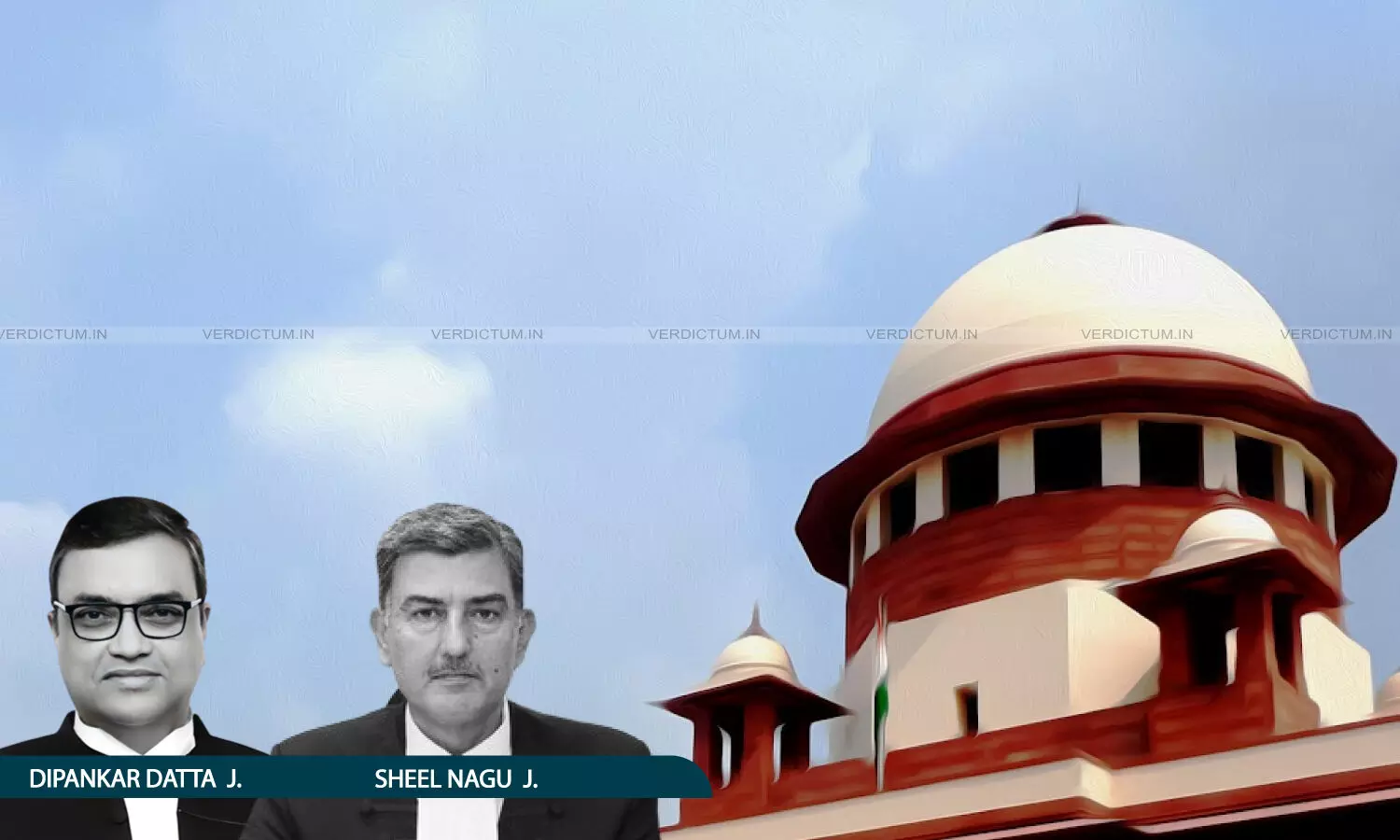
Justice Dipankar Datta, Justice Sheel Nagu, Supreme Court
Does Invocation Of Section 47-A Indian Stamp Act Require Wilful Undervaluation With Fraudulent Intent? Supreme Court Refers Issue To Larger Bench
 |
|The Bench observed that making fraudulent intent a jurisdictional prerequisite could expose an honest purchaser to an unwarranted inquiry while preventing scrutiny of transactions involving concealed consideration.
The Supreme Court has referred to a larger Bench the question of whether the power under Section 47-A of the Indian Stamp Act, 1899 depends upon wilful undervaluation accompanied by fraudulent intent to evade stamp duty, or can be exercised to determine the true nature and market value of a transaction irrespective of the parties’ culpable mindset.
Expressing serious doubts about the correctness of the three-Judge Bench decision in V.N. Devadoss v. Chief Revenue Control Officer-cum-Inspector of Stamps (2009), the Court directed that the questions and papers be placed before the Chief Justice of India.
The Court was hearing an appeal by Bharat Petroleum Corporation Limited against a Madras High Court Division Bench judgment which had reversed the Single Judge’s decision quashing proceedings initiated under Section 47-A for determining alleged deficit stamp duty on land purchased by the company from the Union Government.
A Bench of Justice Dipankar Datta and Justice Sheel Nagu observed: “Having bestowed our anxious thoughts and in the circumstances discussed above, we have serious doubt regarding the efficacy of the law declared in V.N. Devadoss (supra) as a binding precedent and find ourselves unable to accept the proposition laid down therein as correct law. V.N. Devadoss (supra) being a larger Bench decision, the only option now open to us is to refer the following questions for consideration by a Bench larger than the present Bench:
a. Whether, V.N. Devadoss (supra), since followed in ASL Vyapar (P) Ltd. (supra), correctly interprets and declares that the basis for exercise of power under Section 47-A of the Stamp Act is wilful undervaluation of the subject of transfer with fraudulent intention to evade payment of proper stamp duty? Or, whether on the very terms of Section 47-A, power thereunder can be and ought to be exercised by the registering authority, irrespective of absence of any culpable mindset of the parties to the sale, by truly deciding the real nature of the transaction and value of the subject property, without being bound by the apparent tenor of the instrument?
b. Whether the decisions in Ramesh Chand Bansal (supra) and Shanti Bhushan (supra) do not lay down correct law?”
Additional Solicitor General N. Venkataraman appeared for the appellant, while Senior Additional Advocate General Haripriya Padmanabhan appeared for the respondents.
Background
Bharat Petroleum purchased a parcel of land from the Government of India for a fixed consideration, which it paid in full. After possession was delivered, a transfer deed was executed in its favour. The company paid stamp duty and registration charges on the sale consideration recorded in the instrument.
The registering authority, however, referred the instrument to the District Revenue Officer under Section 47-A of the Indian Stamp Act, 1899. The proceedings were based on a difference between the guideline value of ₹500 per square foot and the consideration reflected in the instrument, which worked out to ₹168.30 per square foot. A notice was consequently issued demanding additional stamp duty.
The company challenged the proceedings, contending that there was no material indicating lack of bona fides or any fraudulent attempt by either party to undervalue the property. A Single Judge accepted the challenge by relying on V.N. Devadoss v. Chief Revenue Control Officer-cum-Inspector of Stamps (2009), which held that Section 47-A could be invoked only where there was wilful undervaluation accompanied by fraudulent intent to evade stamp duty.
The Division Bench reversed that decision. It held that Section 47-A and the Tamil Nadu Stamp (Prevention of Undervaluation of Instruments) Rules, 1968 provided a complete mechanism for determining market value and deficient duty. It restored the proceedings before the District Revenue Officer, observing that the company could raise its objections before the statutory authority and pursue the appellate remedies available under the Act.
Court’s Observations
The Supreme Court clarified that the actual market value of the property and the company’s liability to pay additional stamp duty were matters entrusted to the competent statutory authority. The immediate question was whether the machinery under Section 47-A could validly have been set in motion.
The Court observed: “Nonetheless, despite such a statutory relegation, two narrow doors do exist through which a writ court may entertain a challenge to a show cause notice: i) want of jurisdiction and ii) abuse of jurisdiction (i.e., mala fide exercise of jurisdiction).”
The District Revenue Officer was competent to act under the statute. The challenge concerned the manner in which that jurisdiction had been invoked rather than a complete absence of statutory authority.
The Court rejected the company’s submission that fraudulent intent could not arise because the transferor named in the instrument was the President of India. It noted that instruments made in exercise of the Union’s executive power are expressed in the President’s name but executed through authorised officials.
The Bench observed: “The mere fact that the constitutional nomenclature of the President of India figuring in the instrument as the TRANSFEROR, therefore, cannot by itself preclude an enquiry into whether the consideration or market value has been truly set forth in the instrument, nor can it render the question of fraudulent intention incapable of arising as a matter of law.”
Examining the statutory text, the Court noted that Section 47-A requires the registering authority to have reason to believe that the property’s market value or consideration has not been truly stated. It does not expressly require material demonstrating wilful undervaluation or fraudulent intent.
The Court explained: “On its own terms, Section 47-A does not require the registering authority to issue notice having ‘reason to believe’ of a culpable mindset being the motive behind the transaction; it merely requires reason to believe that the market value of the property has not been truly set forth in the instrument presented before him for consideration.”
The Court noted that V.N. Devadoss (2009), subsequently followed in Registrar of Assurances v. ASL Vyapar (P) Ltd. (2024), treated wilful undervaluation with fraudulent intent as the basis for exercising power under Section 47-A.
In contrast, Ramesh Chand Bansal v. District Magistrate/Collector (1999) held that stamp duty is payable on the property’s actual market value and that the registering authority is not bound by the apparent tenor of the instrument. Shanti Bhushan v. State of Uttar Pradesh (2023) reiterated that a taxing statute must be interpreted according to its express language without implying requirements that it does not contain.
The Bench observed: “Furthermore, in our considered opinion, ‘wilful undervaluation’ and/or ‘fraudulent intention’ cannot be read as an intra-sentential component into Section 47-A of the Stamp Act for its invocation, and any distinction, if purportedly demarcated between bona fide undervaluation and wilful undervaluation, is alien to the plain phraseology of the provision as well as the spirit of the statute.”
The Court illustrated its concern through two situations. In an honest transaction, a property may legitimately be sold below its guideline value because of tenancy, inadequate access or pending litigation. A valuation-based inquiry would require the purchaser to establish the property’s actual worth, whereas a fraud-based inquiry could compel the purchaser to defend their bona fides.
Conversely, where part of the consideration is concealed and paid in cash, the registering authority may not possess material establishing fraudulent intent at the notice stage. Treating such material as a jurisdictional prerequisite could prevent the authority from commencing an inquiry.
The Court observed: “The test propounded in V.N. Devadoss (supra) fails to do justice in either situation. In a genuine sale of encumbered property, it exposes an honest purchaser to a roving enquiry for no fault of his; in a case of a clandestine cash consideration, it disables the registering authority from even initiating an enquiry for want of material which, by its very nature, lies within the exclusive knowledge of the parties. In the former, it is too harsh; in the latter, too lax.”
Although the Bench disagreed with the interpretation adopted in V.N. Devadoss, it recognised that the judgment was delivered by a larger Bench and could not be reconsidered by the present two-Judge Bench.
The Court emphasised: “Judicial propriety and discipline require us to follow a binding decision of a larger Bench. Nonetheless, if the proposition in V.N. Devadoss (supra) does not commend our acceptance and we strongly feel that it requires reconsideration, the appropriate course is to leave the question for consideration by a Bench of appropriate strength.”
Conclusion
The Supreme Court directed that the referred questions and the case papers be placed before the Chief Justice of India for appropriate orders. It did not determine the property’s market value or Bharat Petroleum’s liability for additional stamp duty.
The Court clarified that if V.N. Devadoss (2009) is upheld as correctly stating the law, the Single Judge’s decision quashing the notice would be justified; otherwise, it would not be sustainable.
Cause Title: Bharat Petroleum Corporation Limited v. District Revenue Officer (Stamps) and Another (Neutral Citation: 2026 INSC 963)
Appearances
Appellant: Additional Solicitor General N. Venkataraman; Advocate-on-Record T. Sundar Ramanathan
Respondents: Senior Additional Advocate General Haripriya Padmanabhan; Advocate-on-Record Kanika Kalaiyarasan; Advocate Shourya Das Gupta