
Supreme Court Relegates "Bulldozer Justice" Contempt Petitions To High Courts; Directs HCs To Decide Within Four Months
 |
|The court directed the jurisdictional high courts to examine whether authorities followed due process before executing structural demolitions.
The Supreme Court relegated a batch of contempt petitions concerning illegal structural demolitions to the respective jurisdictional High Courts, observing that the disputes involved intense questions of fact that required localized, evidence-based adjudication.
The proceedings primarily centred around allegations that state authorities were executing "bulldozer justice" in flagrant violation of the landmark guidelines previously laid down by the apex court governing municipal demolitions and the right to due process.
It was observed that while the apex court will strictly enforce its judgments against unlawful demolitions, the High Courts are the appropriate forums to determine whether due process was followed, whether the properties were public or private, and if the targeted structures were genuinely unauthorized.
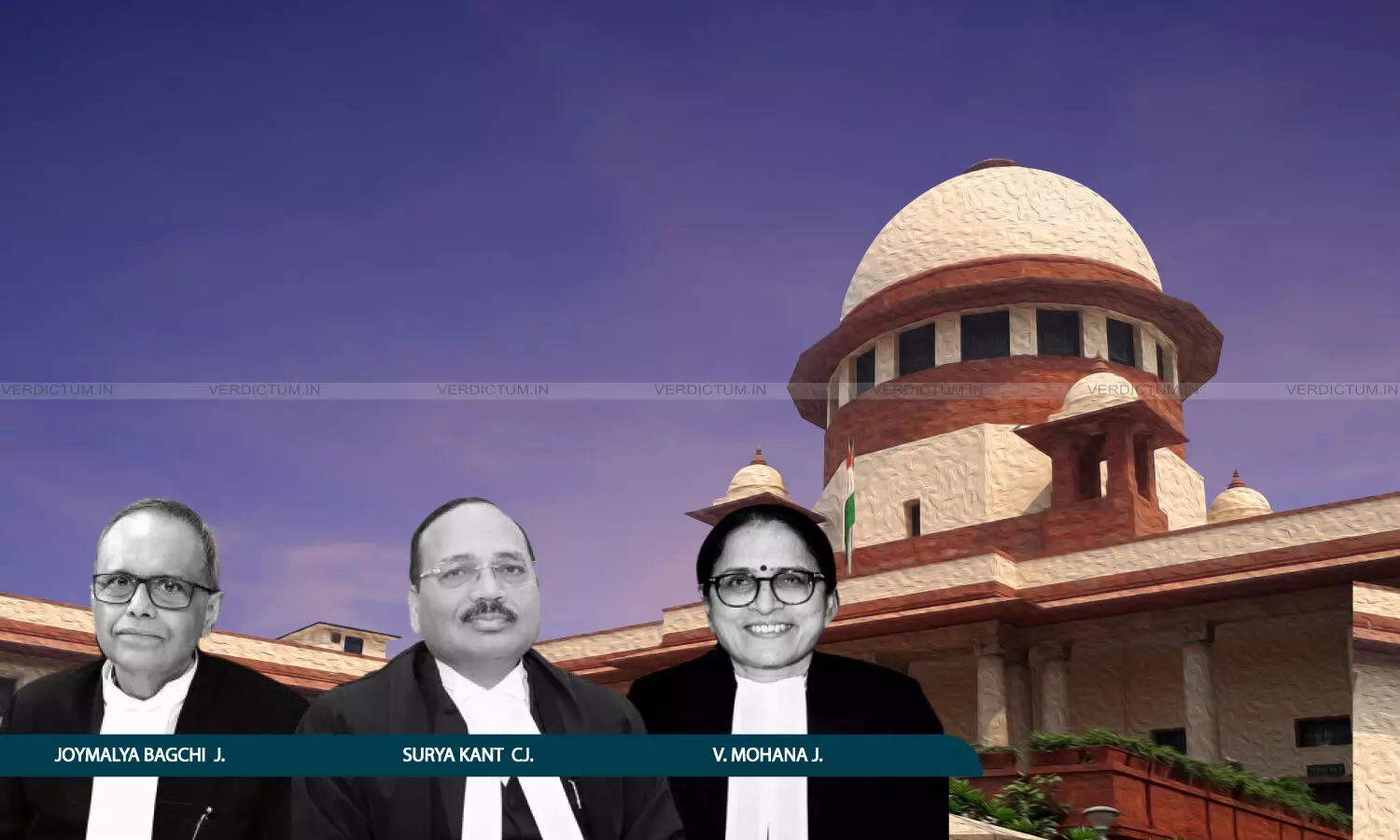
The Bench of Chief Justice Surya Kant, Justice Joymalya Bagchi and Justice V Mohana held, "It may thus be seen that there are multiple questions of fact that arise for consideration. Consequently, we deem it appropriate to transfer the record of these content proceedings to the jurisdictional High Court...The High Court is requested to call for the necessary record and/or obtain evidence through the the district courts... obtain necessary evidence through the district courts for determination of all the questions that arise for consideration. The interim or directions... the interim protection granted by this court shall continue to operate during the pendency of proceedings before the High Court.The High Court is requested to decide the matter expeditiously, and preferably within four months...It is clarified that we have not expressed any opinion on merits of the allegations or counter-allegations made by the parties."
Senior Advocate Huzefa Ahmadi, appearing for one of the petitioners, strongly argued that the state machinery had acted with profound egregiousness. He submitted that the demolition in his case did not involve public encroachment but rather targeted private land protected by registered sale deeds.
Ahmadi contended that the municipal action was maliciously triggered only after a local politician questioned the existence of Asia’s largest mosque in that particular state. He further highlighted that the authorities proceeded with a partial demolition before serving the final notice, openly defying the fact that the High Court was already seized of the matter.
He said, "I will demonstrate from their documents that, very clearly, My Lords, they are in egregious breach of Your Lordships' order. I'll take five minutes to do that. If I am permitted today, I'll do it today. This aspect was noticed by Your Lordships while issuing notice. It's not as if it wasn't noticed, because there were a couple of matters which Your Lordships said, "Go to the High Court, move an application." This is a more egregious case because initially, I moved the High Court. The High Court issued notice, gave me protection, and said, "You will be given time to file a reply, etc., and till then, don't pass a final order." Even before a final order was passed and served upon me, they came and demolished. Then I had to move for contempt before this Court, and Your Lordships granted me an order of status quo."
Senior Advocate C.U. Singh closely supported these submissions, stating that the rule of law was under severe threat as authorities willfully chose to ignore the apex court’s binding directives.
Justice Bagchi said to Singh, "We said that the judgment cannot be read as a statute. The judgment has to be read in the context in which the directions were given. And the directions themselves have been hedged through the caveat in Paragraph 94. Paragraph 94 says public spaces will not attract the directions given thereafter in respect of notice, personal hearing, and appellate provisions....Consider this...These directions are in the form of a reiteration of what statutory rights you already have under municipal law. Go to any municipal law; they demolish them without following it...
"We wanted them to follow the municipal law. Look at all the revenue codes with regard to the removal of encroachment on public land. They all contemplate a notice. But they were not followed. Mr. Singh just see how the judgment has developed the idea of audi alteram partem. Where a statute may require just a notice, the judgment speaks of a personal hearing and also an appellate opportunity...We are on contempt. Unless you appreciate what is going through our minds, you won't be able to assist us. The first thing is, these are clear directions, and these directions are binding on all of us, including ourselves as the Supreme Court, right? Until we set them aside or modify them", he added.
Adding to this, Senior Advocate S. Muralidhar apprised the Bench that when the aggrieved parties originally approached the High Court, it refused to grant relief on the absurd ground that the concerned District Collector had no notice of the Supreme Court's judgment.
Conversely, the Additional Solicitor General Aishwarya Bhati, appearing on behalf of the state respondents, vehemently refuted the allegations. She filed an affidavit asserting that due process of law was meticulously followed and adequate statutory notice was served upon the parties. The respondent authorities maintained that the structures in question constituted unauthorized constructions that either encroached upon public government land or extensively violated the originally sanctioned building plans.
During the course of the arguments, the Bench addressed the institutional framework required to enforce its guidelines. Justice Bagchi observed that while judgments like D.K. Basu provided a remedy by way of contempt before the High Courts, the current judgment lacked a localized enforcement mechanism.
The Court remarked that under the guise of implementing municipal laws, the state could not be allowed to practice "negative equality" or zero-in on accused individuals to bulldoze their homes while disregarding the fundamental presumption of innocence.
The Court reiterated that while the Supreme Court would absolutely enforce its own judgments, the High Courts and District Courts remained the appropriate forums to implement the law on the ground. The CJI pointed out that every case presented a distinct matrix of facts, making a localized factual inquiry indispensable.
The CJI said, "Frankly speaking, we can't understand that. This Court has laid down a law. The High Courts and the District Courts are supposed to follow that. If a person has been dealt with contrary to our direction and has been made to suffer consequences like loss of property, damage to property, or maybe in a given case, sometimes even illegal arrest, whatever the consequences might be, some court will have to determine that."
Dictating the order, the Court noted the sharp divergence in the stands of the parties, where the petitioner alleged a brazen violation of the principles of natural justice on private property, and the respondents asserted strict compliance with due process over public encroachments.
"It appears that multiple questions of fact arise for consideration. Consequently, we deem it appropriate to transfer the record of these contempt proceedings to the jurisdictional High Court," the Court ordered.
The apex court requested the High Court to conduct the necessary inquiry and obtain evidence through the subordinate District Courts to determine whether the properties were public or private, whether the constructions were unauthorized, and if so, whether the mandates of law were duly followed prior to ordering the demolitions.
While clarifying that it expressed no opinion on the merits of the allegations, the Supreme Court directed that the interim protection and status quo orders granted by it would continue to operate during the pendency of the proceedings. The High Court was requested to decide the transferred matter expeditiously, preferably within a period of four months.
Cause Title: In Re: Directions In The Matter Of Demolition Of Structures [W.P.(C) No. 295/2022]