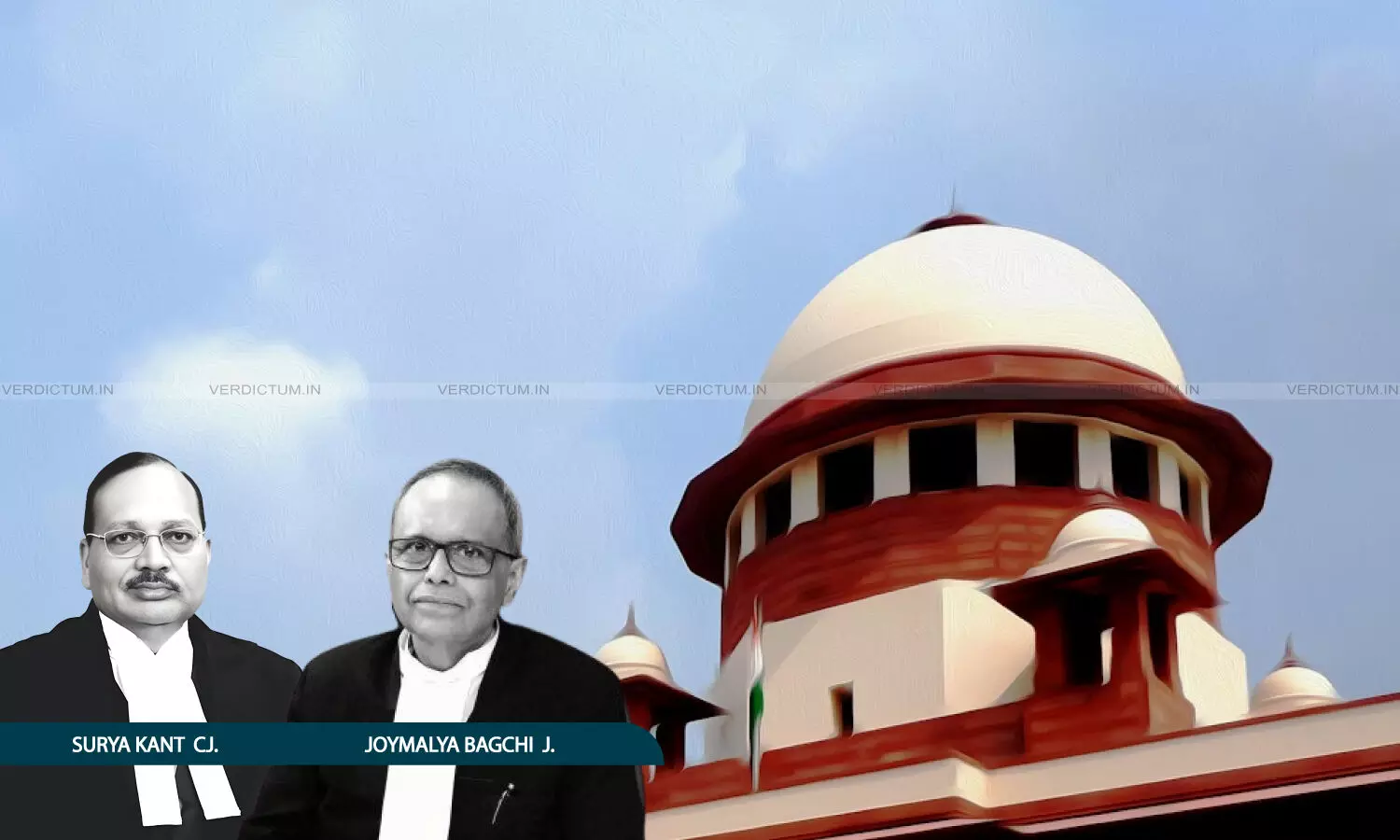
Breaking: Supreme Court Issues Binding Guidelines Formulating Strict Timelines For High Courts To Pronounce Reserved Judgments & Expedite Bail Orders
 |
|The Court established a comprehensive accountability mechanism for nationwide High Courts, fixing a three-month limit for delivery of reserved verdicts and directing the immediate release of undertrials after the grant of bail to safeguard personal liberty.
The Supreme Court of India officially intervened to address the persistent and widespread delays in the pronouncement of reserved judgments across various High Courts.
Recognizing that such delays often diluted or negated the legal reliefs sought by litigants, the Court expanded the scope of individual petitions into a broader constitutional matter.
To assist in this systemic reform, the Court appointed an Amicus Curiae, who painstakingly gathered and analyzed structural data from across the country. Despite initial challenges arising from inconsistent reporting formats, the Amicus Curiae successfully compiled and submitted a comprehensive, four-volume report mapping out the extent of delayed verdicts nationwide.
The Court heard Writ Petitions filed by convicted persons, complaining that the judgments were not being pronounced, delivered, or issued in the cases, including their own, despite the fact that arguments had taken place years back.
The Bench of Chief Justice Surya Kant and Justice Joymalya Bagchi ordered, "we hereby issue the following comprehensive guidelines which shall operate as binding directions upon all High Courts across the country and shall take effect from the date of this judgment. First is procedural timelines for the pronouncement of judgments and orders. In a matter where the judgment is reserved, the High Court shall endeavour to pronounce a reasoned judgment promptly within a maximum period of three months from the date of reserving the judgment."
Following explicit directives from the Bench, the draft guidelines were circulated to all High Court registries via official emails to invite local recommendations. Upon evaluating the subsequent feedback alongside the core data, the Supreme Court deemed the situation a fit case to invoke its extraordinary jurisdiction under Article 142 of the Constitution. The Court concluded that uniform, nationwide directives were absolutely imperative to do complete justice, thereby issuing a set of binding guidelines designed to streamline judicial timelines and take effect immediately.
"The High Court shall display extra promptitude in pronouncing judgments and orders in matters of personal liberty, regular bail, anticipatory bail, criminal appeals, verdicts where convicts are in custody, death references, etc. Bail applications should be heard and orders should preferably be pronounced and uploaded on the same day. In the event the order is reserved, it should be pronounced on the next day and uploaded to the website", it ordered.
The Court said that the influx of cases, coupled with the startling picture presented regarding delays, brought into focus a broader issue affecting the administration of justice in several High Courts across the country. In view of this, the scope of the proceedings was expanded to address a question of wider constitutional significance.
"Consequently, we directed the Supreme Court Registry to circulate a copy thereof to the official emails of all High Courts for their respective suggestions, and the matter was thereafter reserved for orders. Having considered the material on record along with the suggestions received from several High Courts in response to the draft guidelines circulated by the Amicus Curiae, we are of the view that this is a fit case warranting this Court's intervention under Article 142 of the Constitution for doing complete justice to the parties. Such intervention is necessary to formulate uniform guidelines to address delays in pronouncing reserved judgments across all High Courts in the country", it said.
Highlighting that matters involving bail, habeas corpus, and criminal appeals put personal liberty at stake, the Bench mandated strict timelines for reserved verdicts. The Court directed that judgments must be pronounced within three months of being reserved, with an even faster disposal rate expected in matters concerning personal liberty. In cases where the operative part of a judgment was announced in open court, the detailed reasons had to be uploaded onto the High Court website within seven days. This rule applied strictly to urgent matters, including habeas corpus and demolition cases.
It directed, "Orders granting regular bail, suspending sentence, or acquitting a convict in custody should be communicated to the jail authorities and the trial court as soon as they are pronounced. Consequent upon the outcome of Rule No. 2 above, the undertrial or convict should be released preferably on the same day or at most on the next day, unless they are required to be taken into custody in another case or there is a delay in complying with the bail conditions, etc."
The Bench established a strict accountability mechanism for non-compliance with the three-month window. If a judgment remained unpronounced after three months of being reserved, the Registrar General of the respective High Court was directed to place the matter before the Chief Justice of that High Court, who could grant an extension of two weeks. If the bench still failed to deliver the verdict, the case was to be de-reserved and allocated to another bench for a fresh hearing.
Furthermore, the Court ruled that if the detailed reasons were not uploaded within 15 days of the pronouncement of the operative part, the parties could move an application for the same. If the delay extended beyond 30 days, an application could be made to withdraw the case entirely and place it before another bench.
The Court ordered, "Where, after hearing the parties, the bench is of the opinion that any delay in the pronouncement of a reasoned judgment will cause irreparable loss to the parties and urgent orders are required, the operative part may be pronounced in court and the reasoned judgment should be uploaded within 7 days, or a maximum of 15 days if practical difficulties are faced by the High Court. Such cases may include habeas corpus matters, criminal appeals resulting in the acquittal of a convict in custody, matters relating to demolition or eviction, matters relating to admission to educational institutions, etc. A reasoned judgment pronounced in open court should be uploaded on the High Court website within 24 hours."
The Supreme Court ruled that orders on bail applications had to be delivered ideally on the same day, or on the next day if the decision was reserved. The Bench ordered that bail orders must be communicated immediately to the relevant jail authorities to ensure that undertrials were released on the same day or, at the very maximum, the next day. The trial courts were burdened with the duty to inform the respective High Courts regarding compliance with these release orders.
To prevent systemic gridlock, the judgment outlined a strict accountability protocol for verdicts hanging in the balance beyond the three-month deadline. The guidelines ordered the Registrar General of any non-compliant High Court to place the delayed matter before the Chief Justice, who could grant a final two-week extension to the concerned bench. If the judgment remained undelivered past this grace period, the Chief Justice received the administrative authority to de-reserve the case and reassign it to a fresh bench for a prompt rehearing.
The Court also structured parallel remedies for litigants, permitting them to file applications for early disposal after three months, or to petition the Chief Justice to completely withdraw and reallocate the case if the delay extended to four months.
Addressing cases where urgent reliefs were necessary, the Supreme Court permitted benches to pronounce the operative part of a judgment in open court, provided the detailed reasoning was uploaded within seven to fifteen days. For standard judgments delivered in open court, the time limit for digital publication was fixed at twenty-four hours. For cases where only the operative order was announced, the Court gave litigants the right to file early-upload applications after fifteen days, and the right to seek a transfer of the case to another bench if the full text remained missing after thirty days.
To anchor these timelines in institutional transparency, the Court directed all High Court Chief Justices to implement sweeping administrative and technological changes on their official websites. The guidelines required that the exact date on which a judgment was reserved be displayed next to the case status immediately after oral arguments concluded, and that automated monthly tracking emails be generated for the leadership.
Furthermore, the Court ordered that certified copies of judgments explicitly print three critical dates: the date of reservation, the date of pronouncement, and the date of website uploading. Registrars General were instructed to place these directives before their respective Chief Justices to ensure swift incorporation into individual High Court Rules.
Before concluding, the Supreme Court placed these guidelines within the unique context of the immense burdens borne daily by the Indian High Courts. Acknowledging their exceptionally wide jurisdiction under Articles 226 and 227, the Court praised the judges who routinely navigate massive dockets stretching past a hundred matters a day, often sitting well beyond regular hours to balance urgency against sheer volume.
"In a nation of India's size and demographic heterogeneity, it is perhaps inevitable that the High Courts serve as the principal judicial fora to which citizens flock in large numbers across regions and social circumstances seeking protection of the law. The judges of the High Courts bear their obligations day after day under conditions that few judicial institutions elsewhere may be called upon to endure, often carrying rosters that extend far beyond a hundred matters a day. Such circumstances have created an environment in which judges are required not only to adjudicate competing claims in accordance with the law but also to constantly weigh urgency against volume so that no case remains unattended for want of judicial time", the Court held.
The Bench clarified that these guidelines were designed strictly to facilitate, rather than criticize, the discharge of these heavy constitutional duties, expressly stating that the directives contained no adverse reflections on the conduct of any individual High Court judge.
Previously, the Court urged all the High Court to upload the reasoned judgments, in cases where only the operative parts of the Judgment was pronounced, within the ten or fifteen days(maximum).
The Court also mandated that all High Court certified judgments must explicitly state three key dates: when the judgment was reserved, when it was pronounced, and when it was uploaded to the official website.
The Petitioners were convicted persons and sentenced to life imprisonment by the Trial Court. The Petitioners approached the Jharkhand High Court in appeal.
As per the status reports filed by the Registrar, Jharkhand High Court, there were 56 matters, including some Criminal Appeals, where the Division Bench of the High Court has heard the matters on different dates ranging from 04.01.2022 till 16.12.2024 but the final pronouncements are still awaited. While hearing the matter, the Supreme Court noted that the Indian Express – a daily newspaper has today reported under the caption “After SC rap, HC decides 75 criminal appeals in a week”, that the Jharkhand High Court has decided 75 Criminal Appeals in a week after the Apex Court sought information.
Consequently, on May 05, 2025, the Supreme Court directed the Registrar General of all the High Courts to submit a Report in respect of those cases where the judgments were reserved on or before 31.01.2025 and where the pronouncement of judgments was still awaited.
The Court had also referred to its decision in the case of Ratilal Jhaverbhai Parmar vs. State of Gujarat (2024) and underscored that the Supreme Court had observed that the reasons ought to be uploaded within five days of the pronouncement of the operative part.
Cause Title: Pila Pahan@ Peela Pahan & Ors. V. The State of Jharkhand & Anr. [W.P.(Crl.) No. 169/2025]