Long Serving Temporary Status Casual Labourers Entitled To Pension Even Without Regularisation: Supreme Court Grants Relief To Former Postal Dept. Employees
 |
|The Court held that long-serving temporary status casual labourers who were treated at par with temporary Group ‘D’ employees could not be denied pensionary benefits merely because formal regularisation orders were never issued.
The Supreme Court has held that long-serving temporary status casual labourers are entitled to pensionary benefits upon superannuation even in the absence of formal regularisation.
The Court observed that employees who had been conferred temporary status and extended benefits akin to temporary Group ‘D’ employees could not be denied social security and pensionary benefits merely on account of nomenclature or administrative inaction.
The Court was hearing appeals filed by former casual labourers and legal representatives of deceased employees working under the Department of Posts, challenging judgments of the Patna High Court which had denied pensionary benefits on the ground that the employees were never formally regularised as Group ‘D’ employees.
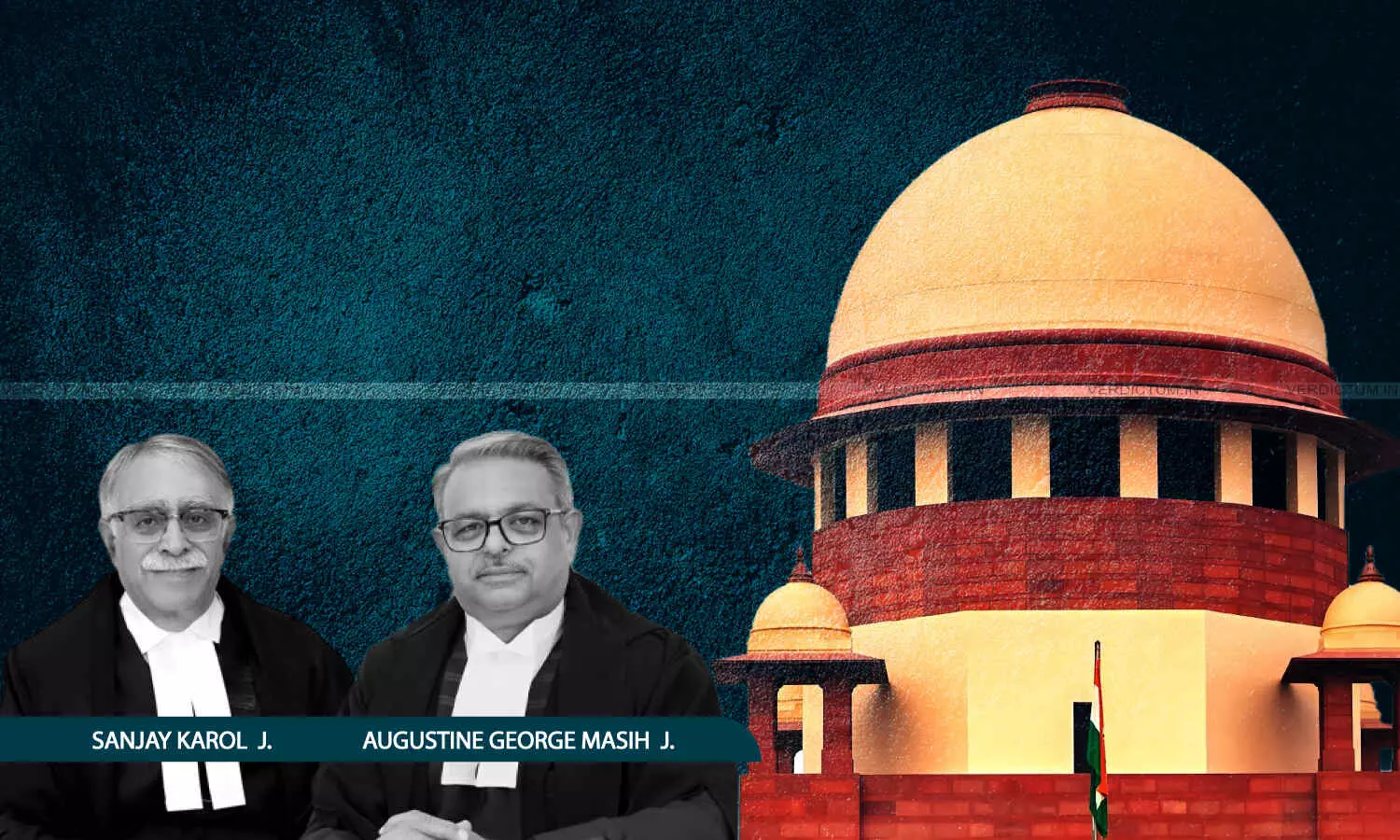
A Division Bench of Justice Sanjay Karol and Justice Augustine George Masih observed: “A temporary status casual labourer would be entitled to pensionary benefits on superannuation even in the absence of regularisation.”
The Bench further observed: “…long-serving employees, whether casual or temporary, particularly those who have been conferred a recognised status and extended benefits akin to regular employees, cannot be denied corresponding benefits including social security and pensionary benefits.”
Advocate Akhilesh Kumar Pandey represented the appellants, while ASG Bijender Chahar appeared for the Respondents
Background
The appellants were either former employees or legal representatives of employees who had worked as casual labourers (Night Guards) in the Department of Posts for several decades.
The employees were initially appointed between 1971 and 1981 and continuously served the Department till superannuation.
Following directions issued by the Supreme Court in Jagrit Mazdoor Union (Regd.) v. Mahanagar Telephone Nigam Ltd. (1990), the Department of Posts introduced the Casual Labourers (Grant of Temporary Status and Regularisation) Scheme, 1991, to provide improved service conditions and social security measures to casual labourers.
Pursuant to the Scheme, the concerned employees were granted temporary status with retrospective effect from 29 November 1989.
Thereafter, a circular dated 30 November 1992 provided that casual labourers who completed three years of continuous service under temporary status would be treated at par with temporary Group ‘D’ employees and would become entitled to benefits admissible to such employees.
Although the employees continued to receive benefits akin to Group ‘D’ employees and served for decades thereafter, they were never formally regularised before retirement.
After retirement, claims seeking pensionary and family pension benefits were rejected by the authorities because formal regularisation was a mandatory prerequisite for pension under the applicable framework.
The Central Administrative Tribunal allowed the employees’ claims and directed consideration of pensionary benefits, but the Patna High Court subsequently set aside the Tribunal’s orders, holding that pension could not be granted in the absence of regularisation.
Court’s Observation
The Supreme Court examined the 1991 Scheme, the departmental circular dated November 30, 1992, and the framework under the Central Civil Services (Temporary Service) Rules, 1965, and the CCS (Pension) Rules, 1972.
The Court observed that the Scheme was conceived as a beneficial framework aimed at progressively integrating casual labourers into the regular service structure by extending service conditions and benefits similar to Group ‘D’ employees.
The Bench noted that the Scheme itself contemplated pay parity, leave benefits, provident fund benefits, medical aid, LTC, bonus and counting of service for pension and terminal benefits.
The Court observed: “The Scheme contemplates extension of benefits admissible to temporary Group ‘D’ employees after completion of the prescribed period of service under temporary status.”
The Bench further held that the expression “such as” used in the circular while enumerating benefits admissible to temporary Group ‘D’ employees was illustrative and not exhaustive.
The Court observed: “The utilisation of the words ‘such as’ clearly indicates that the benefits enumerated therein are illustrative and neither restrictive nor exhaustive.”
The Supreme Court rejected the Union’s contention that pensionary benefits were available only after formal regularisation. The Court clarified that Clause 6 of the Scheme, which referred to counting 50% of service after regularisation, did not create pensionary entitlement itself, but merely conferred an additional benefit in cases where regularisation took place.
The Bench observed: “The pensionary entitlement of temporary status employees who have completed the prescribed period of service flows independently from the Scheme and the circular dated 30.11.1992.”
The Court also distinguished between casual labourers, temporary status casual labourers, temporary Government servants and regular Government servants, while observing that although nomenclature remained unchanged, the nature of benefits extended to temporary status casual labourers became substantially aligned with those available to temporary Government employees.
The Bench observed: “The distinction that remains is one relating to nomenclature, formal status and mode of regularisation but not to the nature of extended benefits.”
The Court further held that Rule 10(1-B) of the CCS (Temporary Service) Rules, 1965 specifically recognised entitlement of temporary Government servants to superannuation pension, gratuity and family pension upon completion of ten years’ service.
The Supreme Court observed: “Pension is not a matter of grace dependent upon the financial convenience of the employer, but a deferred wage earned through long years of service.”
The Court also held: “The emphasis must be on ensuring that the State does not retain such employees in a precarious condition while extracting services identical to those performed by regular employees.”
The Court also reiterated that a pension constitutes a constitutional right and property protected under Article 300A of the Constitution.
Conclusion
The Supreme Court held that temporary status casual labourers who had completed three years of continuous service and were extended benefits admissible to temporary Group ‘D’ employees were entitled to pensionary benefits under Rule 10(1-B) of the CCS (Temporary Service) Rules, 1965, even in the absence of formal regularisation.
The Court consequently set aside the judgments of the Patna High Court and directed the authorities to compute and release pensionary and consequential retiral benefits to the appellants within three months.
The Court further directed that in case of default, interest at the rate of 6% per annum from the date of accrual till disbursement would be payable.
Cause Title: Bhikhani Devi & Etc. v. Union of India & Ors. (Neutral Citation: 2026 INSC 612)
Appearances
Appellants: Advocate Akhilesh Kumar Pandey.
Respondents: ASG Bijender Chahar; Advocates Rohit Khare, Vimla Sinha, Seema Bengani, Rajesh Kr. Singh, Jagdish Chandra, Mohan Prasad Gupta and Sushil Raaja, Amrish Kumar, AOR, Sudarshan Lamba