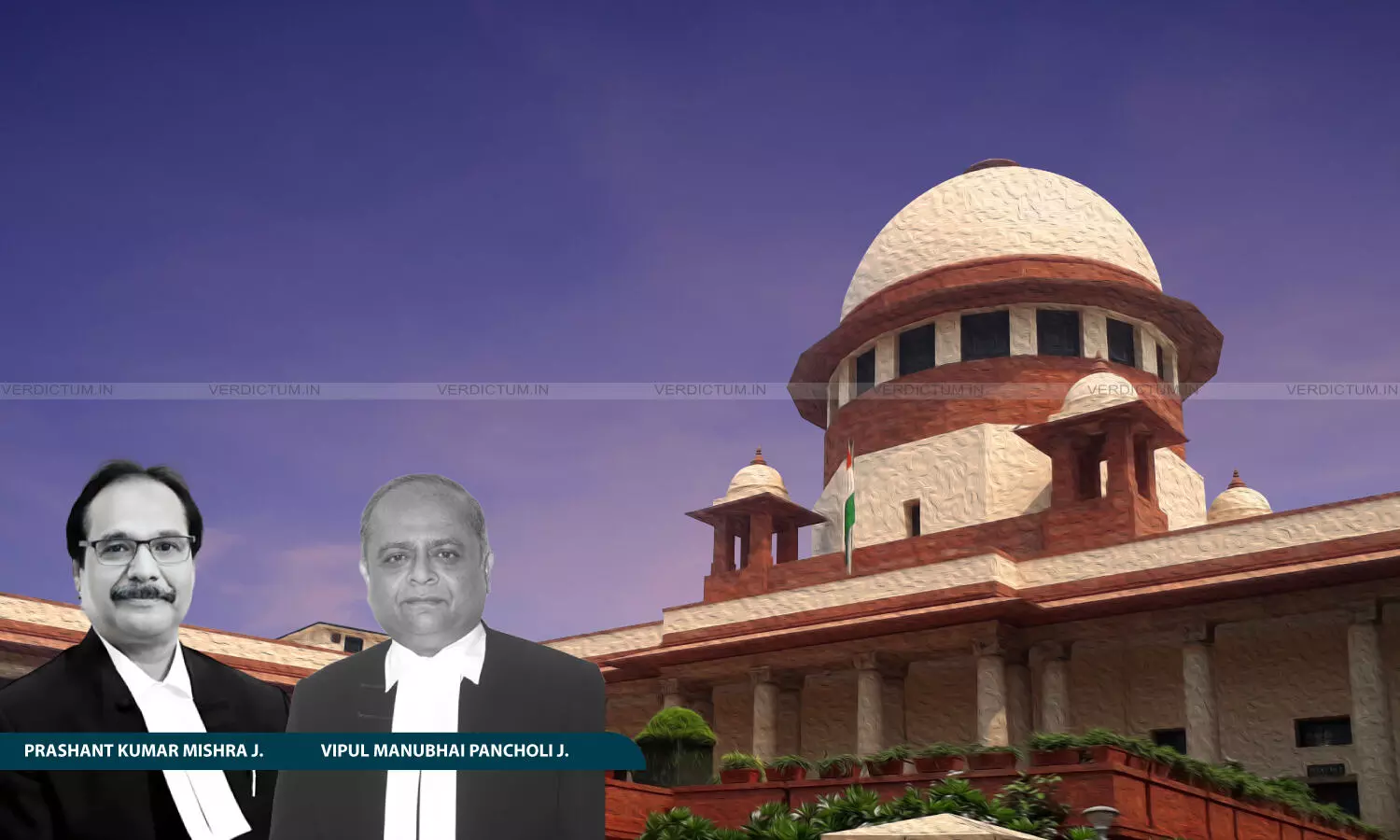
Justice Prashant Kumar Mishra, Justice Vipul M. Pancholi, Supreme Court
General Knowledge Of Illicit Relationship Cannot Be Treated As Proof Of Motive To Commit Murder: Supreme Court
 |
While setting aside a life sentence, the Court held that the alleged motive was “a matter of conjecture and surmise” and that the chain of circumstantial evidence was not complete and unbroken.
The Supreme Court has held that the general knowledge of an illicit relationship cannot be treated as proof of the motive to commit murder, observing that the Trial Court and the High Court had committed an error in doing so in a case resting wholly on circumstantial evidence.
Setting aside a life sentence under Section 302 of the IPC, the Court held that the motive alleged by the prosecution was “a matter of conjecture and surmise”, that the chain of circumstantial evidence was not complete and unbroken, and acquitted the appellant, giving him the benefit of doubt.
A Bench of Justice Prashant Kumar Mishra and Justice Vipul M. Pancholi observed, “On perusal, it is clear that both the Trial Court and the High Court committed an error by treating the general knowledge of an illicit relationship as proof of the motive to commit murder…Significantly, none of the prosecution witnesses testified that the appellant harboured suspicion that the deceased was involved with another man or that any quarrel had ever taken place between them on that account. Thus, we are of the opinion that the motive alleged by the prosecution is a matter of conjecture and surmise, which cannot be accepted as an established circumstance against the appellant”.
Senior Advocate A. Sirajudeen appeared for the appellant, and Avishkar Singhvi, Additional Advocate General appeared for the respondent.
On September 5, 2013, the body of a woman was found stuffed in an iron drum near a lime furnace in Harapanahalli. The prosecution alleged that the appellant, who was in an illicit relationship with her, strangled her with a plastic strap, robbed her ornaments and dumped the body. It claimed the ornaments were recovered from his house on his disclosure after his arrest on September 12, 2013.
The Sessions Judge, Davanagere, convicted him under Section 302 IPC on April 27, 2017, and sentenced him to life imprisonment, but acquitted him under Section 201 IPC. Rejecting the last seen together evidence for an unexplained 58-day delay in recording statements, the trial court sustained the conviction on recovery of the ornaments under Section 27 of the Evidence Act. The High Court dismissed his appeal on July 9, 2024, holding that the “last seen” circumstance was proved.
The Supreme Court held that the courts below erred in treating general knowledge of an illicit relationship as proof of motive, which it termed “conjecture and surmise”. It held that the High Court relied on the last seen witnesses without addressing the delay, and noted that the informant who first reported the body was never traced.
On recovery, the Court found it doubtful, as one panch witness was not examined, the others did not testify to the disclosure statement, and the seizure memo was dictated by the investigating officer. It held that the prosecution had to prove the deceased was wearing the ornaments when last seen alive, which it failed to do, and noted that no charge of theft or robbery was framed.
The appeal was allowed, the conviction and sentence were set aside, the Section 201 acquittal was maintained, and the appellant was directed to be released forthwith unless required in another case.
Cause Title: Bheemanagouda @ Bheemajja v. State by Harapanahalli Police (Neutral Citation: 2026 INSC 1239)