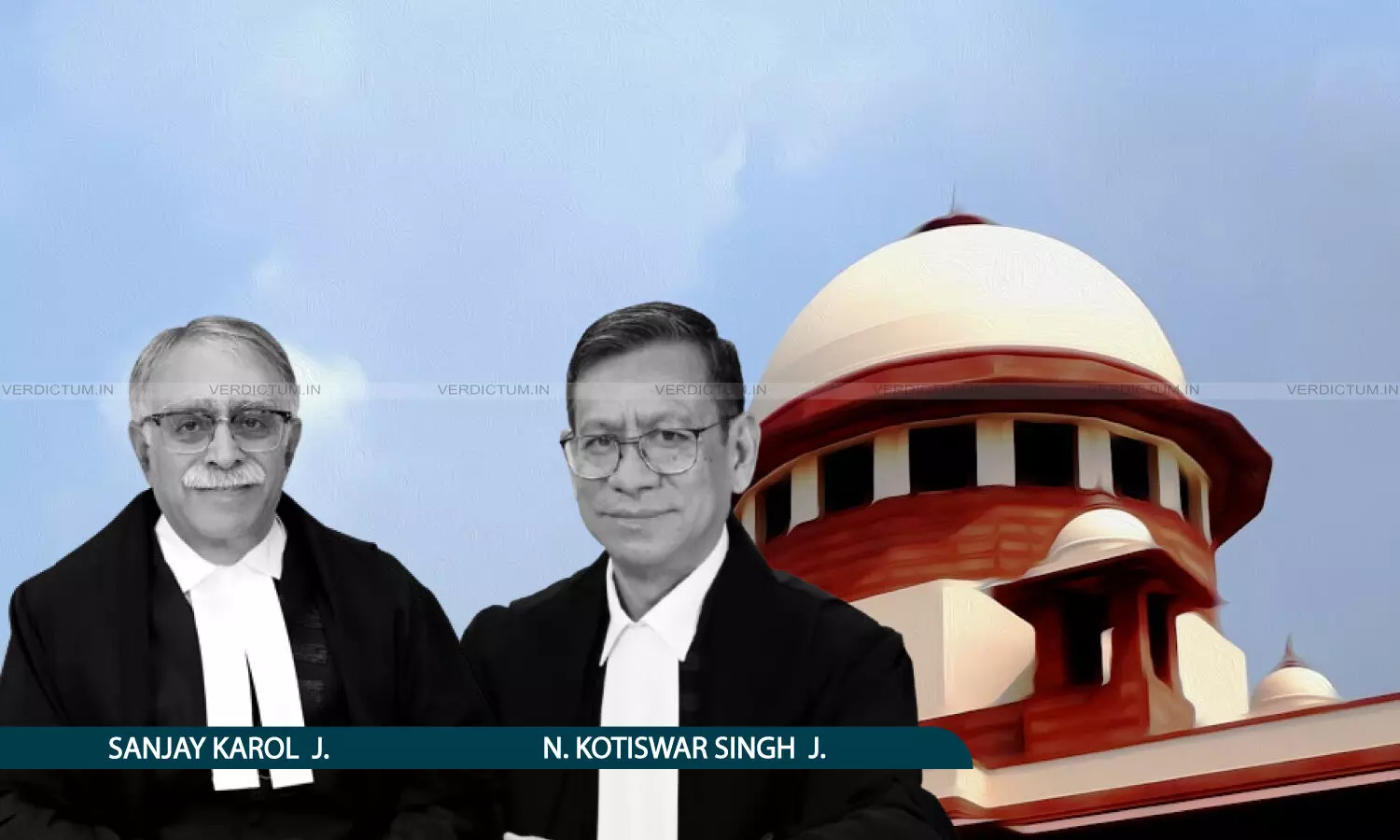
Justice Sanjay Karol, Justice N. Kotiswar Singh, Supreme Court
One Who Alleges A Custom Must Prove It; Uncle-In-Law Cannot Adopt Niece's Husband As "Ghardamad" Under Oraon Tribal Custom: Supreme Court
 |
|The Court while reversing three courts that upheld disputed partition deed without requiring proof of the custom relied upon, held nearest male agnate succeeds to property in absence of validly adopted son-in-law heir.
The Supreme Court has held that a party asserting a customary right must affirmatively establish both the existence of the custom and that the parties are governed by it, reiterating that "he who alleges the custom must prove it", and that mere absence of evidence disproving a customary bar cannot substitute for proof of the custom itself.
The Court set aside concurrent findings of three courts below that had accepted a partition deed executed in favour of a claimed "ghardamad" (adopted son-in-law) whose adoption, on the record, had been carried out not by the father-in-law but by an uncle-in-law, a relationship the Court found had no established basis in the customary law of the Oraon tribal community.
The Court further ruled that where a substantial question of law is framed under Section 100 CPC, the High Court is obligated to answer it on merits rather than dispose of it merely by invoking the concurrent nature of findings below, holding that framing a question and then declining to decide it defeats the very purpose of formulating it.
Justice Sanjay Karol and Justice Nongmeikapam Kotiswar Singh observed, “…It is nowhere established that an uncle-in-law can adopt his niece’s husband as his ghardamad within the prevalent customary law…We found that the High Court observed that since it is not established that there is bar against adoption by uncle-in-law, no adverse inference can be drawn. Well, as we have discussed above, those who allege a custom must be the one to prove it...”.
“Taking a cumulative view of the matter, we are of the considered view that in the present facts the customs as alleged, apart from the ghardamad’s eligibility to get property of his father-in-law could not be proved. The decision made by us places reliance on well-established and acknowledged sources of the law as it prevails in this community which, at the cost of repetition, postulates that in the absence of a ghardamad or any other male heir directly related to the land owner i.e. the male members of the family, the nearest male agnate will have the right in the property. Hence, the judgments of the courts below are set aside”, the Bench noted further.
In the matter, the dispute concerned succession to land owned by one Sukhu Oraon, who had three sons, Dhungru, Ledura and Bhoula. The plaintiff, also named Sukhu, was Dhungru's grandson and claimed ownership of the entire ancestral holding as the last surviving male descendant.
This was contested by Budhain, daughter of Bhoula, and her husband Punai, who claimed that Ledura, being childless, had taken Punai as his ghardamad (a customary practice among the Oraons whereby a son-in-law is adopted to continue the family line), and that following Bhoula's death, Ledura and Budhain had executed a partition deed dated February 27, 1975 dividing the properties between them. It was undisputed that under the applicable custom, daughters have no independent right of inheritance.
The Munsif and the 1st Additional District Judge, Gumla, in first appeal, both dismissed the plaintiff's suit, holding that Punai's status as Ledura's ghardamad had been established.
The Jharkhand High Court, in Second Appeal, framed the specific question of whether an uncle (Ledura) could adopt a ghardamad on behalf of his niece's husband, but ultimately upheld the concurrent findings without independently answering that question, by judgment dated 10.06.2024. The plaintiff's legal heirs appealed to the Supreme Court.
Noting Halsbury's Laws of England and precedents including Gokal Chand v. Parvin Kumari (1952) 1 SCC 713 and Aliyathammuda Beethathebiyyappura Pookoya v. Pattakal Cheriyakoya (2019) 16 SCC 1, the Court held that while the custom of a ghardamad acquiring rights in his father-in-law's property was proved, there was no evidence of a custom permitting an uncle-in-law to adopt his niece's husband as ghardamad.
The appeal was allowed, and the judgments of all three courts below were set aside. The plaintiff's suit was decreed, with the Court holding that in the absence of a validly established ghardamad or other direct male heir, the nearest male agnate, the plaintiff, was entitled to succeed to the property. Parties were directed to bear their own costs.
Cause Title: Bejla Oraon v. Kali Das Oraon & Ors. (Neutral Citation: 2026 INSC 672)