Breaking: BCI Has No Jurisdiction Over Conduct Of Students: Supreme Court Quashes Letters Against NALSAR Batch
 |
|The Court remarked once a law graduate gets himself or herself registered as an advocate, then the advocates come into picture.
The Supreme Court formally quashed the Bar Council of India's (BCI) directives against the 2026 graduating batch of NALSAR University of Law, observing that the Bar Council of India has been statutorily created and does not confer any express or implied power upon the said Council or any State Bar Council to take any disciplinary or punitive action against the students of law.
On August 14, the Court issued notice to the Bar Council of India (BCI) and further restrained the regulatory body from taking any coercive steps against the students or faculty of NALSAR University of Law by the BCI or any State Bar Council in relation to the controversy.
The BCI issued a circular directing that all state bar councils shall not enrol any 2026 graduate of NALSAR University of Law as an advocate until further orders and had sought a report identifying those responsible. However, within hours after an uproar on social media, the BCI reversed this order.
The apex statutory body for lawyers said a final decision in the matter would be taken on August 19 after considering the material placed before it.
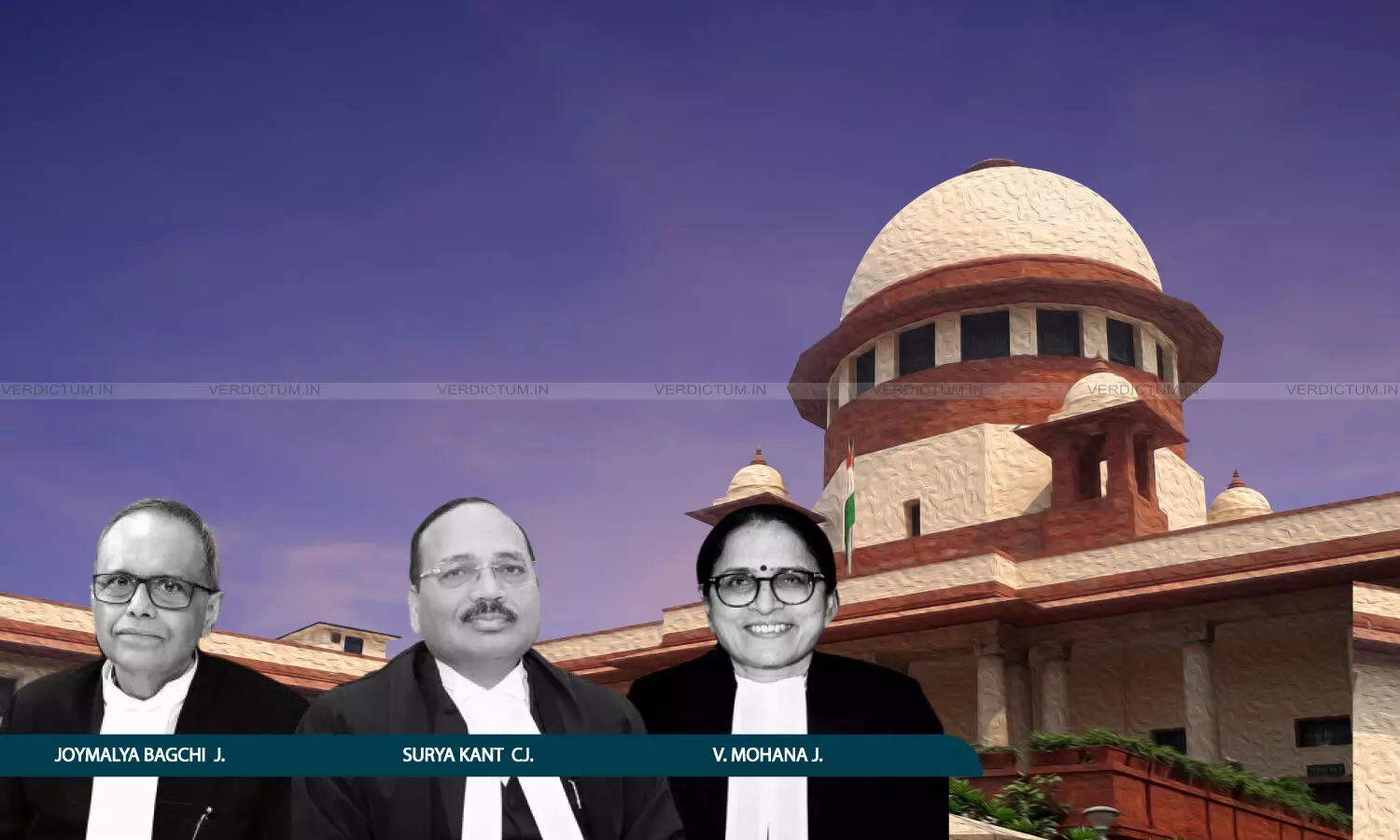
The Bench comprising Chief Justice Surya Kant, Justice Joymalya Bagchi and Justice V Mohana ordered, "On an in-depth consideration of the issue, we are of the view that under the Advocates Act, 1961, whereunder the Bar Council of India has been statutorily created, does not confer any express or implied power upon the said Council or any State Bar Council to take any disciplinary or punitive action against the students of law. Such a power is preceded by the registration of a law graduate as an advocate under the said Act. So far as students are concerned, it is their parent institution or the authority prescribed under the regulations or bylaws of such institution who alone can be competent to take disciplinary action, if so required, against a student...Paragraph 13 letter was followed by another letter whereby the first letter was modified and only a limited direction to the university to hold an inquiry was issued. However, both the letters were immediately withdrawn within few hours...Having held so, we declare all the communications dated 13.08.2026 or the subsequent modified communications to be without any authority in law...And interim directions issued on 14th August 2026 are made absolute."
Senior Advocate K Parmeshwar appeared on behalf of the Petitioners, while Senior Advocate Manan Kumar Mishra appeared for BCI
Chief Justice observed, "Mr. Parameshwar appears to be right that, as far as the conduct of the students is concerned—law students—the BCI has no jurisdiction or statutory competence to go into that. That's an exclusive domain of the educational institution, the university. I think that there should not be any dispute, any quarrel about that part...About after somebody passes out, becomes a member of the Bar... once a law graduate gets himself or herself registered as an advocate, then the advocates come into picture. Then members of the Bar conduct, yes, Bar Council is the statutory authority to regulate their conduct, but not of the students. Not of the students."
Parameshwar, appearing on behalf of the NALSAR Alumni, submitted that the impugned orders issued by the Bar Council of India (BCI) were entirely without jurisdiction and questioned the circumstances under which such directives were passed. He contended that the BCI, being a statutory body responsible for legal education and the regulation of the legal profession, lacked statutory authority to regulate student conduct or interfere with academic freedom prior to enrollment as an advocate.
Parmeshwar submitted, "An entire batch, they said, will not be enrolled—number one. Number two, that partly it came to be withdrawn saying that, "Now we will conduct an investigation." Bar Council of India's powers to direct the university to conduct an investigation on a representation by students to the university. Number three, after all that, a press release is there saying that these orders were passed in a hurry."
He further submitted that although the BCI subsequently withdrew the initial directive denying enrollment to an entire batch and modified it to direct an inquiry by the university, both directives remained bad in law. He urged the Court not merely to treat the matter as closed upon withdrawal, but to quash the offending communications and hold the BCI accountable for its arbitrary and irresponsible conduct, which infringed upon the fundamental freedom of speech and expression of law students.
Chief Justice Kant said, "Undoubtedly, we expect everyone to act in a very responsible manner, and we have no doubt about it that the very fact that it was withdrawn means there must be some realization that a mistake, if not blunder, was committed, and that has been rectified. But irrespective of their rectification, once we find that it was issued without any authority..."
Senior Advocate Manan Kumar Mishra, Chairman of the Bar Council of India, submitted that the communications in question were withdrawn within a few hours of their issuance, accompanied by an official press release to that effect. He stated that the directives were never implemented or executed, and because the Council had resolved the matter and dropped all proceedings, no live controversy survived for adjudication. He accordingly prayed that the matter be granted a quietus, while expressing concern regarding future instances of student misconduct.
Mishra submitted, "The question is that here, my Lord, everything has been closed. The Council, in its meeting, says that there is nothing, everything has been resolved, the letter was immediately withdrawn. Now, whether, my Lord, everything remains to be adjudicated or any finding is to be done, the matter should be given a quietus"
Justice Bagchi noted, "The difficulty is that tomorrow, if another or a similar situation arises... That has to be clarified. That is the point. It's something like this, Mr. Mishra, let us say a student indulges in an act of moral turpitude and is disqualified as per the Advocates Act to enroll. But the university permits him to pursue his education and take the law degree. You can definitely at the time of enrollment examine the conditions precedent for enrolling. But to permit or not to permit to go ahead with the education, or to put a pre-time injunction that "I will not enroll you even if you are an advocate..."
Having considered the statutory framework, the Court formally declared both the primary communication dated 13.08.2026 and the subsequent modified directives to be completely without authority in law and accordingly quashed them.
The interim order dated 14th August 2026, directing that no punitive action be taken against the students or faculty of NALSAR University of Law at the instance of the BCI or any State Bar Council, was made absolute, and the petition was disposed of.
The NALSAR University of Law on Thursday said it will place the Bar Council of India's request for an inquiry into the persons involved in objecting to inviting CJI Surya Kant to the institution's convocation before its Executive Council. The Executive Council is the university's highest decision-making body.
The university's Vice-Chancellor Srikrishna Deva Rao said in a statement late on Thursday that they received a letter earlier in the day from the Bar Council of India (BCI) disallowing the enrollment of all the graduating BA and LLB (Hons) students from the 2026 batch and seeking an inquiry report on persons involved in the recent developments concerning the upcoming convocation.
The initial letter was followed by another one which reversed the directive to the state bar councils disallowing the enrollment of the graduating students, he said.
A section of students of Hyderabad-based NALSAR University had (in July this year) written to the Vice-Chancellor, Registrar and professors of the institution, opposing any proposal to invite the CJI as chief guest to the varsity's convocation, the date of which is yet to be announced.
Cause Title: Mihir Sood v. Bar Council Of India [W.P.(C) No. 1040/2026]