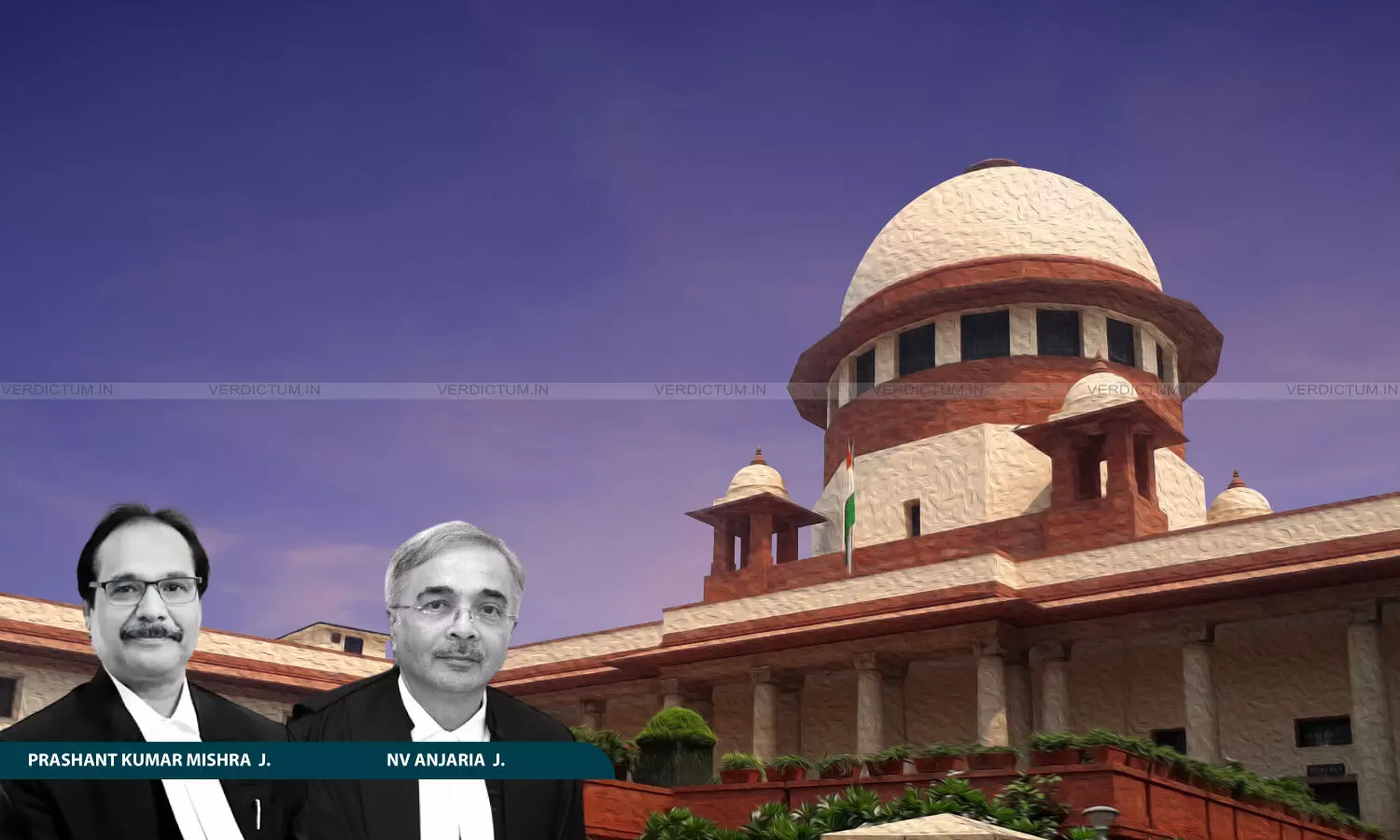
Supreme Court, Justice Prashant Kumar Mishra, Justice N.V. Anjaria
Deceased's Daughter Not Interested Witness Merely By Relationship: Supreme Court Upholds Life Sentence In Witch-Hunting Murder Case
 |
|The Court said the daughter’s direct testimony, corroborated by medical evidence, established that the victim was brutally murdered on the allegation that she had caused another child’s death by practising witchcraft.
The Supreme Court has upheld the conviction and life sentence of a man convicted for murdering a woman after she was branded as having practised witchcraft, holding that the testimony of the deceased’s daughter could not be discarded merely because she was a close relative.
The Court held that a close relative who is a natural witness cannot be equated with an interested witness solely on account of such a relationship, particularly where the testimony is cogent, consistent, and corroborated by medical evidence.
The Court was hearing an appeal against an Orissa High Court judgment which had affirmed the Trial Court’s conviction of the appellant under Section 302 read with Section 34 IPC and the sentence of rigorous imprisonment for life.
A Bench of Justice Prashant Kumar Mishra and Justice N.V. Anjaria observed: “A close relative, who is a natural witness, cannot be equated with an interested witness merely because of such relationship. In the facts of the present case, the direct testimony of P.W.3 has been duly corroborated with medical evidence which further establishes the guilt of the appellant beyond reasonable doubt.”
Senior Advocate Rakesh Kumar Khanna appeared for the appellant, while Advocate Naveen Kumar appeared for the State of Odisha.
Background
The prosecution case was that after the youngest daughter of a villager died, her family members alleged that the deceased woman had caused the death by practising witchcraft. The appellant and a co-accused then allegedly came to the deceased’s house, dragged her out, took her near the house of the bereaved family and assaulted her severely with a lathi.
The incident was witnessed by the deceased’s daughter, who later went to the police station with her maternal uncle and lodged the complaint. The prosecution examined nine witnesses, while the defence examined none.
The Trial Court relied on the daughter’s eyewitness testimony and convicted the appellant and co-accused for murder with common intention. The High Court affirmed the conviction, holding that the injuries were on vital parts of the body and that the testimony of the daughter was corroborated by medical evidence.
Court’s Observations
The Supreme Court first noted that the case was based on direct ocular evidence, with the deceased’s daughter being the only eyewitness to the assault on her mother.
Referring to her deposition, the Court recorded that she had stated that the accused took her mother from the house and beat her with a “BADI”, and that she protested but was also beaten. The Court noted: “From the above testimony, it can be clearly made out that P.W.3 has remained unshaken in both, her chief examination and cross-examination, on the aspect that it was indeed the appellant and the co-accused who inflicted such brutality on the deceased, which ultimately led to her death.”
On the evidentiary value of a sole eyewitness, the Court reiterated that there is no legal bar on conviction based on a single reliable witness. It observed: “When there is a direct evidence in the form of a sole eyewitness testimony, there exists no legal impediment on convicting solely on the basis of that since what matters is the quality and not the quantity of the witnesses.”
Applying that principle to the daughter’s testimony, the Bench said: “Tested on the anvil of the aforesaid principles, the testimony of P.W.3 inspires complete confidence. Being the natural sole witness, her presence at the scene of the occurrence is natural and unquestionable. The version of P.W.3 on the manner of assault and the weapons used has remained consistent, credible enough to safely sustain conviction of the appellant.”
The appellant had argued that the daughter was a related and interested witness. Rejecting that submission, the Court said that a witness can be treated as interested only where there is direct motive, personal animosity or some other reason to falsely implicate the accused.
The Court observed that mere relationship with the deceased does not make a witness unreliable, and that the daughter’s testimony was corroborated by the post-mortem evidence.
The Court also rejected the plea that the case should be converted from murder to culpable homicide not amounting to murder under Section 304 IPC. Referring to the nature and location of injuries, the Bench held: “In the case before us, looking at the nature of the injuries inflicted on the body of the deceased including grievous injuries on head, neck, chest and other vital parts of the body, manifests a clear intention on the part of the appellant to cause the death of the deceased.”
It added that there was nothing on record to attract any exception to Section 300 IPC, and therefore the plea for conversion to Section 304 Part I or Part II was liable to be rejected.
On the alleged delay in lodging the FIR, the Court noted that the daughter was 15-16 years old at the time and had witnessed the brutal assault and murder of her mother. The Bench observed: “It is but natural that after witnessing the brutal assault and murder of her deceased mother, P.W.3 would have been under shock and despair. It was only when the maternal uncle of P.W.3 came to their house, she somehow mustered the courage to go to the Police Station to get the FIR lodged.”
The Court held that the delay was well explained and that it could not be expected of the daughter to run to the police station in the night itself after witnessing the incident.
Before parting, the Supreme Court made strong observations against witch-hunting, describing it as an anathema to human dignity. The Bench said the facts had deeply disturbed its conscience, particularly because the victim was branded as a practitioner of witchcraft and her daughter had to witness her mother being killed.
The Court remarked: “It is true that the malady of witch hunting still plagues sections of our society, where prejudice, superstition and irrational fear supersedes the rule of law, constitutional morality. The brutality associated with witch hunting extends far beyond the act of killing; where victims mostly women are subjected to torture, beatings, sexual violence and social ostracization.”
The Court further observed: “The Constitution of India envisioned a society founded on the principles of equality, fraternity, scientific temperament, wherein any practice derogatory to women was to be discarded. Despite this, practices such as witch-hunting continue to persist within few sections of our society.”
Conclusion
The Supreme Court dismissed the appeal and affirmed the conviction and life sentence imposed on the appellant under Section 302 read with Section 34 IPC.
The Court held that the direct evidence against the appellant was compelling, that the daughter’s testimony was reliable and corroborated, and that both the Trial Court and the High Court had correctly held the appellant culpable for the crime.
Cause Title: Balku Oram v. State of Odisha (Neutral Citation: 2026 INSC 852)
Appearances
Appellant: Senior Advocate Rakesh Kumar Khanna with Advocates Rajiv Kumar Sinha, AOR, Savita Devi, Anand Ranjan and Raj Kumar
Respondent: Naveen Kumar, AOR, with Advocates Ujjawal Kumar Rai, Isha Baloni, Sudhanshu Pathak, Rishabh Chaudhary, Lakshay Singh, Pragya Prachi Pandey, Shailja Singh, Nidhi Singh, Shrijeta Pratik, Prabhat Sejwar and Utkarsh Chandra