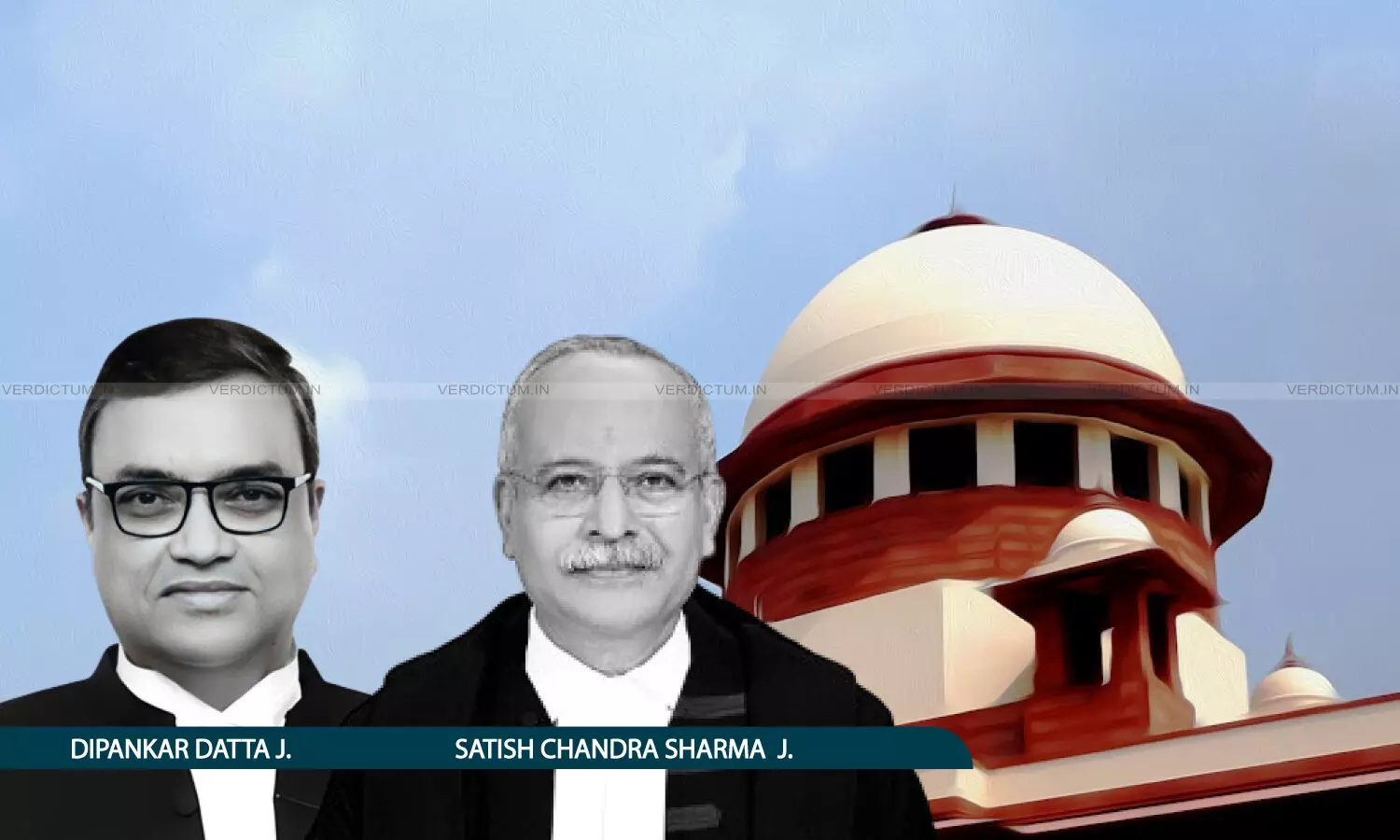
Justice Dipankar Datta, Justice Satish Chandra Sharma, Supreme Court
Doctrine Of Forum Non Conveniens Rarely Applies When Writ Jurisdiction Is Invoked For Pursuing Constitutional Remedies: Supreme Court
 |
|The Supreme Court was considering an appeal filed against the judgment of the Delhi High Court rejecting the challenge to the orders of dismissal.
While allowing an appeal of a dismissed BSF Officer, the Supreme Court has held that where the question of pursuing a constitutional remedy is involved, and invocation of writ jurisdiction is traceable to clause (1) of Article 226, the doctrine of forum non conveniens may rarely apply.
The Apex Court was considering an appeal filed against the judgment of the Delhi High Court rejecting the challenge to the orders of dismissal.
The Division Bench of Justice Dipankar Datta and Justice Satish Chandra Sharma held, “In our considered opinion, the doctrine of forum non conveniens has been misapplied by the Division Bench in the context of writ jurisdiction referable to Article 226 of the Constitution. Such article permits filing of a writ petition as per situs of office of the respondent(s) [clause (1)] and cause of action [clause (2)] which gives the right of action. Where the question of pursuing a constitutional remedy is involved and invocation of writ jurisdiction is traceable to clause (1) of Article 226, the doctrine of forum non conveniens may rarely apply.”
Advocate Mahboob Alam Inayati represented the Appellant, while Additional Solicitor General Aishwarya Bhati represented the Respondent.
Factual Background
The appellant was enrolled as a member of the Border Security Force on December 31, 2010, and he was posted in the 44th Battalion. While serving at Narayanpur, Malda, in West Bengal, a missing person report was received by the Company Commander. The appellant and another constable were suspected of being involved in the abduction of the lady. In the meantime, the appellant's wife also lodged a complaint. It was alleged that the appellant, against her wishes, had contracted a second marriage with the lady. It was also alleged that the appellant subjected her to criminal force. The Sector Headquarters, BSF, Malda, ordered a Staff Court of Inquiry to investigate the allegations. The appellant was later served with a show cause noticeunder Rules 2210 and 1771 of the Border Security Force Rules, 19691, alleging violation of Rule 713 of the BSF Rules and Rule 2114 of the Central Civil Services (Conduct) Rules, 19641, on the ground that he had entered into a second marriage during the subsistence of both his own marriage and that of the lady, without permission.
After no reply from the appellant, the Commandant dismissed the appellant from service without any pensionary benefits, and the appellant was struck off the strength of the BSF from the said date. Aggrieved by the order of dismissal, the appellant preferred a statutory petition under Rule 28A of the BSF Rules seeking reinstatement in service, which was dismissed. Challenging the orders of dismissal from service and rejection of his statutory petition, the appellant invoked the writ jurisdiction of the Delhi High Court, but the same came to be dismissed on the ground of forum non conveniens.
Reasoning
The Bench referred to the judgment in Shri Ranjeet Mal v. General Manager, Northern Railway, Baroda House, New Delhi, which laid down the law that the Union of India would be fastened with the liability for enforcement of an order quashing an order of dismissal/removal from service of a railway servant, and not the officer who passed it. The Bench thus stated. “This decision, read with the provisions of Sections 4 and 5 of the BSF Act, makes the position clear that the Union of India and the Director General, BSF having their offices in New Delhi were necessary parties to the appellant’s writ petition and, thus, had been duly impleaded as the respondents before the Delhi High Court.”
The Bench also explained that in terms of sub-rule (4) of Rule 22, BSF Rules, every order of dismissal/removal passed under sub-rule (3) thereof has to be reported to the Director General. “There is a presumption that official acts have been regularly performed. Hence, on a cumulative assessment of these factors, there may not be any difficulty in holding that the Delhi Court did have the competence to entertain and try the writ petition of the appellant”, it added.
Dealing with the doctrine of forum non conveniens, the Bench held, “What follows from the above passages is that the doctrine of forum non conveniens applies only where multiple fora are available to a litigant for seeking the same remedy; and, when such multiple fora are available, the forum which has been approached is entitled in law to examine whether any other forum is more convenient and/or better suited to consider and decide the claim that has been raised by the aggrieved litigant. For informed reasons, the forum seized of the claim may refuse to entertain the claim and leave the said litigant free to approach the other forum. It is, however, noticed that the decision in Arif Azim (supra) did not arise from writ proceedings.”
The Bench further explained that when a writ of or in the nature of Certiorari is prayed, Rule Nisi requires the records of the case to be placed before the Court for examining whether the order under challenge, which is part of the records, deserves to be quashed or not by a writ of or in the nature of Certiorari. “Such records would invariably be available in the offices of the respondents; if not, it can readily be called for from the custodian thereof.A suitor having himself chosen the forum convenient to the respondents, application of the doctrine of forum non conveniens could be self-defeating and likely to deny access to justice rather than advancing it”, it added.
The Bench was of the view that the doctrine of forum non conveniens was misapplied by the Division Bench. Thus, the Bench allowed the appeal, which resulted in the revival of the appellant’s writ petition on the file of the Delhi High Court.
Cause Title: Baksish Ahmad v. Union of India (Neutral Citation: 2026 INSC 630)
Appearance
Appellant: Advocates Mahboob Alam Inayati, Furkan Ali Mirza, AOR Naresh Kumar
Respondent: Additional Solicitor General Aishwarya Bhati, Advocates Anukalp Jain, Rajan Kr.Chourasia, V.V.V. Pattabhi Ram, Padmesh Mishra, Udai Khanna, Adarsh Kumar Pandey, AOR Arvind Kumar Sharma