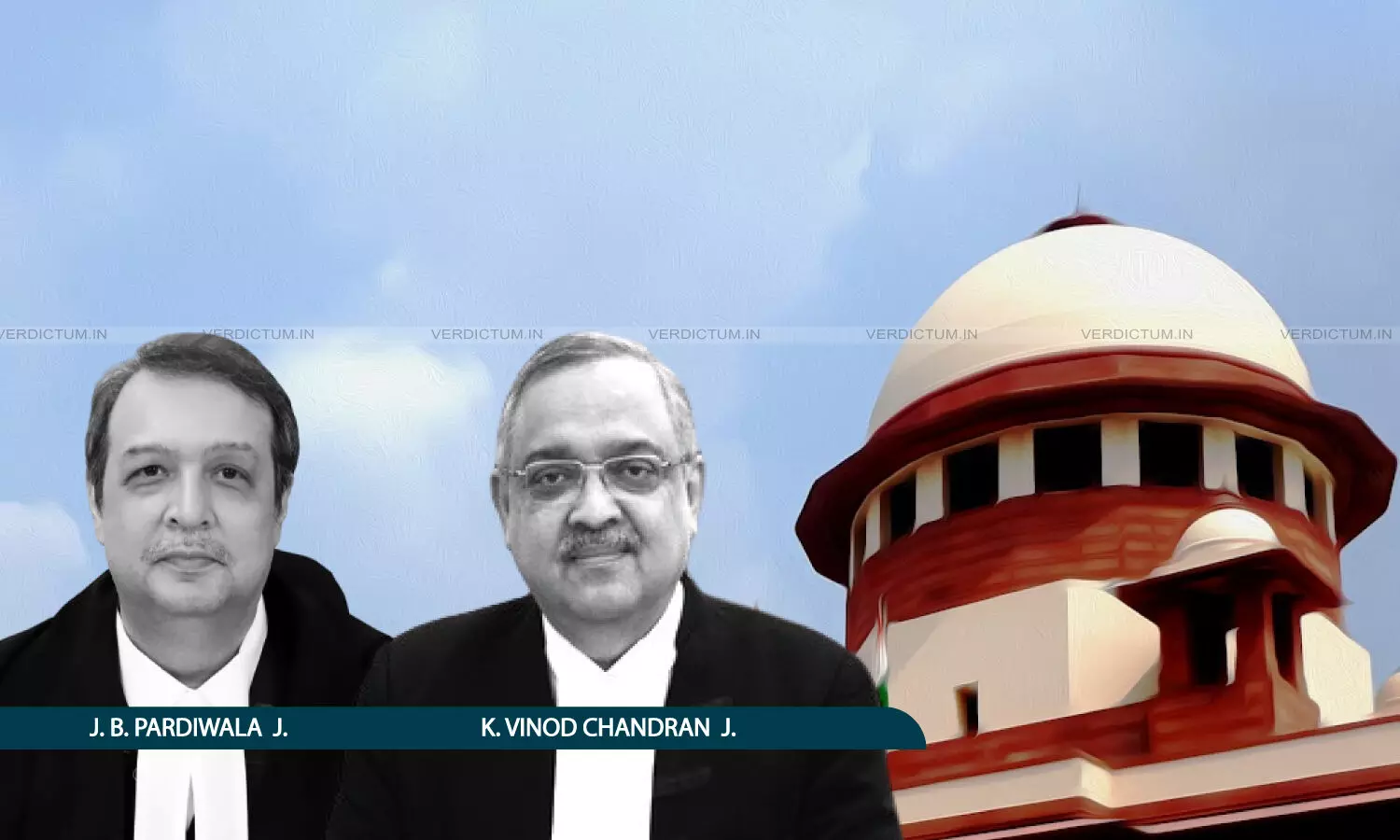
Justice J. B. Pardiwala, Justice K. Vinod Chandran, Supreme Court
Related Witnesses Can’t Be Called Interested Witnesses; But Closer Scrutiny Warranted If A Ring Of Falsity Found In Their Testimonies: Supreme Court
 |
|The Supreme Court was considering a case of murder arising out of a gunshot injury.
While granting acquittal in a murder case, the Supreme Court has observed that the related witnesses merely for their relationship with the deceased cannot be called interested witnesses but a closer scrutiny is warranted when a ring of falsity is found in their testimonies.
The Apex Court was considering a case of murder arising out of a gunshot injury. Out of the five accused persons, two were convicted. The appeal was filed at the instance of the convicts.
The Division Bench of Justice J. B. Pardiwala and Justice K. Vinod Chandran held, “Related witnesses merely for their relationship with the deceased cannot be called interested witnesses. But when, from the circumstances, as in the present case, where there is found a ring of falsity in their testimonies, a closer scrutiny is warranted. If the incident occurred at the front yard of the house, then the related witnesses are not chance witnesses and could be relied on. But there is no clear substantiation in this case, as to the scene of occurrence. The independent witness PW8, though, spoke of having accompanied PW2, there was no corroboration on that aspect by PW2, making him also a doubtful eyewitness.”
Senior Advocate Manan Kumar Mishra represented the Appellant while AOR Manish Kumar represented the Respondent.
Factual Background
A quarrel erupted due to a dispute regarding blockage of drainage, resulting in waterlogging in front of the house of the deceased. Two families entered into a brawl, in which the second appellant was accused of shooting the deceased, while the first appellant allegedly fired at the other family members, injuring them. The prosecution examined twelve witnesses and the defence three. The conviction under Section 302 read with Section 34 of Indian Penal Code and Section 27 of the Arms Act as also the sentence handed down, were affirmed by the High Court.
Reasoning
The Bench noted that the fact that there was a homicide was proved from the medical evidence. The Bench also found that there was no reconnaissance made of the scene of occurrence by the Police, and nothing was recovered from the scene of occurrence. The blood-stained clothes of the relatives of the deceased were also not seized and sent for medical examination
The Bench noticed various contradictions with respect to the statements made by five witnesses. On a perusal of the medical evidence, the Bench stated that the injuries sustained did not inspire a finding as to the persons having been involved in an altercation where assault was made by lathis and multiple shots fired from a firearm. “It also has to be noticed that the eyewitnesses were PW2, PW3 and PW10; who were the sons of the deceased, as also PW5; his daughter and PW6; his daughter-in-law. We already found that the evidence of PW5 & PW6, especially after the contradictions marked from the Section 161 statements does not inspire confidence to find their presence at the scene of occurrence. The testimonies of PW2, PW3 and PW10 also must be tested with the other attendant circumstances”, it added.
It was noticed that the inquest report and the testimony of I.O indicated that the body was taken to the police station. The Bench, thus, mentioned, “It is surprising that the body was taken to the police station while in the normal circumstances it would have been taken to the hospital. Here we again notice the testimony of the Doctor who conducted the postmortem, that the injury which led to the death of the deceased could not result in an instantaneous death and the person who sustained it, could survive for 3 to 6 hours.”
The Bench held, “Due to the discrepancies and the inconsistencies, we are unable to place faith on the oral testimony of eyewitnesses. In that circumstance, the reasonable doubt regarding a hypothesis of innocence assumes relevance. We must emphasize that despite specific overt acts alleged on the other accused, the Trial Court acquitted them, affirmed by the High Court.”
Thus, allowing the appeal and granting the benefit of the doubt to the appellants, the Bench ordered their acquittal.
Cause Title: Ashok Upadhyay and Anr. v. The State of Bihar (Neutral Citation: 2026 INSC 971)
Appearance
Appellant: Senior Advocate Manan Kumar Mishra, Advocates Anjul Dwivedi, AOR Divya Roy, Advocate Saurabh Tiwari
Respondent: AOR Manish Kumar, Advocates Divyansh Mishra, Kumar Saurav, Adv.