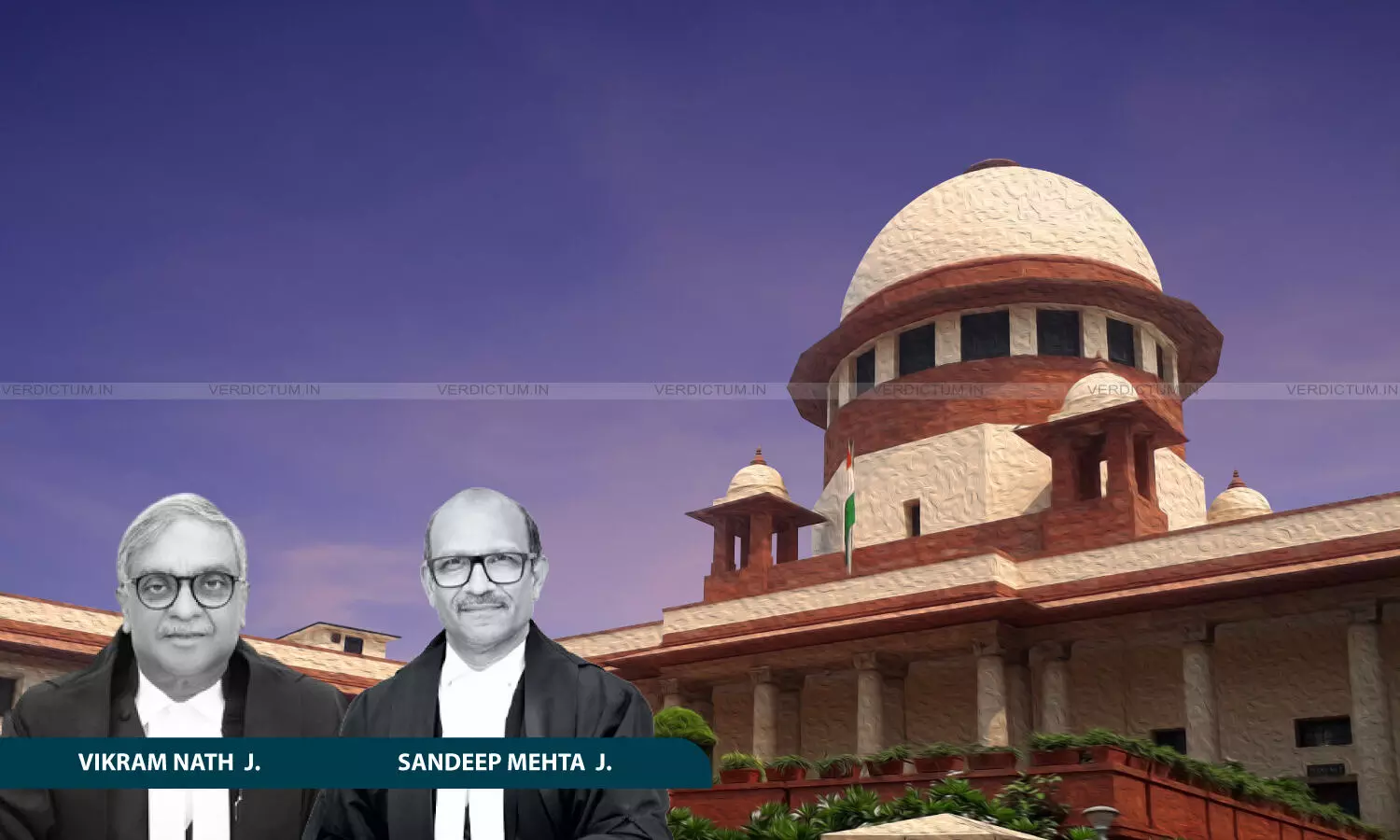
Justice Vikram Nath, Justice Sandeep Mehta, Supreme Court
Wife Pursuing Her Career Goals Cannot Be Treated As Cruelty Merely Because It Hurt Sentiments Of Husband Or In-Laws: Supreme Court
 |
|The Court held that the Family Court’s reasoning reflected “deeply entrenched archaic societal assumptions” incompatible with constitutional values of dignity, autonomy and equality.
The Supreme Court has held that a wife’s decision to pursue her professional career and independently establish her own identity cannot be construed as cruelty merely because such choices may not align with the expectations of the husband or his family.
The Court also expunged findings of cruelty and desertion recorded against a qualified dentist, observing that treating her effort to pursue career goals as matrimonial misconduct reflected a legally unsustainable and regressive approach towards women’s autonomy and professional aspirations.
The Court was hearing appeals arising out of matrimonial proceedings between a qualified dentist and her husband, an Army Officer, wherein the Family Court had granted divorce on grounds of cruelty and desertion attributed to the wife.
While the wife sought expungement of the adverse findings, the husband sought prosecution of the wife for perjury under Section 195 read with Section 340 of the Code of Criminal Procedure, 1973.
A Bench of Justice Vikram Nath and Justice Sandeep Mehta observed: "To brandish the effort of the wife to pursue her own career goals as acts of cruelty, as the same may have hurt the sentiments of the husband or the in-laws, is highly objectionable and deplorable in the era where the society proudly talks of women empowerment".
The Bench added: "... the approach of the Family Court was clearly meant to convey that the wife, even though having a degree in Dentistry, should have sacrificed her own career to go and stay with her husband at his place of posting and failure to do so, tantamounted to committing cruelty by deserting her husband, ....this approach can never be countenanced and deserves to be deprecated".
Advocates Jesal Wahi and Kabir Hathi appeared for the parties, while both the appellant-wife and respondent-husband also appeared in person.
Background
The parties were married in 2009. The appellant-wife was a qualified dentist, while the respondent-husband was serving in the Indian Army and was posted at Pune.
The wife started a private dental clinic in Pune in 2010. Subsequently, after the husband was posted at Kargil, she shifted there and stayed with him for over four months. During that period, she conceived. Finding the medical facilities at Kargil inadequate for her pregnancy, she returned to Ahmedabad and started residing with her in-laws.
After the birth of their daughter, the wife again went to Kargil with the child. However, when the child developed seizure episodes and required medical treatment, the parties returned to Ahmedabad in view of the limited specialised medical facilities at Kargil.
The matrimonial dispute thereafter escalated into multiple proceedings before various fora. The Family Court ultimately granted divorce on grounds of cruelty and desertion attributed to the wife and rejected the husband’s application seeking prosecution of the wife for perjury. Both sides challenged the judgment before the Gujarat High Court, which dismissed both appeals.
The wife approached the Supreme Court seeking expungement of the findings regarding cruelty and desertion, while not opposing the decree of divorce. The husband sought prosecution of the wife for alleged perjury.
Court’s Observation
At the outset, the Supreme Court observed that the reasoning adopted by the Courts below was rooted in outdated notions regarding the role of women within marriage. The Court observed: “The reasoning which permeates the impugned judgments appears to be founded upon deeply entrenched archaic societal assumptions that a wife’s professional identity is subject to an implied spousal veto.”
The Bench further held that such assumptions were “wholly incompatible with the progressive evolution of society” where dignity, autonomy and equal participation of women are increasingly recognised as fundamental social values.
Emphasising the autonomy and individuality of married women, the Court observed: “Marriage does not eclipse her individuality, nor does it subjugate her identity under that of her spouse.”
The Court further observed that matrimonial obligations cannot operate to erase a woman’s independent professional identity. The Bench noted: “A woman can no longer be treated as a mere appendage to the household of the husband, and her independent intellectual and professional identity and aspirations must receive due credence and respect.”
While examining the factual background, the Court found that the Family Court had incorrectly construed the wife’s efforts to pursue her dental profession and provide a better environment for her daughter as acts of cruelty and desertion. Referring to the Family Court’s findings, the Supreme Court observed that the wife had been faulted for opening a dental clinic without informing the husband and for choosing to stay at her parental home during visits to Ahmedabad.
The Court strongly disapproved of this approach. The Bench observed: “To brandish the effort of the wife to pursue her own career goals as acts of cruelty, as the same may have hurt the sentiments of the husband or the in-laws, is highly objectionable and deplorable in the era where the society proudly talks of women empowerment.”
The Court noted that the wife had already once sacrificed her professional practice to accompany the husband to Kargil. It held that her subsequent decision to reside at Ahmedabad for the welfare of the child and continuation of her profession could not amount to desertion. The Court observed: “The endeavour on the part of the appellant to choose a more secure place for bringing up her minor daughter, who suffered from a concerning medical condition, could not have been construed as an act of desertion under any circumstances.”
The Bench further criticised the Family Court’s expectation that the wife was duty-bound to abandon her profession and accompany the husband to every place of posting. The Court observed: “The expectation that a woman must invariably sacrifice her career and conform to traditional notions of an obedient wife meant for cohabitation, irrespective of her own aspirations or the welfare of the child, reflects a line of reasoning that is archaic, ultra-conservative, and cannot be countenanced in the present day scenario.”
The Court also found the Family Court’s reasoning to be reflective of a “regressive and feudalistic mindset”. The Bench observed that had the roles been reversed, a husband pursuing his profession while his wife served in the Army would never have been accused of cruelty or desertion.
Referring to the husband’s conduct during litigation, the Court observed that his approach appeared domineering and controlling. The Bench observed: “We are convinced that he has an attitude of domineering and control, which must have been the probable cause for the appellant taking the steps for gaining independence and pursuing her career goals.”
The Court also rejected allegations that the wife had attempted to coerce the husband into converting to Christianity. It noted that the material on record did not disclose any clear or credible evidence supporting such allegations and observed that the parties had entered into a love marriage solemnised according to both Hindu and Christian rites.
After examining the findings of the Family Court and the High Court, the Supreme Court held that the findings of cruelty and desertion could not be sustained in law. The Bench observed: “Having found the observations made by the learned Family Court regarding cruelty and desertion attributed to the appellant to be unjustified and untenable in the eyes of law, we are convinced that the same deserved to be expunged and scored off the record.”
The Court nevertheless declined to interfere with the decree of divorce since the wife no longer wished to continue the marriage and the husband had reportedly remarried. The Court held that the decree of divorce would stand sustained on the ground of irretrievable breakdown of marriage.
While dealing with the husband’s plea seeking prosecution of the wife for perjury, the Court held that the allegations appeared to stem from “personal vendetta and spiteful approach” arising out of matrimonial acrimony and did not disclose the ingredients of the offence of perjury.
Conclusion
The Supreme Court partly allowed the wife’s appeal and expunged the findings of cruelty and desertion recorded against her by the Family Court and affirmed by the Gujarat High Court. The Court, however, upheld the decree of divorce and held that it shall be deemed to have been granted on the ground of irretrievable breakdown of marriage.
The Court also dismissed the husband’s special leave petition seeking prosecution of the wife for perjury under Section 195 read with Section 340 CrPC.
Cause Title: ASD v. LCSIBD (Neutral Citation: 2026 INSC 475)