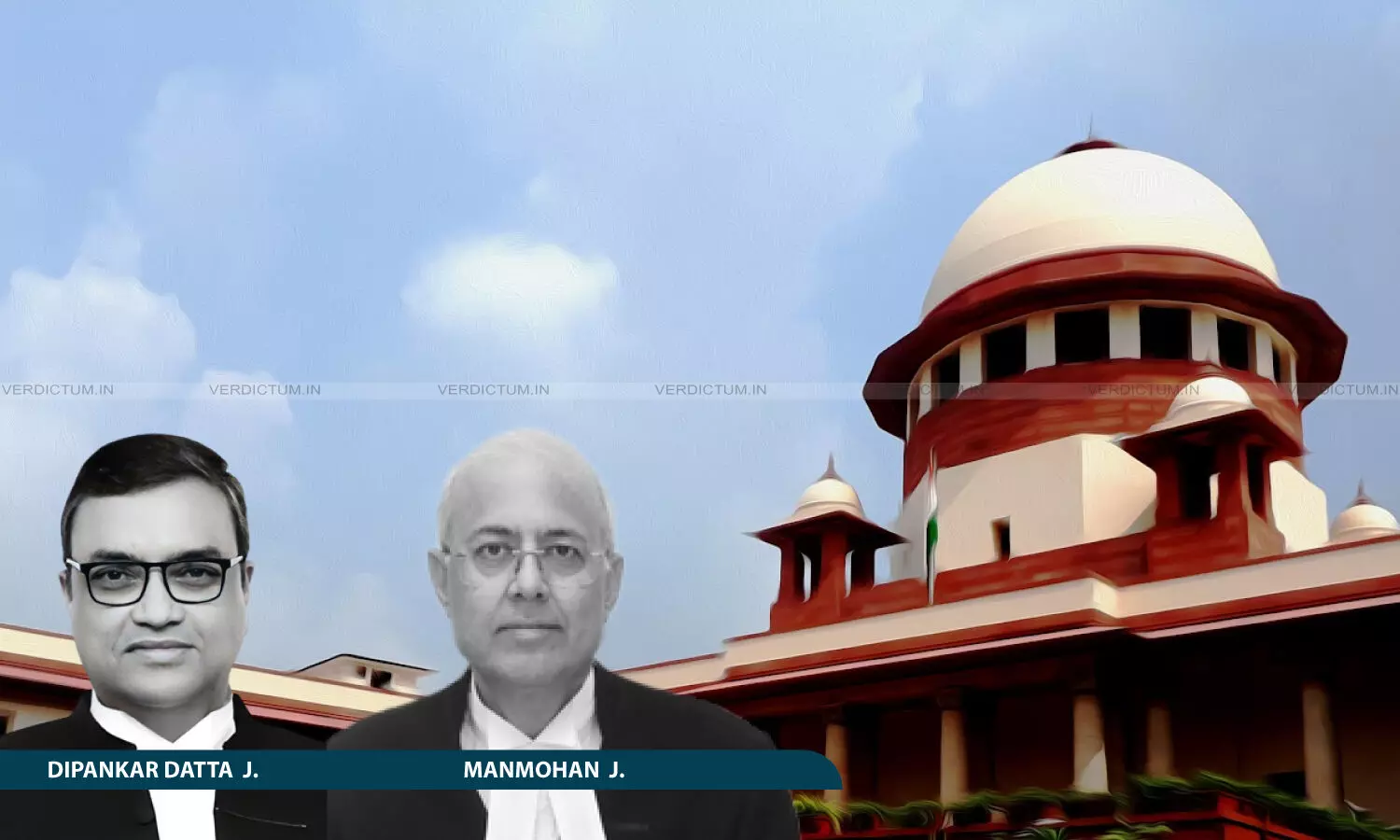
Justice Dipankar Datta, Justice Manmohan, Supreme Court
Burden Of Proof Has To Be Discharged By Petitioner While Questioning Public Office Appointment: Supreme Court On Quo Warranto Writ Petitions
 |
|The Supreme Court was considering an appeal in a controversy pertaining to the Ph. D. degree allegedly awarded by Bundelkhand University to one of the candidates.
The Supreme Court has ordered a probe in a case involving allegations of a fake PhD degree being obtained by an aspirant to the post of Assistant Professor of Physical Education. The Apex Court observed that while questioning an appointment to a public office under the writ of quo warranto on the ground of lack of authority of the appointee to occupy the same, the burden of proof has to be discharged by the writ petitioner by producing unimpeachable evidence in support of his assertion
The Apex Court was considering an appeal in a controversy pertaining to the Ph. D. degree allegedly awarded to the sixth respondent by Bundelkhand University, Jhansi, Uttar Pradesh.
The Division Bench of Justice Dipankar Datta and Justice Manmohan explained, “To seek and succeed in a proceeding for a writ or in the nature of quo warranto, it is absolutely necessary for the writ petitioner, who could even be a stranger, to establish that an appointee, not having the requisite qualification for occupying a public office or suffering from such other disability, thereby attracting a disqualification to hold such office, was appointed and, in the process, has usurped a public office. While questioning an appointment on a public office on the ground of lack of authority of the appointee to occupy the same, the burden of proof has to be discharged by the writ petitioner by producing unimpeachable evidence in support of his assertion. If produced, the onus shifts to the appointer and the appointee to rebut such evidence and convince the Court of there being no illegality, irregularity and/or discrepancy of any nature in the process of such an appointment or lack of any of the essential qualifications of the appointee.”
“This is a fit case, where exercise of power conferred by Article 142 of the Constitution is warranted. Documentary evidence on record does necessitate an inquiry to be conducted by Maharshi Dayanand University against the sixth respondent, once again, for verifying his Ph. D. degree in the light of the disclosures made by Bundelkhand University and to reach a satisfaction that the Ph. D. degree is genuine and that the sixth respondent never deceived it by projecting himself as a Ph. D. degree holder”, it directed.
AOR Shekhar Kumar represented the Appellant while Senior Advocate Naresh Kaushik represented the Respondent.
Factual Background
A vacancy on the post of Assistant Professor of Physical Education was advertised on February 14, 2018, by Sat Jinda Kalyana College, Rohtak, Haryana, affiliated to Maharshi Dayanand University, Haryana. The Appellants, the sixth respondent, and 17 (seventeen) other aspirants had applied for appointment on the said post. After completion of the selection process, the sixth respondent emerged as the most-qualified candidate and was ultimately appointed as Assistant Professor in Physical Education. The Appellants did not, figure in the merit list.
A query regarding the authenticity of the Ph. D. degree of the sixth respondent was made by the first appellant’s brother, and it was revealed that the sixth respondent never attended any Ph. D. course at the University, as no Ph. D. programme was conducted by the University during the years 2011- 2014, when the sixth respondent claimed to have been awarded the degree. The Appellants, while assailing the appointment of the sixth respondent before the High Court, alleged that such appointment had been secured on the strength of a forged Ph. D. degree; and since the sixth respondent had usurped a public office, a writ of quo warranto was prayed.
This petition under Article 226 of the Constitution failed before a Single Judge. An intra-court appeal carried by the appellants before a Division Bench met the same fate. Aggrieved by dismissal of their appeal, the appellants applied for a review together with an application for condonation of delay. The judgment dismissing these applications was subjected to challenge in special leave petitions.
Reasoning
On a perusal of the facts of the case, the Bench noted that qualifying the National Eligibility Test conducted by the UGC or tests accredited by the UGC like SLET/SET remained the mandatory qualification as per the regulations of 2010 with those acquiring a Ph. D. degree in terms of the University Grants Commission (Minimum Standards and Procedure for Award of Ph.D. Degree) Regulations, 2009 being exempted from the requirement of the minimum eligibility condition of NET/SLET/SET for recruitment and appointment of Assistant Professor or equivalent positions in Universities/Colleges/Institutions.
The Bench held that the minimum qualification required for the sixth respondent to be considered for appointment was the UGC-NET Examination. The Bench held that the post of Assistant Professor for which the sixth respondent aspired for appointment did not require, as an essential qualification, a PhD degree and it was a desirable qualification. As per the Bench, it was only those aspirants seeking appointment, not having qualified the NET/SLET/SET, who were required to possess a Ph. D. degree awarded in terms of the UGC Ph. D Regulations, 2009. “
“Any aspirant, having acquired a Ph. D. degree apart from qualifying the NET/SLET/SET, would have been entitled to additional marks of 10 over and above the marks allotted under different other heads. Thus, in the absence of a Ph. D. degree, the aspirants were mandatorily required to qualify the UGC-NET examination which the sixth respondent did, in fact, qualify. Ergo, by no stretch of reasoning can it be concluded that he lacked a mandatory qualification; although, we hasten to observe that it is quite possible that he stole a march over the second and the third candidates in the merit list by dint of marks being awarded for the questionable Ph. D. degree”, it added.
Thus, upholding the impugned appellate judgment and order of the High Court and not disturbing the appointment of the sixth respondent for the time being, resulting in non-grant of any relief to the appellants, the Bench also ordered Maharshi Dayanand University to undertake an inquiry to sift the grain from the chaff.
“It is also made clear that should the outcome of inquiry be unfavourable to the sixth respondent, that is, the Ph. D. degree is found to be a forged document, it shall be open to Maharshi Dayanand University or 11 Sat Jinda Kalyana College or Bundelkhand University or anyone else to lay information before the police to prosecute the sixth respondent for a criminal offence, in accordance with law”, it concluded.
Cause Title: Annu Kumar & Anr. v. Maharshi Dayanand University Rohtak & Ors. (Neutral Citation: 2026 INSC 968)
Appearance
Appellant: AOR Shekhar Kumar
Respondent: Senior Advocate Naresh Kaushik, AOR Vardhman Kaushik, Advocates Dhruv Joshi, Nishant Gautam, Manoj Joshi, Anand Singh, P S Vijayadharni, Shikha Kaushik, D.A.G. Shekhar Raj Sharma, AOR Akshay Amritanshu, Advocates Nidhi Narwal, Srishti Jain, Sarthak Srivastava, Kamal Kumar Pandey, Pawan Kumar Shukla, Pankaj Kumar Singh, AOR Raj Singh Rana, Advocates Vivek Vishnoi, Kanika