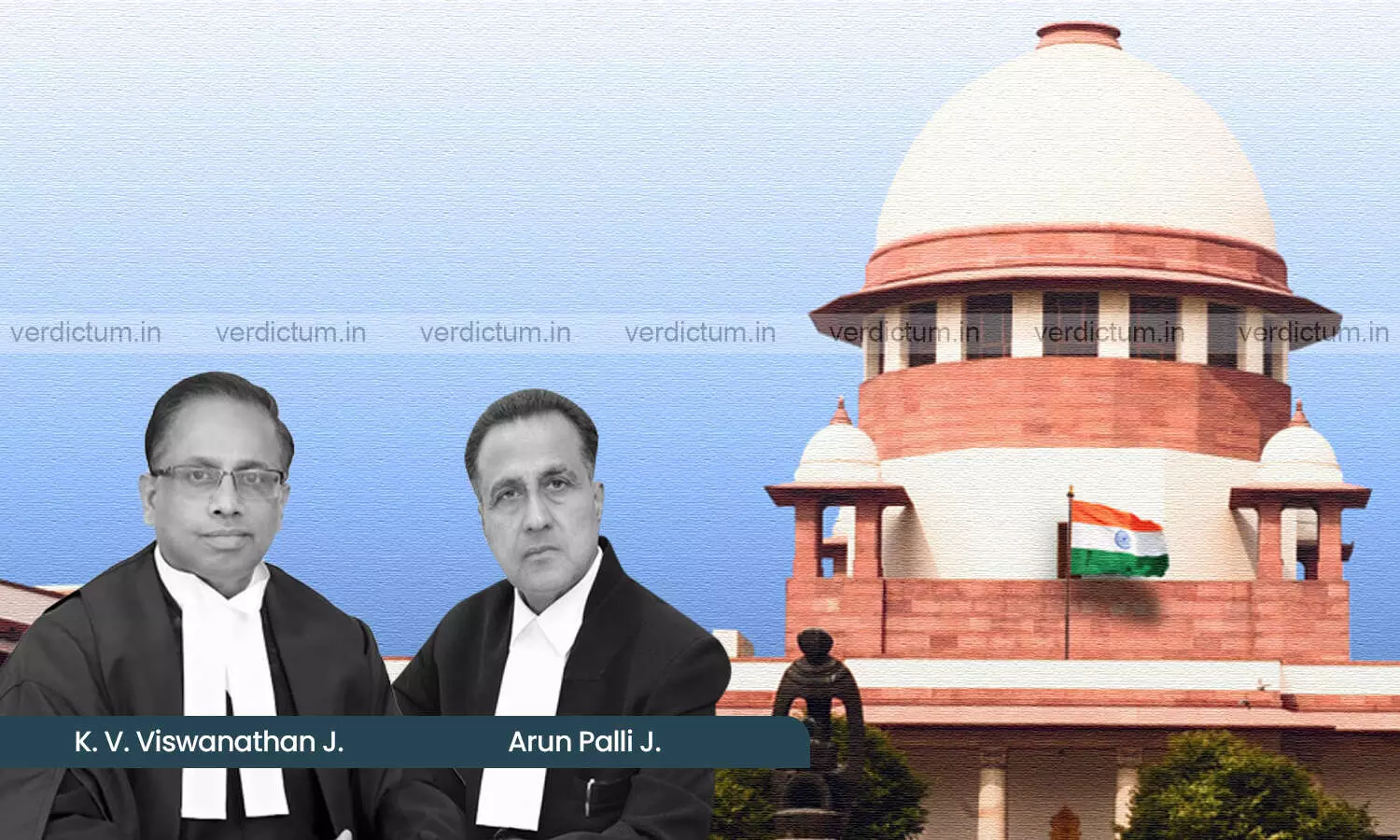
Victim Must Be Party To Settlement For Quashing Criminal Proceedings; Informant’s Settlement Not Enough: Supreme Court
 |
|The Court distinguished compounding from settlement-based quashing and held that even where offences are non-compoundable, proceedings may be quashed if the dispute has a civil flavour and continuing the trial would amount to an abuse of process.
The Supreme Court has held that criminal proceedings cannot be quashed based on a settlement unless the real victim, and not merely an informant who set the criminal law in motion, is a party to the settlement relied upon for quashing under Section 482 of the Code of Criminal Procedure, 1973.
The Court was hearing a criminal appeal against the Madhya Pradesh High Court’s order dismissing a petition under Section 482 CrPC seeking quashment of criminal proceedings arising from a land-related complaint alleging forgery, cheating, criminal breach of trust and conspiracy under the Indian Penal Code, 1860.
A Bench of Justice K.V. Viswanathan and Justice Arun Palli observed: “As has been elucidated hereinabove, to set the criminal law in motion, it need not always be the victim who does it. Disastrous consequences will arise if such informants (who are not victims) are allowed to enter into settlement and the real victim is left in limbo. Hence, what law contemplates is that it is the real victim who has to be a party to the settlement on the basis of which quashment of proceedings are sought under Section 482. Further, the case on which quashment is sought should fall within the parameters of such categories of cases which could be quashed based on parties arriving at a settlement.”
Senior Advocate R. Basant appeared for the appellant; Senior Advocate Meenakshi Arora, Advocate Sankalp Kochar, and Advocate Rajan K. Chaurasia appeared for the respondents.
Background
The criminal complaint alleged that the appellant and other accused had conspired to usurp agricultural land by preparing a forged General Power of Attorney and thereafter creating a partnership deed through which the land was shown as contributed to a partnership firm. The complaint further alleged that part of the land had come to the informant and that mutation in favour of the firm caused loss both to the informant and to respondent No. 2.
The Magistrate took cognisance of offences under Sections 466, 467, 468, 471, 420, 406 and 120B IPC. In the first round before the High Court, the appellant and other accused sought quashing under Section 482 CrPC. The High Court declined relief to the appellant, but recorded that in the absence of documentary evidence, it could not be assumed merely on oral statements that the informant had any interest in the disputed land.
After the case was committed to the Sessions Court and charges were framed under Sections 467, 468 and 471 IPC, the appellant again approached the High Court seeking quashing based on a compromise with respondent No. 2. The compromise affidavit stated that the land had been contributed to the partnership firm, the formalities and mutation had been carried out as instructed, no consideration had passed in favour of the informant for the claimed 7.50 acres, and respondent No. 2 had no grievance against the accused.
The High Court dismissed the petition, holding that the complainant/informant had not entered into settlement and that quashing could not be sought only based on a compromise between the accused and respondent No. 2, who was described as a witness to the complaint. Before the Supreme Court, the appellant submitted that the High Court had wrongly treated the case as one of compounding rather than settlement-based quashing, while the informant and the State opposed the appeal.
Court's Observations
The Court first clarified that compounding and settlement-based quashing operate in different fields. Referring to Section 359 of the Bharatiya Nagarik Suraksha Sanhita, 2023, corresponding to Section 320 CrPC, the Court observed: “At the very outset, it has to be highlighted that ‘compounding of offence’ and ‘Quashing of offence due to a settlement’ are two different concepts.”
Relying on Naushey Ali and Others v. State of Uttar Pradesh and Anr. (2025) and Gian Singh v. State of Punjab (2012), the Court noted that while compounding is controlled by the statutory provision, quashing depends on whether conviction is likely despite settlement and whether continuation of proceedings would amount to abuse of process.
The Court also reiterated the limitation on settlement-based quashing, observing that “merely because there is a settlement, for certain categories of offences, proceedings will not be quashed.” It added that the carve-out applies to crimes having harmful effects on the public and wrongdoing that seriously endangers society.
The Court then examined the distinction between a victim and an informant. Referring to Jagjeet Singh and Others v. Ashish Mishra alias Monu and Another (2022), it observed that criminal law does not require the victim alone to lodge information.
The Bench quoted the principle that “‘victim’ and ‘complainant/informant’ are two distinct connotations in criminal jurisprudence. It is not always necessary that the complainant/informant is also a ‘victim’, for even a stranger to the act of crime can be an ‘informant’, and similarly, a ‘victim’ need not be the complainant or informant of a felony.”
The Court held that for quashing based on settlement, the settlement must be with the person who suffered loss or injury. It referred to the definitions of “victim” under Section 2(wa) CrPC and Section 2(y) of the BNSS.
The Court further observed: “Though the offences in our case are non-compoundable, the above Chart is only to highlight that it is only the victim, namely, the person who has suffered loss or injury, who could settle with the accused.”
On the facts, the Court found that respondent No. 2 was a victim because the substratum of the complaint was that his signature had been forged and that, on that basis, the partnership was created and mutation was obtained.
The Bench held: “There is no manner of doubt that Pradeep Singh Mehta-Respondent No. 2 is indeed a victim. A careful perusal of the complaint, which has been dealt with in detail hereinabove, clearly brings out this fact.”
After examining the sworn statement and the subsequent compromise affidavit, the Court recorded that respondent No. 2 did not want the proceedings to continue. It observed: “In the teeth of this affidavit, we are convinced that Pradeep Singh Mehta, who being the star witness, would be of no support to the prosecution. The writing is clearly on the wall.”
The Court was satisfied that the settlement fell within the parameters laid down in Gian Singh v. State of Punjab (2012). It found that the dispute was personal in nature and did not have repercussions on society in general.
The Court observed: “The offences alleged have a civil flavour with commercial overtones. In the face of settlement, chances of conviction are bleak.”
The Court separately examined whether the informant was also a victim. It noted the earlier High Court finding that there was no documentary evidence to show the informant’s interest in the land.
The Bench observed: “We will proceed on the basis that Subhash Chandra Lalwani-Respondent No. 3 was indeed a victim. But the question is whose victim was he?”
Considering the complaint and the affidavit of respondent No. 2, the Court found that the informant could not continue the prosecution against the appellant and other accused. It held: “Considering the overall facts and circumstances and in the teeth of the affidavit of Pradeep Singh Mehta, on these facts we are of the opinion that allowing the complainant to prosecute the appellant and the other accused would be an abuse of process.”
Conclusion
The Supreme Court allowed the appeal and set aside the Madhya Pradesh High Court’s order dismissing the Section 482 CrPC petition. It quashed the complaint pending trial before the Second Additional Sessions Judge, Bhopal, against all arrayed accused. The Court also held that, in view of its judgment, nothing further survived in the pending criminal revision before the High Court, which stood dismissed.
Cause Title: Anand Kumar @ Sanjay Lalwani v. The State of Madhya Pradesh and Ors. (Neutral Citation: 2026 INSC 928)