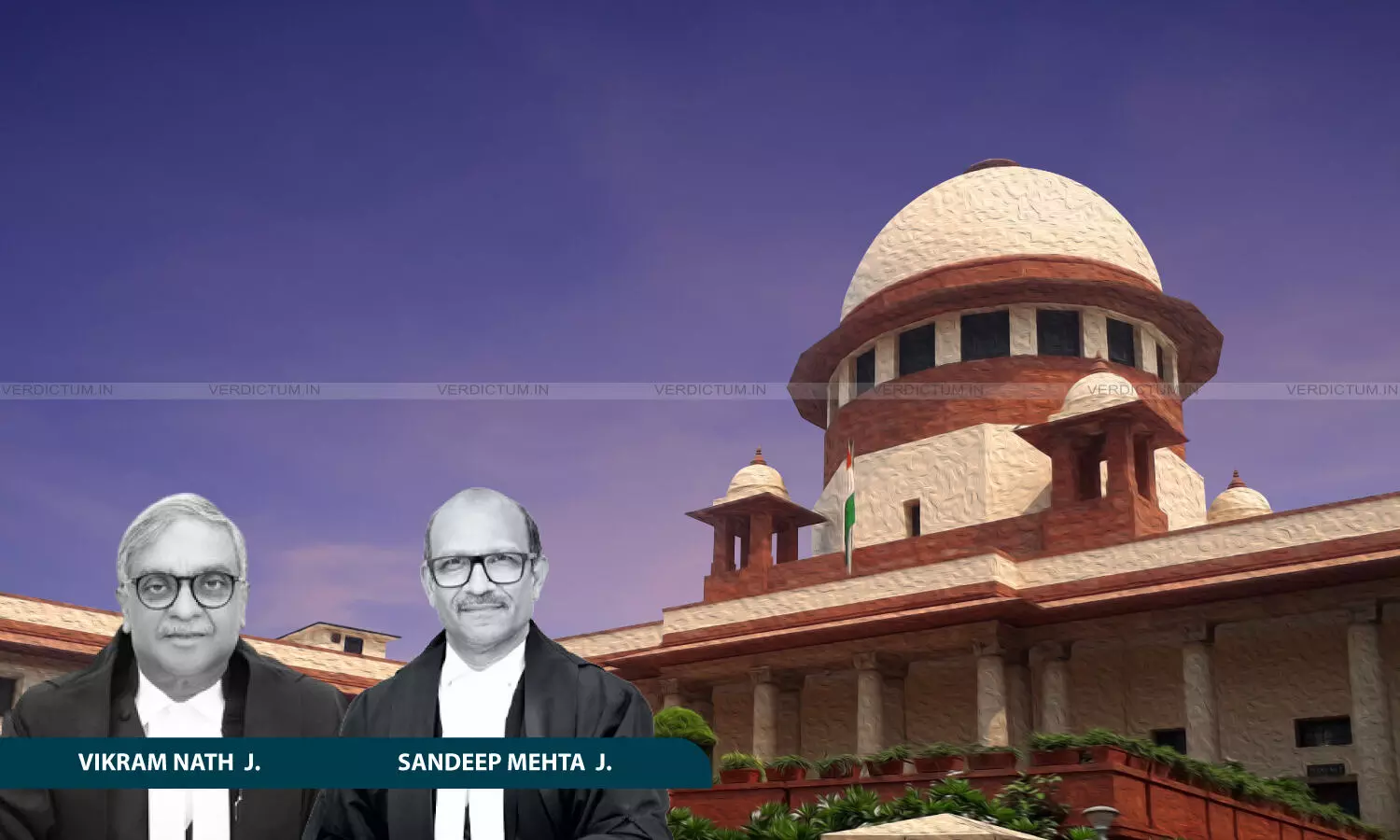
Justice Vikram Nath, Justice Sandeep Mehta, Supreme Court
Supreme Court Orders Time-Bound Clearance Of Encroachments Across Agasthyamalai Landscape; Directs Closure Of Resorts, Deployment Of Forces
 |
|The Court observed that the Agasthyamalai landscape is a globally significant biodiversity hotspot and held that ecological protection cannot be indefinitely deferred on account of administrative or political challenges.
The Supreme Court has issued extensive directions for the removal of encroachments, dismantling of illegal infrastructure and restoration of forest land across the Agasthyamalai landscape in Tamil Nadu and Kerala, observing that the ecologically sensitive region is a globally significant biodiversity hotspot requiring urgent institutional protection.
The Court held that despite measures initiated by the State of Tamil Nadu, the pace and scale of compliance remained significantly below the threshold demanded by the gravity and urgency of the situation.
The Court was hearing appeals concerning the preservation of Reserve Forests, Wildlife Sanctuaries and Tiger Reserves in Tamil Nadu, along with issues relating to the rehabilitation of displaced tea estate workers evicted from the Bombay Burma Trading Corporation Limited (BBTCL) estate after the area was declared a Reserved Forest, Wildlife Sanctuary and Tiger Reserve under the Wild Life (Protection) Act, 1972.
A Bench of Justice Vikram Nath and Justice Sandeep Mehta observed: “The Agasthyamalai landscape is not merely another protected area, it is a globally significant biodiversity hotspot, home to flagship species including the tiger, elephant, leopard, Indian Gaur sloth bear, Nilgiri langur, Great Indian Hornbill, and numerous other endangered species.”
The Bench further observed: “… despite the steps taken by the State, the matter requires a structured, time-bound and closely monitored framework to ensure effective implementation and consequences for noncompliance. The assurances and commitments made in the reply affidavit must translate into concrete, measurable and verifiable action on the ground through effective monitoring, institutional accountability and sustained enforcement”.
Senior Advocate K. Parameshwar appeared as Amicus Curiae. Advocate Purnima Krishna appeared on behalf of the appellant. Solicitor General Tushar Mehta and Additional Solicitor General Aishwarya Bhati appeared for the Union. Advocate General Vijay Narayan appeared for the State of Tamil Nadu.
Background
The proceedings arose from issues concerning ecological preservation and protection of wildlife habitats in the Agasthyamalai landscape, covering Reserve Forests, Wildlife Sanctuaries and Tiger Reserves spread across Tamil Nadu and Kerala.
Earlier, the Supreme Court had directed the Central Empowered Committee to conduct an extensive survey of the entire Agasthyamalai landscape, including the Periyar Tiger Reserve, Srivilliputhur Grizzled Squirrel Wildlife Sanctuary, Meghamalai and Thirunelveli Wildlife Sanctuaries, and identify instances of non-forestry activities contrary to environmental statutes.
Pursuant to these directions, the CEC submitted reports documenting widespread encroachments, illegal infrastructure, non-forestry activities and degradation of ecologically sensitive areas within the Srivilliputhur-Megamalai Tiger Reserve, Kalakad-Mundanthurai Tiger Reserve and Kanyakumari Wildlife Sanctuary.
The CEC found that more than 4,600 encroachers had occupied over 5,000 hectares of Reserved Forest land in the Srivilliputhur-Megamalai Tiger Reserve alone, while numerous government structures and illegal resorts existed inside forest areas without approvals under the Forest (Conservation) Act, 1980.
The reports further identified 118 serving or retired government employees as encroachers, including personnel from the Army, Police, CRPF, Forest Department, Revenue Department and other government services.
The State of Tamil Nadu filed a detailed affidavit acknowledging challenges in eviction operations, including resistance from encroachers, ongoing litigation, difficult terrain and law-and-order issues, while also placing on record steps taken for rehabilitation, resettlement and ecological restoration.
Court’s Observation
The Supreme Court observed that the present proceedings concerned not merely regulatory compliance but struck “at the very heart of environmental governance” and the constitutional obligation of the State to preserve ecologically sensitive regions, fragile ecosystems and endangered wildlife.
Referring to T.N. Godavarman Thirumulpad v. Union of India (2025), the Court reiterated that conservation must adopt an eco-centric rather than anthropocentric approach and that constitutional courts are duty-bound not only to prevent ecological degradation but also to ensure restoration of damaged ecosystems.
The Bench took note of the State’s acknowledgement of the seriousness of the situation and recognised several measures initiated towards ecological restoration, including rehabilitation schemes, eviction efforts, relocation of government facilities and retrieval of portions of encroached forest land.
However, the Court found that the overall pace of implementation remained grossly inadequate. The Bench observed that encroachments had persisted for decades despite repeated directions of the Madras High Court, orders of the Supreme Court and recommendations of expert bodies, including the CEC.
The Court noted that only 66 out of more than 4,600 encroachers in the Srivilliputhur-Megamalai Tiger Reserve had been relocated and only 52.86 hectares out of over 5,000 hectares under encroachment had been effectively recovered. The Court held that these “meagre figures” did not reflect progress commensurate with the gravity of the situation.
The Bench further expressed concern over delays in survey and demarcation exercises, observing that procedural prerequisites such as drone surveys could not be used as justification for indefinite postponement of eviction action in areas where boundaries were already clearly established and legal proceedings had concluded in favour of the Forest Department.
The Court also criticised the continued operation of government facilities within encroached forest areas, including Public Distribution System shops and Anganwadi centres. The Bench observed that even limited continuation of such services legitimised illegal occupation and undermined relocation efforts.
Regarding government employee encroachers, the Court held that encroachment upon protected forest land by persons holding public office constituted a particularly grave dereliction of duty warranting urgent disciplinary and legal action. The Court directed that the removal of such encroachments must be completed before the next date of hearing.
The Bench additionally examined the issue concerning Bombay Burma Trading Corporation Limited and noted that although more than 97% of leased forest land had been handed back to the Forest Department, the State proposed retaining substantial permanent infrastructure, including offices, bungalows, labour houses and religious structures within the Tiger Reserve. The Court found such a proposal difficult to reconcile with the objective of comprehensive habitat restoration.
The Court also referred to the ecological importance of the Agasthyamalai landscape, observing that the Srivilliputhur-Megamalai Tiger Reserve had been identified by the National Tiger Conservation Authority as a critically affected tiger reserve facing threats from the cotton-silk mafia, commercial cattle grazing and ganja cultivation.
The Bench observed that the Kalakad-Mundanthurai Tiger Reserve constituted the critical catchment area of the Thamirabarani River serving millions of people in southern Tamil Nadu and that restoration of natural forest cover was imperative for biodiversity, water security and ecological balance.
The Supreme Court nevertheless acknowledged the humanitarian dimension of the issue and recognised that many encroachers had lived in forest areas for decades under circumstances not entirely attributable to them, including displaced dam workers and economically vulnerable communities. The Court endorsed the State’s categorisation-based rehabilitation framework but clarified that humanitarian considerations could not justify the indefinite postponement of legally mandated eviction and restoration measures.
Directions Issued By The Court
The Supreme Court issued a comprehensive set of directions requiring the preparation of a time-bound, division-wise encroachment eviction plan with measurable milestones and officer-level accountability.
The Court directed that the eviction plan must include physical eviction, rehabilitation measures, legal action against wilful violators and post-eviction ecological restoration to prevent re-encroachment.
The Bench ordered disciplinary and legal action against all 118 identified government servant encroachers and further directed consideration of additional penalties and environmental restitution charges to be deposited with the Tamil Nadu CAMPA fund for ecological restoration.
The Court imposed a blanket moratorium on welfare schemes, public utilities, transport facilities, electricity supply and infrastructure support within encroached forest areas.
The Court further prohibited approval or commencement of any new non-forestry activity or diversion proposal within the Agasthyamalai landscape until all encroachments were removed and illegal infrastructure dismantled in accordance with law.
The Bench directed stringent disciplinary, penal and criminal action against officials responsible for illegal infrastructure works within forest areas and ordered the filing of status reports before the CEC.
The Court additionally directed closure and dismantling of all illegal resorts, commercial establishments and tourism-related infrastructure operating within Megamalai and other forest lands, along with immediate disconnection and removal of electricity connections and transmission lines servicing such encroachments.
The Supreme Court also directed the Forest Survey of India to undertake a survey, demarcation, geo-referencing and digitisation of the entire boundaries of the Kalakad-Mundanthurai Tiger Reserve, Srivilliputhur-Megamalai Tiger Reserve and Kanyakumari Wildlife Sanctuary within six months.
The Court clarified that in the event of failure by the State Government to ensure compliance, the CEC may recommend deployment of paramilitary forces to assist in the removal of encroachments.
Conclusion
The Apex Court directed the States to submit monthly compliance reports to the CEC and further directed the CEC to undertake ground verification and submit quarterly status reports before the Supreme Court until all directions are fully complied with to the satisfaction of the Court.
The matter has been directed to be listed for further hearing as part-heard after submission of the CEC report.
Cause Title: A. John Kennedy & Ors. v. State of Tamil Nadu & Ors. (Neutral Citation: 2026 INSC 605)
Appearances
Appellants: Advocates Purnima Krishna, M.F. Philip, Karamveer Singh Yadav, Togin M. Babichen, Prasanna S., Injila Muslim Zaidi, Maamidi Ashish Reddy, Prasanna B and Ishita Tulsyan.
Respondents: Senior Advocate K. Parameshwar (Amicus Curiae), Solicitor General Tushar Mehta, Additional Solicitor General Aishwarya Bhati, Advocate General Vijay Narayan, Advocates Gurmeet Singh Makker, Sarthak Karol, Aaditya Dixit, Shantnu Sharma, Bhuvan Kapoor, Rohan Gupta,