
Breaking: Supreme Court To Examine Validity Of 2026 Transgender Amendment Act; Issues Notice To Centre And States
 |
|A three-judge bench will review the controversial law that replaces the right to self-identification with mandatory medical board evaluations.
The Supreme Court has issued notices to the Union of India and all State Governments regarding a batch of writ petitions challenging the Transgender Persons (Protection of Rights) Amendment Act, 2026.
The petitions argued that the new legislation is unconstitutional and "ultra vires" as it systematically dismantles the landmark NALSA (2014) judgment by stripping away the fundamental right to self-perceived gender identity.
During the proceedings, the bench acknowledged the gravity of the shift from self-recognition to state-sanctioned medical gatekeeping and referred the matter to a larger 3-judge bench for detailed adjudication.
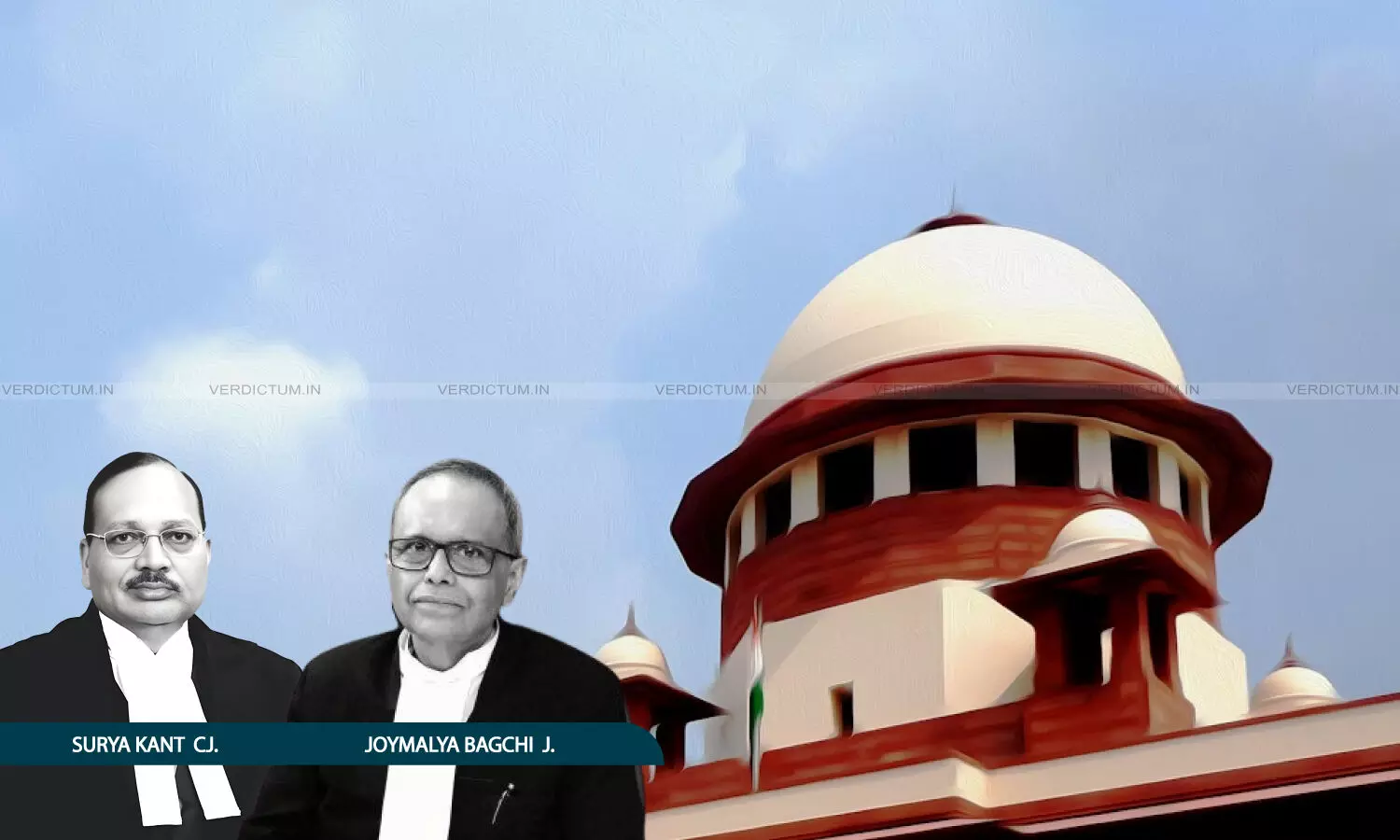
The Bench of Chief Justice Surya Kant and Justice Joymalya Bagchi ordered, "Issue notice. Returnable in four weeks. Notice on behalf of Union of India is accepted. Notice to all the States and Union Territories. Matter may be listed before a 3-Judge bench as considered by the Chief Justice of India."
Senior Advocate Manusinghvi and Senior Advocate Arundhati Katju appeared for the Petitioners, while Solicitor General Tushar Mehta appeared for the Union of India.
During the proceedings, Senior Advocate A.M. Singhvi, representing the petitioners, highlighted a critical shift in the law that moves away from the principle of self-identification toward a model of medical and bureaucratic gatekeeping.
Singhvi categorized the impacted individuals into two primary groups to explain the practical hurdles created by the 2026 Amendment: Category 1: Intersex Variations: These are individuals born with biological variations (chromosomal, hormonal, or genital) that do not fit typical binary definitions. Singhvi noted that while these individuals have a biological basis for their identity, the Act now conflates them with the broader transgender category while simultaneously stripping away their right to self-identify.
Category 2: Psychological and Lived Identity: These are individuals born as "healthy" males or females (as the CJI noted) but whose mental and psychological makeup aligns with another gender. This group includes those who may have expressed this identity since childhood through dressing or behavior and later choose to undergo Gender Affirming Surgery (GAS), such as breast augmentation or phalloplasty/vaginoplasty.
Senior Advocate Singhvi said, "The third issue is of constitutional importance. You cannot simply nullify a judgment; while the legislature can remove the legal basis of a judgment, it cannot outright nullify it. In this case, the NALSA judgment has been nullified without an attempt to address or remove the underlying legal basis."
Justice Bagchi replied, "You cannot say that categorically. What you can say is that the amendment should be examined in the light of Article 21. This amendment has changed the substratum of the law under which NALSA examined the issue. Consequently, self-identification has been replaced with medical evaluation."
Singhvi replied, "If I am undergoing therapy now, by way of this Act, it becomes illegal."
Solicitor General Mehta intervened and said, "There are cases of castration as well. The Amendment only prohibits the forceful change of gender."
Singhvi argued that the 2026 Act effectively prohibits self-recognition. Under the new law, if an individual identifies as transgender and seeks medical transition, hospitals are reportedly refusing to proceed because the Act mandates a state-sanctioned medical board’s recommendation before such an identity—and the subsequent surgeries—can be legally recognized.
Senior Advocate Katju submitted that the persons who are receiving hormonal therapy have had their therapy stopped abruptly.
The plea was filed seeking, "a) Issue an appropriate writ, order or direction in the nature of certiorari, and/or declaration, declaring the Transgender Persons (Protection of Rights) Amendment Act, 2026 (No. 3 of 2026) unconstitutional, ultra vires, null and void in its entirety, as being violative of Articles 14, 15, 19, and 21 of the Constitution of India, read with the constitutional principles affirmed in NALSA v. Union of India, (2014) 5 SCC 438 and India's obligations under the ICCPR, the ICESCR, and the UDHR as read through Article 21 of the Constitution..."
Further it was prayed, "b) In the alternative, and without prejudice to prayer (a) above, issue an appropriate writ, order, or direction declaring the following provisions of the Transgender Persons (Protection of Rights) Act, 2019 as amended by the Impugned Amendment Act, unconstitutional, ultra vires, and void: the substituted Section 2(k) and its Proviso; the deletion of Section 4(2); the amended Section 6(1); the amended Section 7(1), the newly inserted Section 7(1A), and the deleted Section 7(3) Proviso; the amended Section 16; and the replaced Section 18 to the extent it retains a two-year maximum for offences including sexual abuse against transgender persons; c) Issue an appropriate writ, order, or direction declaring that the right to self-identification of gender, as recognised by this Hon'ble Court in NALSA v. Union of India, (2014) 5 SCC 438, is a fundamental right under Article 21 of the Constitution that no legislation may make conditional upon bureaucratic certification, medical procedure, surgical intervention, or any clinical gateway of the State's choosing;"
The petition also sought direction declaring that all certificates of identity lawfully obtained by transgender persons under the Transgender Persons (Protection of Rights) Act, 2019, prior to the commencement of the Impugned Amendment Act, shall remain valid and shall not be invalidated, revoked, or rendered ineffective by any provision of the Amendment Act, and that the rights and entitlements flowing from those certificates shall continue in full force.
Furthermore, a writ of mandamus was prayed directing Respondent No. 1-Union of India to place before Parliament within a period of this Hon'ble Court may specify, comprehensive legislation in conformity with the constitutional mandate of NALSA, the Yogyakarta Principles (2006) and Yogyakarta Principles Plus 10 (2017), and international best practices, providing for: self-identification oas the sole basis for gender recognition; reservation in education and public employment; comprehensive in education and public employment; comprehensive anti-discrimination protections with proportionate penalties; marriage, civil union, adoption, and inheritance rights; and an independent statutory commission for transgender persons.
"Issue a writ of mandamus directing the Respondent No. 1 to give effect to the reservation directions issue by this Hon'ble Court in NALSA vs. Union of India, (2014) 5 SCC 438, by treating transgender persons as socially and educationally backward classes entitled to reservation in educational institutions and public employment under Articles 15(4) and 16(4) of the constitution", it said.
The Transgender Persons (Protection of Rights) Amendment Act, 2026, represents a significant and controversial shift in India's legal landscape regarding gender identity. Passed by Parliament in late March 2026 and receiving Presidential assent shortly after, the Act primarily rolls back the principle of "self-identification" that was established by the Supreme Court’s 2014 NALSA judgment.
The most critical change is the deletion of the right to self-perceived gender identity. Under the original 2019 Act, a person could obtain a transgender certificate based on their internal sense of self. The 2026 Amendment mandates that a Medical Board, typically headed by a Chief Medical Officer, must examine and recommend an applicant before a District Magistrate can issue an identity certificate.
The Amendment also introduces mandatory reporting and surveillance mechanisms. Hospitals and medical institutions are now required to report details of all gender-affirming surgeries to the District Magistrate and the Medical Board.
Cause Title: Laxmi Narayan Tripathi v. Union of India and other connected matters. [W.P.(C) No. 548/2026]