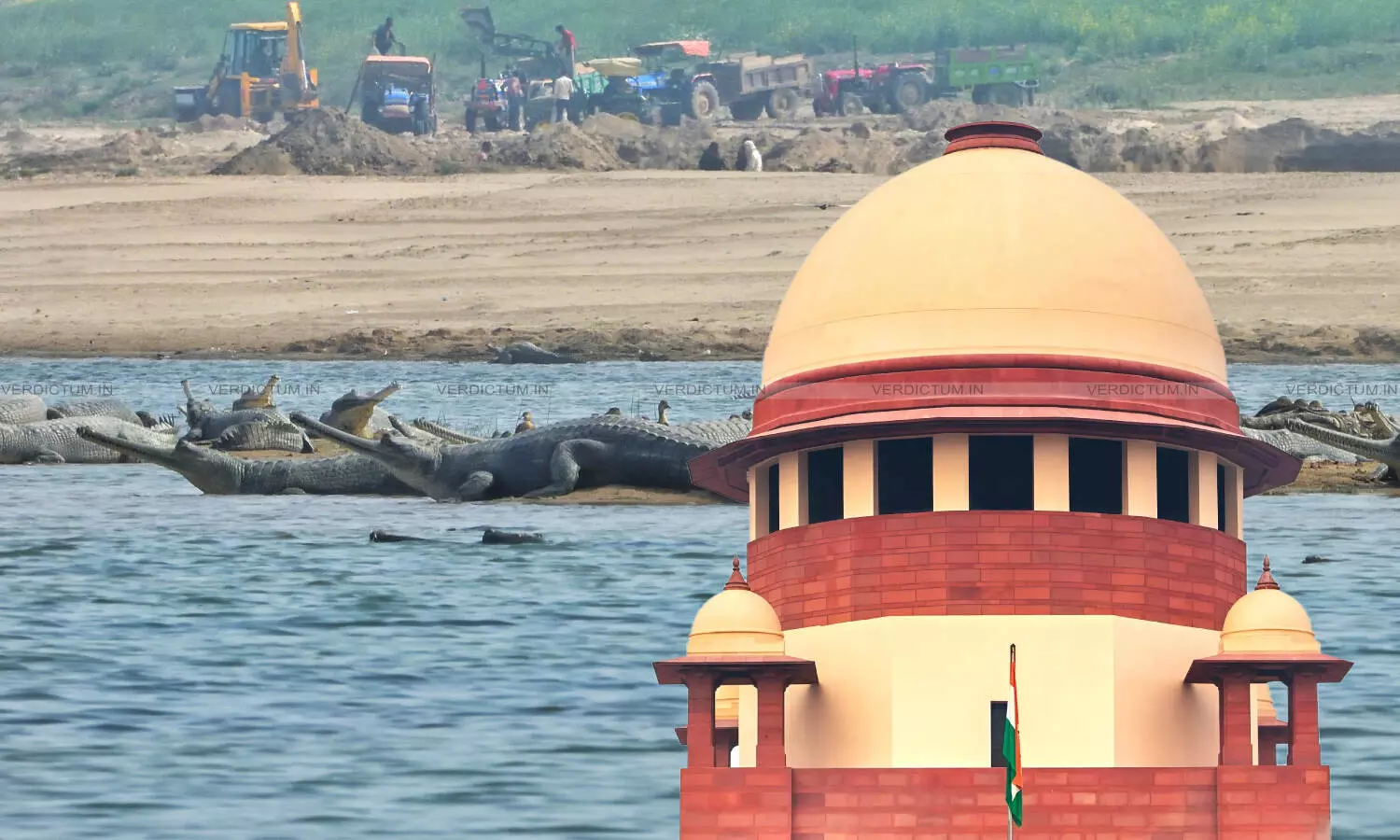
Duties Discharged By Forest Officers Are Highly Dangerous Tasks, Intrinsically Connected Within Public Order Under Section 218(3) Of BNSS: Supreme Court
 |
|The Court directed the states of MP, Rajasthana nd Uttar Pradesh to protect the frontline forest staff under Section 218(3) of the BNSS against sand mining cartels in the National Chambal Sanctuary.
The Supreme Court held that the duties performed by frontline Forest Officers and Forest Guards within the National Chambal Gharial Sanctuary extend far beyond forest conservation and constitute highly dangerous tasks intrinsically connected with the maintenance of public order.
The Court directed the States of Madhya Pradesh, Rajasthan, and Uttar Pradesh to immediately issue notifications under Section 218(3) of the Bharatiya Nagarik Suraksha Sanhita, 2023, recognizing that the duties of frontline forest staff safeguarding the National Chambal Gharial Sanctuary are intrinsically connected with maintaining public order.
The Court warned that failure on the part of district administrations to enforce its comprehensive enforcement and monitoring directives would invite strict departmental action and legal proceedings for wilful non-compliance.
The Bench of Justice Vikram Nath and Justice Sandeep Mehta held, "The duties discharged by Forest Officers and Forest Guards within the National Chambal Gharial Sanctuary are not confined merely to protection of forests and wildlife. These personnel are entrusted with the highly dangerous task of safeguarding ecologically fragile and strategically significant wildlife habitats from organised illegal sand mining, poaching, and other unlawful activities, which have serious ramifications not only for the survival of endangered species and the preservation of the forest and pristine ecosystem, but also for public safety, the integrity of public infrastructure and the maintenance of law and order."
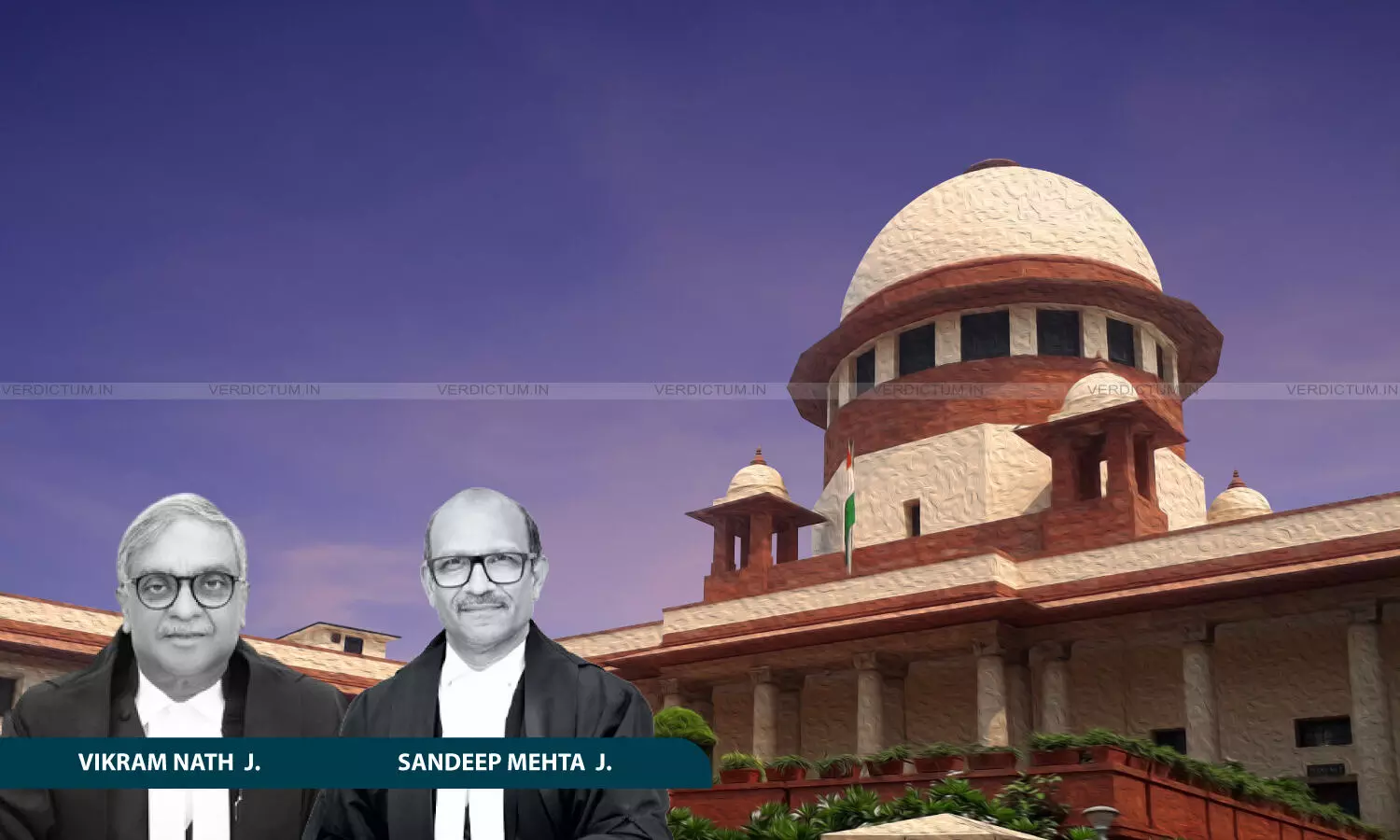
Senior Advocate Nikhil Goel appeared as Amicus Curiae, while ASG S.V. Raju appeared for the Respondents.
It added, "The discharge of such functions is, in our prima facie opinion, intrinsically connected with the maintenance of public order within the meaning of Section 218(3) of the Bharatiya Nagarik Suraksha Sanhita, 2023. In this background, and bearing in mind the increasing attacks, intimidation and obstruction faced by frontline Forest personnel in the bona fide discharge of their official duties, we direct the States of Madhya Pradesh, Rajasthan and Uttar Pradesh to issue the requisite notifications under Section 218(3) of the Bharatiya Nagarik Suraksha Sanhita, 2023 before the next date of hearing and place the same on record by filing appropriate compliance affidavits."
The suo motu Writ Petition (WP) came to be registered based on certain news reports pertaining to rampant illegal mining on the sand banks of the Chambal River, thereby destroying the habitats of the protected species of Gharial.
The news reports give a vivid description of the destruction of the habitat of various aquatic animals in addition to that of Gharials. Further, the news reports also refer to the de-notification of 732 hectares from the National Chambal Sanctuary by the State of Rajasthan as part of a boundary rationalization exercise.
On April 17, 2026, the Court laid down a rigorous legal and operational framework to tackle organized illegal mining in the National Chambal Sanctuary. The Court directed State Pollution Control Boards to recover environmental compensation from violators for ecological restoration.
On May 17, 2026, the Court impleaded the National Highways Authority of India (NHAI) in the matter, asked the authorities from the Mines Department and the Transport and Road Safety Department, State of Rajasthan, to file a compliance affidavit and be present in the court on the next date of hearing.
On May 26 2026, the court had issued directions regarding surveillance, recruitment, enforcement, and bridge protection. Thereafter, compliance affidavits, status reports, and the Third Report of the Central Empowered Committee (CEC) dated 20th July 2026 were submitted before the court.
Observations of the Court
The court placed its imprimatur on the undertaking given by the MOEF&CC and directed strict adherence to it. It expressed satisfaction with the progress in surveillance made by Madhya Pradesh and Rajasthan, but expressed dissatisfaction with the lack of budgetary allocations and progress shown by the State of Uttar Pradesh.
The court observed that none of the States appeared to have seriously considered invoking preventive detention laws against kingpins and habitual offenders of illegal sand mining.
It was noted that the discharge of functions by frontline Forest Officers within the sanctuary was intrinsically connected with the maintenance of public order, justifying protection under Section 218(3) of the BNSS, 2023.
The court found that the NHAI took substantial steps but failed to provide a concrete, time-bound schedule for completion.
The court deferred consideration of the CEC's 18th recommendation regarding the expansion of the suo motu scope to evolve a national framework.
Directions of the Court
1. Affidavits and Responses: The Court directed the Chief Secretaries of Madhya Pradesh, Rajasthan, and Uttar Pradesh to file comprehensive compliance affidavits responding to the findings and recommendations of the CEC's Third Report before the next date of hearing.
2. BNSS Notifications: It directed all three States to issue notifications under Section 218(3) of the Bharatiya Nagarik Suraksha Sanhita, 2023, protecting frontline forest personnel before the next date of hearing.
3. NHAI Schedule: It further directed the NHAI to place on record an additional affidavit containing a definite timeline for the completion and operationalisation of all surveillance and protective measures.
4. Joint SOP and Institutional Reforms: The Court directed Rajasthan and Uttar Pradesh to examine adopting a Joint Standard Operating Procedure (SOP) similar to District Morena. Directed all three States to examine notifying revenue lands within the sanctuary as Protected Forests, formulating dedicated welfare schemes, and establishing M-Sand units.
5. Administrative Accountability: It also designated the District Magistrate of every district in the sanctuary as the Nodal Officer, and made the Superintendent of Police responsible for dismantling illegal networks and registering criminal cases. Directed that APARs of key officers be modified to evaluate performance in preventing illegal mining.
6. Enforcement & Monitoring: The Court directed fortnightly joint inspections by revenue and forest officials, surprise bi-weekly joint operations with video recording, and monthly review meetings by Chief Secretaries.
7. Financial & Criminal Action: It said that cases involving large-scale syndicates be referred to the Enforcement Directorate, Income Tax Department, and FIU. Directed the designation of Special Public Prosecutors, filing of chargesheets ordinarily within 60 days, recovery of environmental compensation based on the 'Polluter Pays' principle, and confiscation of offending vehicles.
8. Grievance Redressal & Transparency: The Court directed the establishment of a QR Code-based Integrated Public Reporting Mechanism and an online public dashboard displaying case and enforcement data.
9. Independent Oversight: Finally, the Court directed the constitution of an Independent Monitoring Committee to conduct bi-annual inspections, along with monthly satellite and drone surveys during the dry season.
"Repeated failure of any district administration to implement the directions issued by this Court, despite adequate resources having being made available and appropriate opportunities having been afforded for compliance, shall be viewed seriously and may be construed as wilful non-compliance. In such an event, the defaulting officers may be proceeded against in accordance with law", it observed.
It also observed that the eighteenth recommendation of the Central Empowered Committee (CEC) pertained to expanding the scope of the present suo motu proceedings to evolve a uniform national framework for protecting riverine protected areas against illegal sand mining. Considering that the recommendation raised issues of significant importance with wider ramifications beyond the National Chambal Gharial Sanctuary, the Court deferred its consideration on the matter.
The Court directed that the question of enlarging the scope would be considered on the next date of hearing, after the responses of the concerned States, NHAI, and MOEF&CC were placed on record.
Previously, the Court reserved its orders in the present matter. The Court, on April 2, 2026, granted an interim stay on a December 2025 notification by the State of Rajasthan that sought to denotify 732 hectares of sanctuary land for boundary rationalization.
The Court had also slammed the State of Madhya Pradesh for inaction in the death of a forest guard. The Court had suggested putting high-resolution cameras and a GPS monitor tracking system on all the vehicles, including loaders, tippers, excavators, etc.
On March 20, the Court remarked that the officials of departments of Forest, Mining, and Water Resources, as well as the police authorities of the states of Rajasthan, Madhya Pradesh, and Uttar Pradesh, by their lethargy and inaction, would be liable to be held vicariously liable for aiding and abetting the destruction of these precious habitats by allowing illegal sand mining to continue at the National Chambal Sanctuary.
Cause Title: Cause Title: In Re: Illegal Sand Mining In The National Chambal Sanctuary And Threat To Endangered Aquatic Wildlife [Neutral Citation: 2026 INSC 745]
Appearances:
Amicus Curiae: Senior Advocate Nikhil Goel
Respondents: Additional Solicitor General S.V. Raju, Additional Advocate General & Senior Advocate Manisha T. Karia, Additional Advocate General D.S. Parmar, Government Advocate Sarthak Raizada, Advocate on Record Harmeet Singh Ruprah, Advocate Karan Singh, Advocate Nilesh Yadav, Advocate Aryansh Shukla, Additional Solicitor General Aishwarya Bhati, Additional Advocate General Shiv Mangal Sharma, Advocate on Record Saurabh Rajpal and others.
Click here to read/download the Order