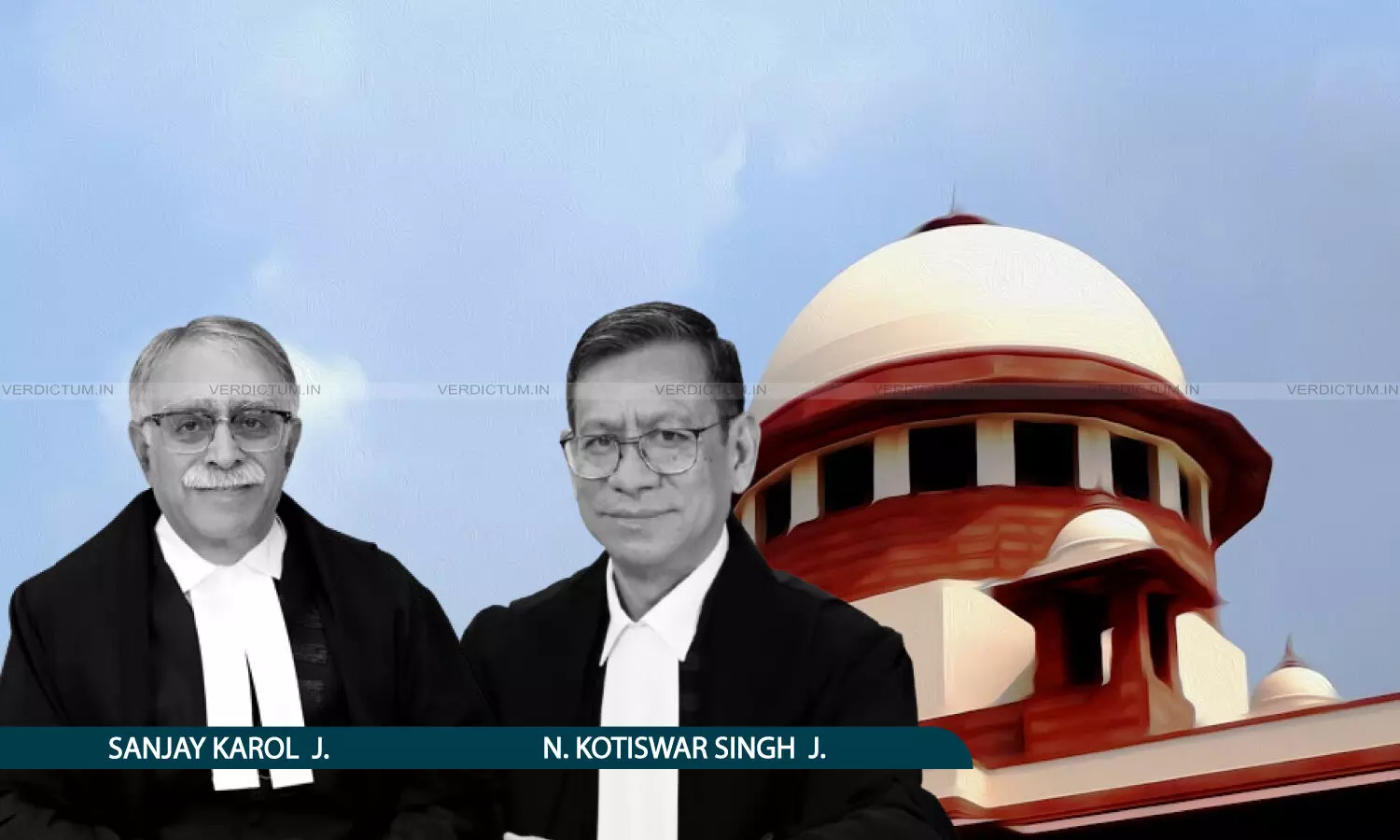
Justice Sanjay Karol, Justice N. Kotiswar Singh, Supreme Court
Statutory Policy Cannot Supersede Constitutional Power: Supreme Court Holds 2008 Haryana Guidelines Untenable Against 2002 Remission Policy
 |
|The Court ruled that short-sentencing policies invoking the Governor's powers under Article 161 cannot be overridden by subsequent statutory guidelines, reinforcing that the most liberal remission policy must apply at the time of consideration.
The Supreme Court has held that the 2002 Remission Policy stood framed under the Constitution, and such power is to be exercised by the Governor himself, and the subsequent Policy of 2008 cannot deter the effect of the former and the observation that it supersedes the 2002 Policy is untenable in law.
The Court allowed an appeal preferred by a life convict, holding that his application for premature release must be governed by the more liberal "Policy Regarding Release of Life Convicts 2002" instead of the stricter subsequent 2008 statutory policy.
The Bench observed that policy instructions directing files to the Governor for invoking Article 161 of the Constitution carry an independent constitutional mandate.
Consequently, the Court held that the coordinate Bench decision in State of Haryana v. Raj Kumar[2021]—which had erroneously categorized the 2002 policy as a mere statutory memorandum—was rendered per incuriam as it directly conflicted with the larger three-judge Bench precedent in State of Haryana v. Jagdish[2010].
The Bench Justice Sanjay Karol and Justice NK Singh held, "In light of the discussion as aforesaid, we proceed to decide the question as has arisen in this case. Since the 2002 Policy stood framed under the Constitution and such power is to be exercised by the Governor himself, the subsequent Policy of 2008, cannot deter the effect of the former and the observation that it supersedes the 2002 Policy, is untenable in law. In respect of the appellant herein, it can be said that the 2002 Policy would still have its effect. The holding in Jagdish supra would operate, and the appellant would be entitled for the benefit of the lesser time served thereby making him eligible for remission."
Advocate on Record Sunil Kumar Verma appeared for the Appellant, while Advocate on Record Akshay Amritanshu appeared for the Respondents.
Brief Facts
The appellant was convicted of murder, kidnapping, and destroying evidence. He was sentenced to undergo life imprisonment along with shorter concurrent terms of imprisonment. The High Court subsequently set aside his conviction for kidnapping but maintained the life sentence for murder, which was later upheld by the Supreme Court.
After serving over fourteen years of actual imprisonment, the appellant submitted a representation to the State authorities seeking premature release and remission of his sentence. The prison authorities rejected his representation on the grounds that his case was governed by a stricter subsequent policy rather than the older liberal policy.
They further noted that he had not completed the required twenty years of actual sentence specified under the newer policy. The appellant challenged this rejection through a writ petition, which was dismissed by the High Court, leading to the preferred appeal.
Contentions of the Parties
For the Appellant:
It was contended that the older policy was framed under the constitutional powers vested in the Governor under Article 161 of the Constitution of India, and therefore, a subsequent statutory policy could not dilute or denude the appellant of his vested benefits.
It was submitted that a more beneficial or liberal remission policy ought to be applied to a convict instead of a stricter policy that prevailed on the date of conviction or consideration.
It was argued that an intervening co-ordinate Bench judgment which took a contrary view lacked precedential value because it ran directly counter to an earlier judgment delivered by a larger three-judge Bench of the Supreme Court.
For the Respondent/State:
The State contended that the subsequent policy explicitly superseded all earlier government memorandums and policies on premature release.
It was argued that since the subsequent policy was active and operational on the date of the appellant's conviction, he could only claim benefits under the criteria laid down by the newer policy.
It was further asserted, relying on a co-ordinate Bench precedent, that both the older and newer policies were statutory instructions traceable to the Code of Criminal Procedure rather than the Constitution, meaning the older policy did not occupy a higher legal pedestal.
Observations of the Court
The Court observed that the older policy explicitly required papers to be placed before the Governor to solicit orders under Article 161 of the Constitution, whereas the subsequent policy directed the files to the Chief Minister under statutory provisions of the Code of Criminal Procedure. The Court noted that a statutory policy cannot override or diminish an exercise of independent constitutional power.
Relying on the controlling three-judge Bench precedent in State of Haryana v. Jagdish[2010], the Court reiterated that if a more liberal policy is in effect or creates a legitimate expectation for the convict, the benefit of such a liberal policy must be extended to the prisoner.
The Court laid down guidelines regarding when ‘does’ or ‘does not’ in a decision becomes per incuriam.
The Court further observed that the intervening judgment in State of Haryana v. Raj Kumar [2021], which had labeled the older policy as a mere statutory memo, was rendered per incuriam as it directly conflicted with the larger Bench's ratio.
"This is for the reason that the Policies of 1993 and 2002 are, as already observed above, identical in terms of their source of power under Article 161, and since the former has been declared by a Bench of three judges to be an exercise under the constitutional power, the inescapable conclusion would be that the identical later policy would also be the same. But for reasons discussed above, the judgment in Rajkumar supra held the 2002 Policy to be of statutory origin. This would fall foul of the reasoning in Jagdish supra and hence be rendered per incuriam", the Court held.
The Court also clarified that findings in this case shall apply prospectively and shall not operate to reopen any applications for remissions that already stood decided. In effect, now the respondent State shall have two distinct and separate policies functioning. How it is that the State want to proceed further is for them to decide, it was added.
Holding that the older policy remained operative for the appellant's case, the Court allowed the appeal and directed the State to reconsider the appellant’s remission application under the older, more beneficial policy guidelines.
Cause Title: Parveen Kumar @ Parveen Chauhan v. State of Haryana & Ors. [Neutral Citation: 2026 INSC 667]
Appearances:
Appellant: Advocate on Record Sunil Kumar Verma, Advocate Himank Nargotra, Advocate Desam Sudhakara Reddy.
Respondents: Advocate on Record Akshay Amritanshu, Advocate Aashna Gill, Advocate Harsh Rekha, Advocate Sarthak Srivastava.