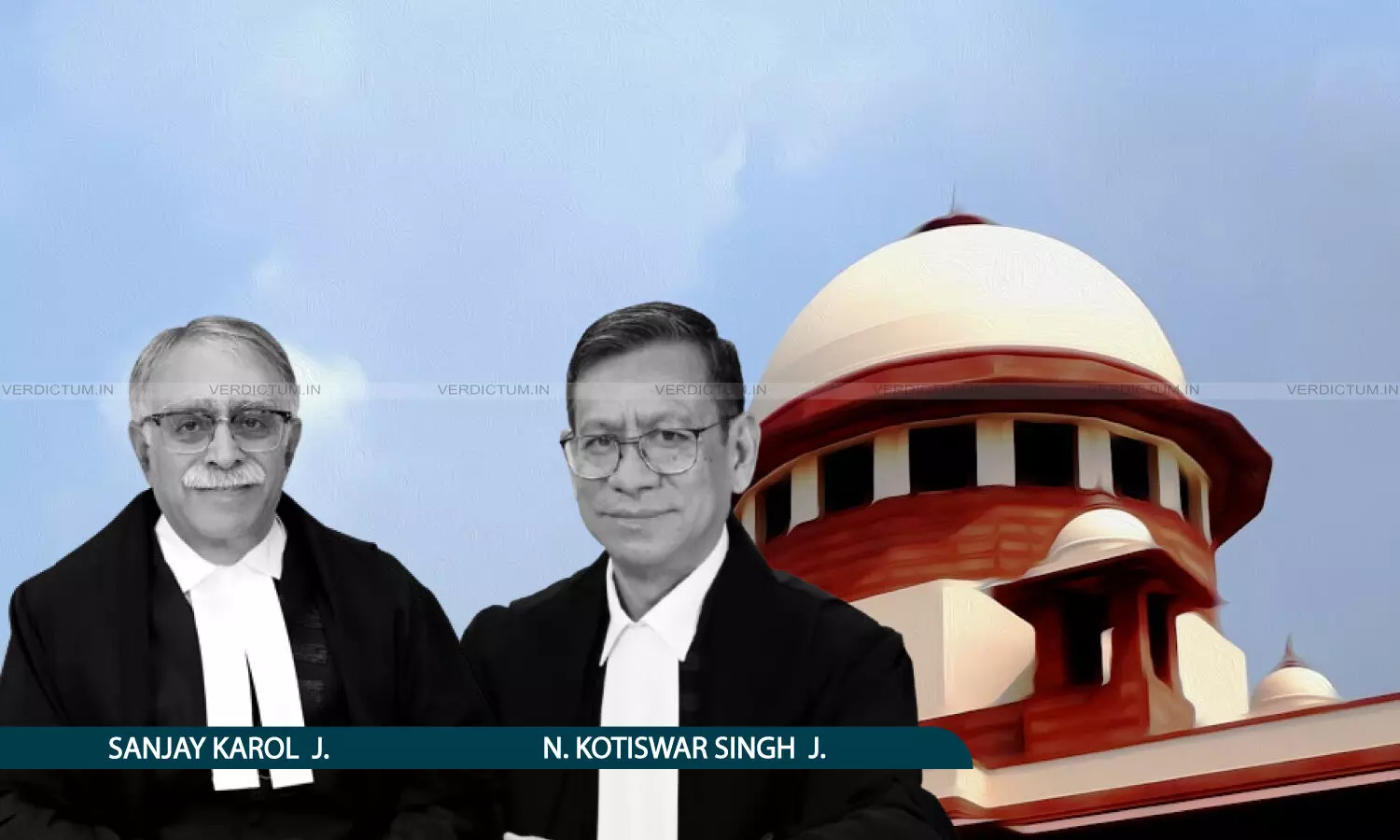
Justice Sanjay Karol, Justice N. Kotiswar Singh, Supreme Court
Non-Filing Of Additional Copies Of Charge-Sheet Is No Ground For Default Bail If Final Report Is Filed Within Timeline: Supreme Court
 |
|The Court clarified the distinction between mandatory timelines for filing a final report and directory guidelines for submitting additional paperwork.
The Supreme Court has held that the non-filing of additional copies of the charge-sheet under Section 193(8) would not vitiate the charge-sheet/police report itself, and therefore is no ground for default bail.
The Court said that once the chargesheet is filed, in compliance with the form prescribed under Section 193(3) BNSS, within the aforesaid period, the right to default bail ceases.
The Bench of Justice Sanjay Karol and Justice NK Singh held, "Applying the aforesaid exposition of law, in our considered view, the non-filing of additional copies of the charge-sheet under Section 193(8) would not vitiate the chargesheet/police report itself. As was the case under the erstwhile CrPC, the position under BNSS is to remain that the right to default bail arises when the chargesheet is not filed within a period of sixty or ninety days, as applicable. Once the chargesheet is filed, in compliance with the form prescribed under Section 193(3) BNSS, within the aforesaid period, the right to default bail ceases. Non-compliance with Section 193(8) of the BNSS cannot be construed to give the same result as Section 187(3) of the BNSS."
Advocate on Record Vidhi Pankaj Thaker appeared for the Appellant, while Advocate on Record Mukesh Kumar Maroria appeared for the Respondent.
Brief Facts
The appellant was arrayed as an accused in a criminal case registered by the Central Bureau of Investigation for various offences under the Bharatiya Nyaya Sanhita, 2023, the Prevention of Corruption Act, 1988, and the Information Technology Act, 2000.
The prosecution case involved a deep-rooted criminal conspiracy where sophisticated digital means, including digital arrests and phishing attacks, were deployed by cybercriminals to cheat innocent persons and extort money.
The illegal proceeds of the crime were allegedly routed through various "mule" bank accounts opened on the strength of forged documents with the active connivance of bank officials.
The specific role attributed to the appellant was that of providing logistics and operational support to the principal accused by transporting incriminating materials such as chequebooks, ATM cards, and SIM cards used in the commission of the offences.
The investigating agency completed the investigation and submitted the final report before the competent court within the statutory period, and a copy thereof was subsequently supplied to the accused.
The appellant preferred an application for the grant of statutory/default bail before the Special Judge on the primary ground that the investigating agency had failed to file additional copies of the charge-sheet along with the documents as mandated by the statutory provisions. The Special Judge rejected the statutory bail application, which led the appellant to prefer a criminal revision application before the High Court of Judicature at Bombay.
The High Court dismissed the revision application, holding that the right to default bail does not accrue if the charge-sheet is filed within the prescribed period, and the mere non-supply or non-filing of copies of the charge-sheet cannot be a ground to claim statutory bail. Aggrieved by this rejection, the appellant approached the Supreme Court by way of the present criminal appeal.
Contentions of the Parties
The Appellant contended that the statutory requirement to submit a specific number of copies of the police report along with duly indexed documents to the Magistrate for onward supply to the accused was strictly mandatory in nature. This mandatory requirement was further fortified by the statutory timeline prescribed for the supply of the police report to the accused within a fixed period from their appearance or production. It was further submitted that since the essential copies of the final report and its accompanying documents were not filed within the stipulated period, the final report was incomplete, thereby rendering the appellant fully eligible for the benefit of default bail.
The investigative agency countered that the indefeasible right to statutory bail extinguishes the moment a charge-sheet is filed within the prescribed sixty or ninety days. It was urged that the agency had complied with the statutory mandates by submitting the final report to the court, and the subsequent delivery of the copy to the appellant fell well within the permitted window after his appearance.
Observations and Findings of the Court
The Court observed that the statutory provisions governing default bail under the new procedural law remained substantially identical in import to the corresponding provisions of the erstwhile Code of Criminal Procedure, 1973. It was noted that the right to default bail is an indefeasible right flowing from Article 21 of the Constitution of India, which operates strictly on the failure of the investigating agency to file the charge-sheet within the prescribed statutory period.
It was explicitly observed that once an investigation is completed and a police report containing all essential particulars is successfully forwarded to the Magistrate within time, the right of the accused to claim statutory bail stands completely extinguished.
The Bench relied on its precedent in CBI v. Kapil Wadhawan (2024) and clarified that even if certain documents relied upon by the prosecution do not accompany the final report, such an omission would neither vitiate the charge-sheet nor render it incomplete for the purpose of denying default bail.
The Court held that the newly added provision requiring the investigating officer to submit additional copies of the police report for the accused was merely directory and not mandatory in nature.
It was observed that a simple technical non-filing of extra copies could not be equated with a failure to file the charge-sheet itself, and it could not be interpreted to defeat the investigation or bestow an unmerited right of default bail upon the accused.
The Court concluded that since the primary charge-sheet was filed in its proper form within the statutory timeline and cognizance had already been taken by the competent court, the lower courts were perfectly justified in rejecting the plea.
Consequently, the Court dismissed the appeal, while clarifying that the appellant’s plea for regular bail must be considered independently on its own merits.
Cause Title: Shaurya Sunil Kumar Singh v. Central Bureau of Investigation [Neutral Citation: 2026 INSC 666]
Appearances:
Appellant: Advocate on Record Vidhi Pankaj Thaker, Advocate Ritesh Kalra, Advocate Anish Khandekar, Advocate Prastut Mahesh Dalvi, Advocate Rahul Kalangiwale, Advocate Urusa Shaikh.
Respondent: Advocate on Record Mukesh Kumar Maroria