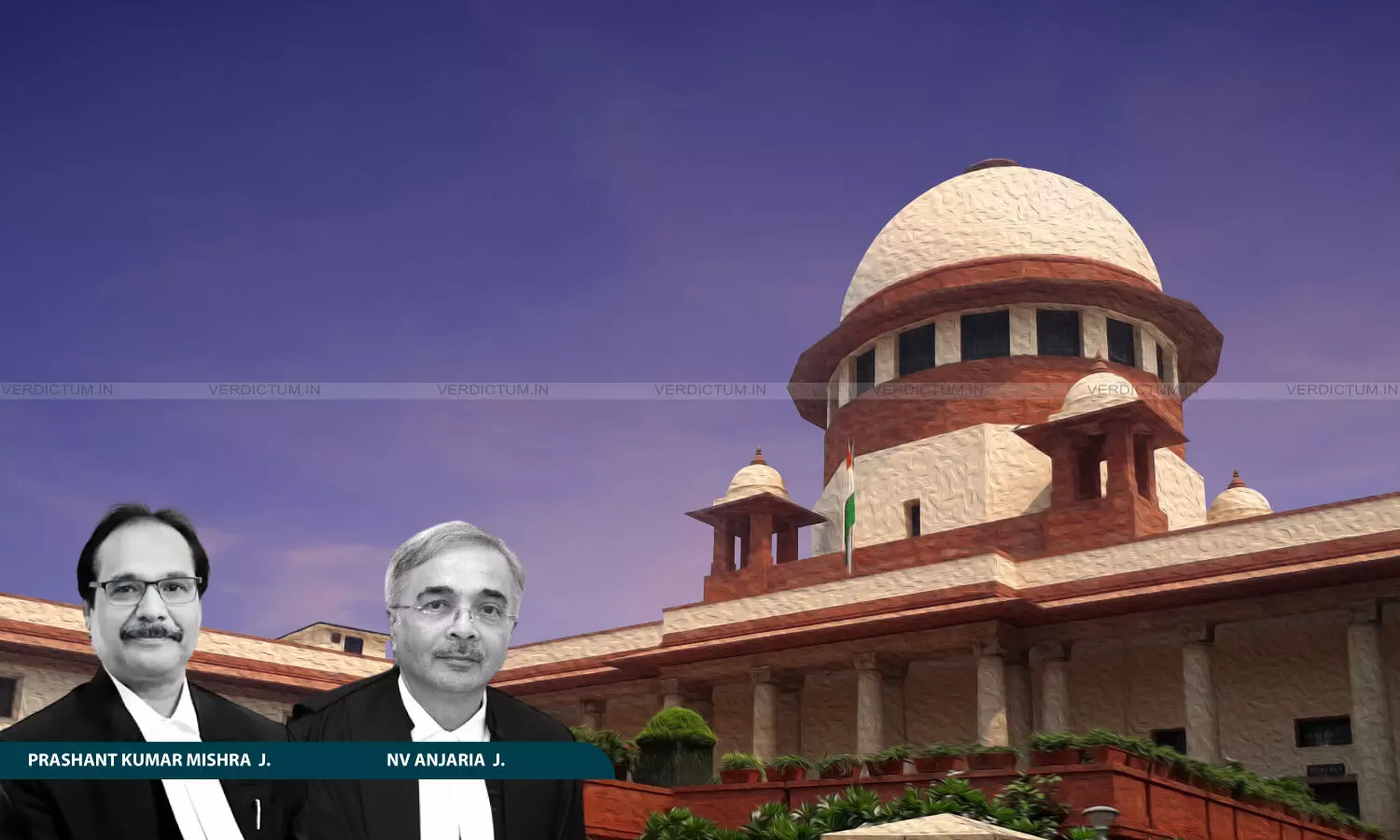
Supreme Court, Justice Prashant Kumar Mishra, Justice N.V. Anjaria
Motor Accident Compensation Can't Be Founded On Assumptions Of Assured Professional Success: Supreme Court
 |
|The Court dismissed the insurer's appeal against a motor accident claim award, holding that hyper-technical calculations must yield to substantive justice.
The Supreme Court has held that compensation under the Motor Vehicles Act cannot be founded on assumptions of assured professional success or on salary benchmarks of unrelated successful professionals.
The Court affirmed the concurrent findings of negligence against a truck driver who left his punctured vehicle hazardously stationed on the road without indicators or warning signs in the dead of night.
While dealing with the quantum of compensation for the parents of a twenty-year-old Chartered Accountancy student who died in the ensuing collision, the Court acknowledged that the Motor Accident Claims Tribunal had adopted an exceptionally liberal methodology by projecting entry-level professional earnings as the base income and simultaneously adding a fifty percent increment for future prospects.
Refusing to scale down the dependency amount after nearly a decade since the accident, the Apex Court observed that awarding "just compensation" under the Motor Vehicles Act cannot be viewed in sterile mathematical terms or detached from the underlying human element.
The Bench of Justice Prashant Kumar Mishra and Justice N.V. Anjaria observed, "It is no doubt true, as we have emphasised in the preceding paragraphs, that the determination of compensation under the MV Act is guided by the principle of awarding ‘just compensation’, which must account for the future prospects of the deceased. At the same time, such determination cannot travel into the realm of conjecture. In the present case, while there was evidence of the stipend being earned by the deceased, no cogent material was placed on record to establish the alleged income from private tuition. Equally, the assertion of the claimants that the deceased would certainly qualify as a Chartered Accountant and thereafter earn substantially higher income remains a matter of future uncertainty. Compensation cannot be founded on assumptions of assured professional success or on salary benchmarks of unrelated successful professionals."
Advocate on Record T. Mahipal appeared for the Appellant, whereas Advocate on Record Ashutosh Yadav appeared for the Respondents.
Brief Facts
The case arose out of a motor vehicular accident wherein a twenty-year-old bachelor, who was pursuing his final year in Chartered Accountancy and undergoing articleship, sustained fatal injuries. The deceased was travelling in a car driven by his roommate when it collided with a truck from behind in the dead of night. According to the claimants, the truck was stationed in the middle of the road without any parking lights, indicators, or reflectors, making it completely invisible due to the darkness. Conversely, the driver and owner of the truck claimed that the vehicle had suffered tyre punctures and was parked safely on the extreme left side of the road, attributing the accident entirely to the rash and negligent driving of the car.
The parents of the deceased instituted a claim petition before the Motor Accident Claims Tribunal seeking compensation. The Tribunal held the truck driver entirely liable for negligence and assessed the compensation by taking into account the bright professional prospects of the deceased student, rather than restricting it to his actual articleship stipend. Both the insurer and the claimants preferred appeals before the High Court, which came to be dismissed, thereby affirming the Tribunal's award. Aggrieved by the concurrent findings, both parties approached the Supreme Court by way of cross-appeals.
Contentions of the Parties
The Insurer contended that both the courts below erred in fastening absolute liability upon the truck driver, arguing that the car driver was contributorily negligent since he rammed into the stationary truck from behind. It was argued that the assessment of the income of the deceased was based on purely hypothetical considerations and salary benchmarks of unrelated professionals, resulting in an astronomical and excessive award. It was further urged that adding a standardized fifty percent towards future prospects on top of an already highly inflated and enhanced artificial income amounted to a double and impermissible benefit.
Per contra, the claimants sought a further enhancement of the compensation, arguing that the future earning potential of a budding Chartered Accountant had been grossly underestimated by the courts below. It was contended that the actual income from private tuitions was discarded without justification, and the prospective salary of a qualified professional would have been significantly higher than that of an entry-level government officer. It was also pointed out that the courts below completely failed to grant statutory compensation under the mandatory conventional heads, specifically omitting the filial consortium due to the grieving parents.
Observations of the Court
The Apex Court observed that a stationary vehicle occupying the road in the dead of night without any warning indications posed an evident hazard, and since neither the truck driver nor the owner entered the witness box to rebut the eyewitness testimony, the adverse inference drawn by the courts below was fully justified.
The Bench noted that the mere fact that a vehicle collided from behind could not by itself lead to an inference of contributory negligence, and in the absence of any cogent evidence, a plea of negligence could not be accepted on mere conjecture.
It was observed that while the Tribunal adopted a highly liberal methodology by merging the prospective career growth directly into the basic income and then adding another fifty percent for future prospects, reducing the compensation at this belated stage on a technical overlap would defeat the ends of substantive justice.
The Court reiterated that the Motor Vehicles Act is a piece of beneficial legislation aimed at providing "just compensation," which cannot be measured with sterile mathematical precision or arithmetical exactitude when the loss of a promising young life is concerned.
"The case before us concerns the loss of a young life with promising professional potential, and the determination of compensation under the MV Act is ultimately guided by the principle of awarding ‘just compensation’. This principle is not one of exact mathematical equivalence, rather it is an attempt by the law to provide a measure of solace, within human limitations, to those who have suffered an irreparable loss. In the present case, a young student has died on the threshold of a professional career, whose life and potential stand extinguished forever. The claimants are parents who lost their young son in an accident that occurred in the year 2013 and the award was rendered by the Tribunal in 2017. For nearly a decade, the compensation determined by the Tribunal and affirmed by the High Court has held the field", the Court said.
The Court further observed that while the loss of dependency required no interference, the courts below committed a legal error by omitting the conventional head of consortium.
The Court observed, "The loss suffered by the parents of the deceased cannot be measured with arithmetical precision, and the compensation awarded, viewed holistically, cannot be said to transgress the bounds of ‘just compensation’ under the MV Act. The beneficial character of the legislation, the long passage of time since the accident, the concurrent assessment made by the Tribunal and the High Court, and the impossibility of placing a precise monetary value upon the loss of a young life, together persuade us not to disturb the compensation awarded towards loss of dependency. Viewed holistically, we are of the considered view that no interference is called for with the compensation awarded towards loss of dependency."
The Court also observed that the Motor Vehicle Act is a beneficial legislation and therefore it is the duty of the Court to ensure that just compensation is awarded, even if a legitimate conventional head has been omitted by the lower courts.
The appeal preferred by the insurance company challenging the concurrent findings on negligence and the loss of dependency was dismissed. The cross-appeal preferred by the claimants was partly allowed to the limited extent of correcting the omission of conventional heads.
The Court modified the award by granting an additional sum of Rs. 40,000/- each (totaling Rs. 80,000/-) to the parents towards filial consortium, together with interest at the rate awarded by the Tribunal.
Cause Title: The Oriental Insurance Company Limited v. Kalu Ram and Ors. [Neutral Citation: 2026 INSC 653]
Appearances:
Appellant: Advocate on Record T. Mahipal, Advocate on Record Ashutosh Yadav, Advocate on Record Yadav Narender Singh, Advocate Rohit Kumar Sinha, Advocate Surya Kamal Mishra, Advocate Partap Singh, Advocate Arun Yadav, Advocate Chetna Yadav, Advocate Mayank Kumar Singh, Advocate B.N Yadav.
Respondents: Advocate on Record Ashutosh Yadav, Advocate on Record Yadav Narender Singh, Advocate on Record T. Mahipal, Advocate Partap Singh, Advocate Arun Yadav, Advocate Chetna Yadav, Advocate Mayank Kumar Singh, Advocate B.N Bajpai, Advocate Rohit Kumar Sinha, Advocate Surya Kamal Mishra.