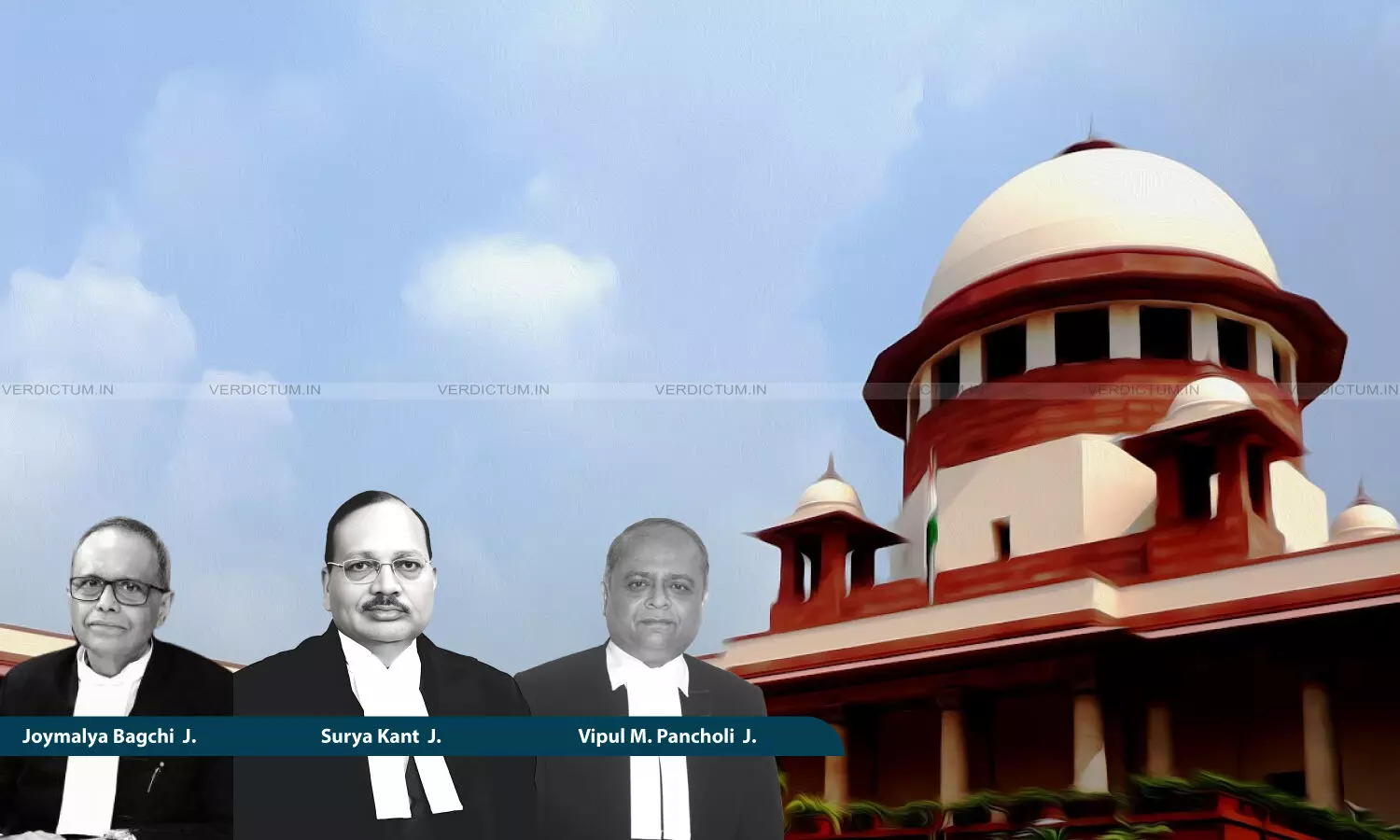
Supreme Court of India, Justice Surya Kant, Justice Joymalya Bagchi, Justice Vipul M. Panhcoli
Nominated Members Of Municipalities Cannot Vote In Legislative Council Elections: Supreme Court
 |
|The Apex Court dismissed appeals arising from the Karnataka Legislative Council election dispute, holding that nominated members of Town Panchayats could not be included in the electoral roll for a Local Authorities’ Constituency when the constitutional scheme denies them voting rights in municipal affairs.
The Supreme Court has held that nominated members of municipalities, who are barred by the Constitution from voting in municipal decision-making, cannot be allowed to vote in elections to the Legislative Council.
The Court was hearing appeals arising from the election to the Karnataka Legislative Council from the Chikkamagaluru Local Authorities Constituency, where 12 nominated councillors of Town Panchayats had been included in the electoral roll and had cast their votes in an election decided by a margin of six votes.
A Bench of Chief Justice Surya Kant, Justice Joymalya Bagchi and Justice Vipul M. Pancholi held: “If Article 171(3)(a) of the Constitution was to be interpreted literally so as to include nominated members, an unreasonable consequence would follow, that is, a nominated member who is not allowed by the Constitution to vote in the municipality’s own decision-making process would still be allowed to vote in the election of a member of the Legislative Council. This interpretation would give nominated members more voting power in the election of a constitutional legislative body than they have within the municipality itself, which Article 243-R of the Constitution never intended.”
The Bench added: “The Constitution should not be interpreted in a way that creates such contradictions. The Courts need to contextually interpret the provisions in order to further the constitutional objective, that is, democratic representation. The purpose of Article 171(3)(a) is not just to give representation to local authorities as institutions, but to ensure representation of democratically elected local self-governing bodies in the Legislative Council.”
Senior Advocates Shekhar Naphade and S Niranjan Reddy appeared for the appellant, while Senior Advocates A.N. Venugopala Gowda and Abhishek Manu Singhvi appeared for the respondents.
Background
The dispute arose from a Legislative Council election in Karnataka from a Local Authorities’ Constituency comprising members of local bodies, including Zilla Panchayat, Taluk Panchayat, Municipal Councils and Town Panchayats.
In four Town Panchayats, three members each had been nominated by the State Government under Section 352(1)(b) of the Karnataka Municipalities Act, 1964. Their names were included in the electoral rolls, and they voted in the Legislative Council election.
The returned candidate secured 1188 votes, including the votes of nominated members, while the rival candidate secured 1182 votes. After the result, the inclusion and voting rights of the nominated members were challenged.
The Karnataka High Court held that nominated members did not have the right to vote in Legislative Council elections. In the election petitions, the High Court directed the opening of ballot boxes, segregation of ballot papers relating to the nominated members, and a recount after excluding those votes.
The returned candidate argued before the Supreme Court that the electoral roll had attained finality, that nominated members were validly included under statutory provisions, that Section 27(2)(b) of the Representation of the People Act, 1950, used the expression “every member”, and that excluding their votes would violate ballot secrecy.
The respondents argued that Article 243-R of the Constitution expressly denies voting rights to nominated municipal members, that their role is advisory and not representative, and that their inclusion in the electoral college was constitutionally invalid.
Court’s Observations
The Supreme Court first rejected the objection that the writ petitions before the High Court were not maintainable. It held that the challenge was not to the conduct of the election, but to the legality of including nominated members in the electoral roll for the Local Authorities’ Constituency.
The Court observed: “We find no merit in the submission. The challenge raised before the High Court was not directed against the conduct of the election or against any stage of the electoral process; however, the challenge was to the legality of the inclusion of nominated members in the electoral roll prepared for the Local Authorities’ Constituency. The challenge was raised before the election and went to the root of the composition of the electoral college and not merely to the validity of the election result. Thus, the issue raised was a pure question concerning the interpretation of constitutional and statutory provisions.”
The Court accordingly agreed with the High Court that the writ petitions were maintainable.
The Court then examined Article 171(3)(a), Section 27(2)(b) of the 1950 Act, Article 243-R of the Constitution and Section 352 of the Karnataka Municipalities Act.
It rejected a purely literal reading of Article 171(3)(a) and Section 27(2)(b), holding that the Constitution must be read as a coherent whole in light of the democratic local self-government framework introduced by the Seventy-Fourth Amendment.
The Court stated: “We are of the view that the submission is attractive on a plain reading of the provisions, however on closer examination, overlooks the constitutional transformation brought about by the Constitution (Seventy-Fourth Amendment) Act, 1992. The constitutional provisions cannot be construed in isolation or by adopting a purely textual approach divorced from the constitutional structure and every provision must be interpreted harmoniously so as to give effect to the Constitution as a coherent whole.”
The Bench held that Article 243-R draws a conscious constitutional distinction between directly elected municipal representatives and nominated members brought in for their expertise.
The Court observed: “Therefore, the constitutional distinction between elected and nominated members is clear and intentional, as the elected members derive their authority from the democratic mandate of the electorate and represent the will of the people. On the other hand, the nominated members are inducted into the municipal body because of their expertise, experience or specialised knowledge. Thus, their role is advisory and consultative rather than representative.”
The Court relied on Ramesh Mehta v. Sanwal Chand Singhvi (2004) and Shelly Oberoi v. Office of Lieutenant Governor of Delhi (2023), and held that nominated members cannot be given greater electoral power in Legislative Council elections than they enjoy within municipalities themselves.
The Court accordingly held that the expressions “members of municipalities … and other local authorities” in Article 171(3)(a) and “every member” in Section 27(2)(b) must be read in context, and apply to elected representatives with voting rights in the concerned local authority.
The Court rejected the argument that once the electoral roll had attained finality, votes cast by persons included in it could not be excluded.
It distinguished the cases relied on by the appellant, holding that they dealt with ordinary mistakes or irregularities in electoral rolls, whereas the present case involved constitutionally ineligible persons forming part of the electoral college.
The Court observed: “However, the above referred cases cited by the appellants do not apply to this case because they dealt with ordinary mistakes or irregularities in preparing electoral rolls. In the present case, the issue is different, here, the inclusion of certain voters in the electoral roll was later found to be unconstitutional void ab initio, thus, this means the issue affects the basic composition of the electoral college itself. Therefore, the Court cannot overlook this constitutional violation simply by saying that the electoral roll had become final.”
It further held that once the Court had found that nominated members were not constitutionally entitled to be part of the electoral college, the votes cast by them were invalid.
The Supreme Court found that Section 100(1)(d)(iii) of the Representation of the People Act, 1951, was attracted because the margin of victory was six votes, while 12 nominated members had cast votes.
The Court held: “As per the factual matrix of the present case, the returned candidate secured victory by a margin of 6 votes. The number of votes cast by the nominated members was 12. Thus, the number of invalid votes was double the margin of victory. In such circumstances, the requirement of material effect stands established.”
The Court also rejected the argument that segregation of the nominated members’ votes would violate the secrecy of the ballot. Referring to Kuldip Nayar v. Union of India (2006), it held that ballot secrecy is important but cannot be used to sustain a constitutional illegality.
The Court stated: “We also do not find merit in the contention that segregation of the votes cast by the nominated members would violate the secrecy of the ballot. The principle of ballot secrecy is undoubtedly a vital feature of the electoral process and is to ensure the freedom and independence of the voter, however, such secrecy is not an absolute principle and cannot be invoked to sustain a constitutional illegality.”
The Bench added that the High Court’s direction was not an open-ended inquiry into individual voting preferences, but a confined exercise to exclude votes found void in law.
Conclusion
The Supreme Court held that nominated members appointed under Section 352(1)(b) of the Karnataka Municipalities Act were not entitled to be included in the electoral roll for the Local Authorities’ Constituency and that their inclusion was contrary to the constitutional scheme.
The Court dismissed the appeals, affirmed the Karnataka High Court’s view, and directed transmission of the sealed cover containing the recount report and revised result to the High Court. The authorities were directed to take further steps in terms of the High Court’s directions within 30 days.
Cause Title: Pranesh M.K. v. A.V. Gayathri Shanthegowda and Others (Neutral Citation: 2026 INSC 716)
Appearances
Appellants: Randhir Kumar Ojha, AOR, Senior Advocates Shekhar Naphade, S. Niranjan Reddy and Anand Sanjay M. Nuli, with Advocates Akhila Wali, Dharam Singh, Suraj Kaushik, Abhishek Kanyalur, Divya Sinha, Ashritsai Torgal, Tanya Chhillar, Akhila Palem, Salonee Paranjape, Abhishekh Singh, M/s. Nuli & Nuli, AOR, Agam Sharma, AOR and Archi Aggarwal
Respondents: Senior Advocates A.N. Venugopala Gowda, Dr Abhishek Manu Singhvi, V. Giri and K.M. Nataraj, ASG, with Advocates Nishant A.V., Garima Jain, AOR, Mohit Singh, Mayank Kshirsagar, AOR, Anumita Verma, Pavani Verma, Megha Bhati, Akhilesh Yadav, Sharanagouda Patil, Supreeta Patil, Nishant Venugopal, Kotresh A.M., M/s. S-Legal Associates, AOR, K.V. Muthu Kumar, AOR, S. Selvakumari, Gagandeep Chauhan, Shreemoyee Bhattacharjee, Balaji Srinivasan, AOR, Vishwaditya Sharma, Parikshit Pitale, Aakriti Priya, Kaniksha Singh, Subornodeep Bhattacharjee, Suganya Sivasamy, Patil Rekha Chandra Gouda, AOR, Prateek Kumar, AOR, Devansh Rai, Harshed Sundar, Rahul Narang, Nihar Dharmadhikari, Aishwarya Raj Mishra, K. Shiva, AOR, Saurabh Ankit, Amiti Gupta, Agam Sharma, AOR, Archi Aggarwal, Gurmeet Singh Makker, AOR, Sharath Nambiar, Vinayak Sharma, Indira Bhakar, Vatsal Joshi, Chitransh Sharma, Anuj Srinivas Udupa, Satvika Thakur, Nikita Capoor, Yogya Rajpurohit, Ritika Ranjan and Dr. N. Visakamurthy, AOR
Click here to read/download Judgment