
The Perpetrator Hid Behind Cloak Of Self- Styled Godman: Rajasthan HC Upholds Life Sentence For Asaram Bapu In Rape Case, Acquits Him Of Gang Rape
 |
|The Bench maintained the punishment of rigorous life imprisonment for the remainder of his natural life under Section 376(2)(f) of the IPC, rejecting his plea for leniency by observing that his physical frailty cannot justify ignoring the minor victim's voice.
The Rajasthan High Court modified the Trial Court's judgment by setting aside Asha Ram’s convictions for criminal conspiracy, common intention, and gang rape under Sections 120B, 34, and 376D of the Indian Penal Code, alongside Sections 5(g)/6 of the POCSO Act, owing to a total failure by the prosecution to prove a prior meeting of minds or a common design.
However, the High Court upheld his individual convictions under Sections 370(4), 342, 509, 506, 354A, and 376(2)(f) of the IPC, Section 23 of the Juvenile Justice Act, and Sections 7/8 of the POCSO Act, while newly recording convictions under Section 376 IPC and Sections 3/4 of the POCSO Act.
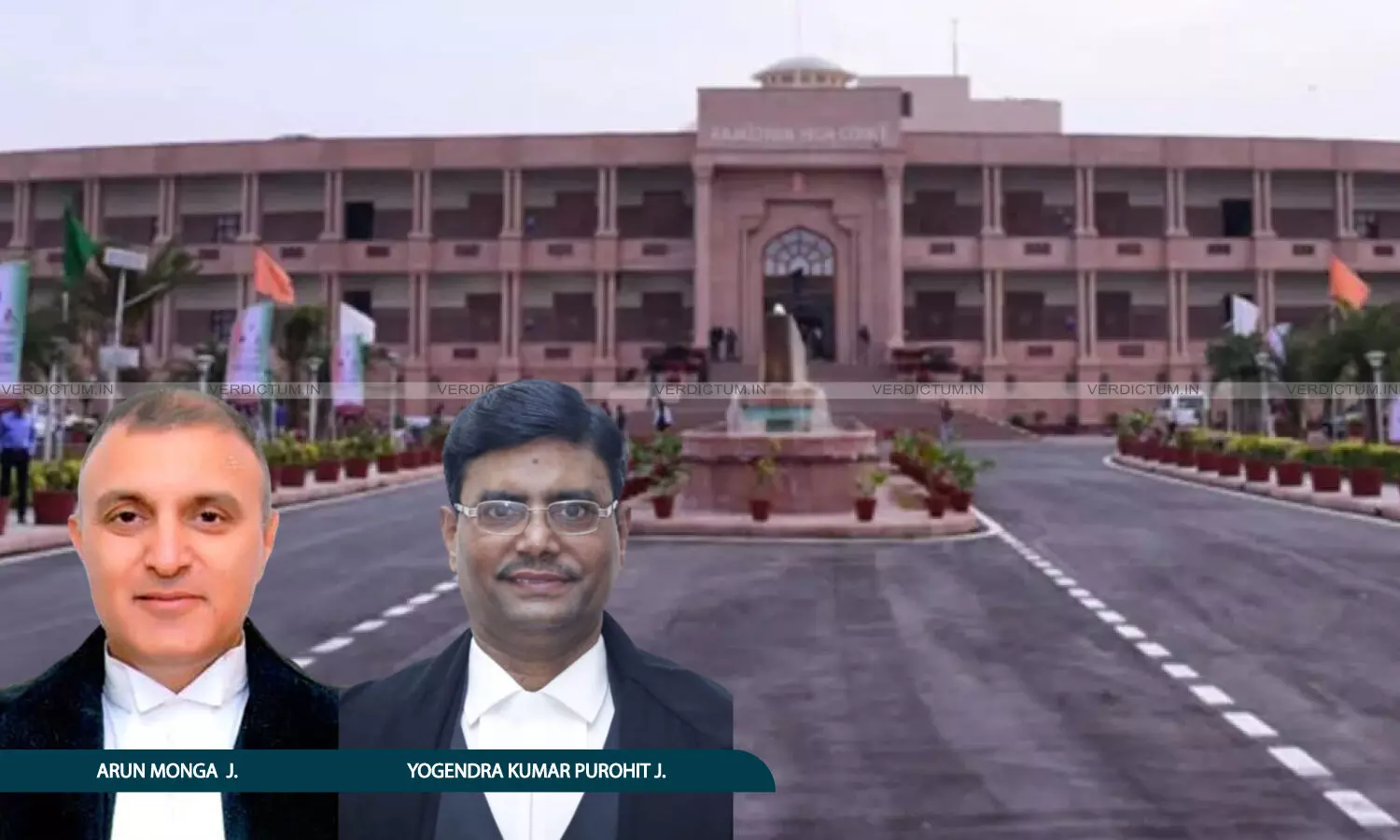
The Bench of Justice Arun Monga and Justice Yogendra Kumar Purohit observed, "We have given our thought to the learned trial court's well-reasoned order denying leniency to the appellant and find ourselves in full agreement with it. The appellant was 73 at the time. He is now 86. He thus stands before us bent by age and burdened by ailment, imploring a fresh look at his plea for leniency. We have considered his plea and applied our mind. We are unable to grant any indulgence, since in the shadow of his frailty cannot justify ignoring the victim's voice. Quiet. Devastating. Irrefutable. To ignore it would be to shake society's faith in the criminal justice system, and send wrong a message no court must ever send, least of all when the perpetrator hid behind the cloak of a self- styled godman."
Senior Advocates Devadatt Kamat and Vineet Jain appeared for the Appellants, while AAG Deepak Choudhary appeared for the State.
Brief Facts Of The Case
The minor victim was a Class XII student residing at the Sant Shri Asha Ram Gurukul in Chhindwara, Madhya Pradesh. On August 6, 2013, she suffered from giddiness, leading the hostel warden, Shilpi, to claim that she was possessed by evil spirits. Shilpi, along with co-accused Sharad, subsequently convinced the victim's parents that only the religious guru, Asha Ram, could cure her through ghost healing, and directed them to take the girl to him.
The family located Asha Ram in Jodhpur, Rajasthan, and arrived at his Manai village ashram. On the night of August 15, 2013, Asha Ram summoned the family to his cottage, ordered the parents to stay outside to meditate, and commanded the victim to enter his room. He locked the doors, turned off the lights, silenced her screams by force, and subjected her to a penetrative sexual assault lasting over an hour while threatening to kill her parents if she resisted or disclosed the incident.
The family returned home the following day, where the victim narrated the ordeal to her parents. Her father lodged a written complaint on August 20, 2013, at Kamla Market Police Station in Delhi, which was subsequently transferred to Jodhpur, where a formal FIR was registered. Following a police investigation, a charge sheet was filed against Asha Ram and his assistants, leading to a trial where all the accused individuals pleaded not guilty.
Observations of the Court
The appellant argued that the FIR was deliberately delayed and maliciously filed as a "Zero FIR" in Delhi rather than Jodhpur as part of a pre-planned conspiracy. The High Court rejected this argument, agreeing with the Trial Court’s findings. The Court noted that the victim's family first travelled to Delhi to confront Asha Ram directly after the victim's revelation on August 19, 2013. Upon discovering he had already fled to Jodhpur, they immediately lodged the Zero FIR in Delhi to prevent any further delay that travelling to Rajasthan would cause. Furthermore, the Court held that even if a portion of the delay had remained unexplained, it was not fatal to the case because the evidence convincingly satisfied the conscience of the Court.
The appellant asserted that his trial was entirely vitiated by hostile media propaganda, which the Trial Judge failed to curb. The Court dismissed this claim, ruling that if the appellant felt aggrieved by media coverage, it was his responsibility to seek appropriate legal remedies at that time. Having failed to do so, he cannot lay the blame on the Trial Court, which evaluated the case purely on its legal and factual merits.
The defence relied on a book written by the then DCP (West) Jodhpur, titled "Gunning for the Godman," arguing his written narrative proved that Jodhpur police launched a pre-determined investigation and sealed the crime scene before the FIR was lawfully transferred from Delhi.
The Court rejected this contention. It pointed out that while the High Court had initially allowed the DCP to be summoned under Section 391 CrPC, the Supreme Court subsequently set aside that order in State of Rajasthan v. Asha Ram. Because the contents of the book remained legally unproven, the appellant could not use them to find fault with a fully verified and proved police investigation.
The Court then turned to the highly contested issue of the victim's age, firmly upholding the Trial Court’s finding that she was a minor born on July 4, 1997. The defence had produced an early nursery entry copy to claim she was born in 1995, but a side-by-side comparison with the prosecution's original document exposed fraudulent subsequent additions in the defence's version, which the school principal entirely failed to explain.
Furthermore, the Court noted that every official record spanning from Class 2 at Saraswati Shishu Mandir to Class 12 at Asha Ram's own Gurukul uniformly recorded her birth date as July 4, 1997. The Court strongly condemned the defence’s suggestion that the father had intentionally falsified his daughter's age years in advance just to trap Asha Ram under the POCSO Act in the future, labelling the theory as absurd, preposterous, and the height of perversity.
In a profound analysis of the defence’s claim that the "ghost healing" narrative was too improbable to be believed, the High Court delivered an extensive observation on the psychological power of deep religious indoctrination. The Court observed that faith is a powerful force capable of suspending even the sharpest of minds, causing devotees to blindly embrace superstitious pronouncements and irrational counsel.
This surrender of rationality, the Court noted, becomes heavily pronounced when individuals stand at the edge of despair or are trapped in a crisis that logic has failed to solve. Since the victim's parents had been staunch disciples since 2002, had built a local ashram for the appellant, and had sent their children away to his Gurukul, their absolute trust in the hostel warden's instructions to seek Asha Ram's spiritual healing for their daughter’s sudden illness was entirely consistent with human behaviour under intense devotion.
The Court held, "We are of the view that defence is right in contending that the offence under Section 376D IPC has not been proved. It has been held above that offence under Section 120B IPC had not been proved in the case. There is not even any allegation that more than one person had committed the offence of rape, let alone reliable evidence on record to prove the same. In our opinion, learned Trial Court erred in convicting and sentencing the appellant for the offence gang rape falling under Section 376D IPC. Thus he ought to be acquitted of the said charge. However, on the proved facts of the case it stands established that the appellant had, inter alia, committed the offence of rape. We, therefore, convict him for the lesser/minor offence under Section 376 of IPC."
The bench observed that it was entirely contrary to normal human nature to assume the principal accused, Asha Ram, would openly communicate an intention of sexual exploitation when asking his co-accused to send the prosecutrix to him under the pretext of "ghost healing."
The prosecution failed to bring forth any worthwhile material establishing a prior meeting of minds or a common design between the main accused and the co-accused. Consequently, the charge of criminal conspiracy under Section 120B of the IPC collapsed entirely against all three appellants.
Because the charge of criminal conspiracy was unproven, and since there was absolutely no allegation or reliable evidence on record that more than one individual participated in the actual commission of rape, the statutory ingredients of gang rape were not satisfied.
The court held that the conviction and sentence recorded by the Trial Court under Section 376D of the IPC was unsustainable in law. While Asha Ram was acquitted of gang rape, the established medical and testimonial facts firmly proved individual acts of sexual violation. The court therefore downgraded and held him liable for the individual offence of rape under Section 376 of the IPC.
The High Court resolved the misapplication of specialized child protection statutes by the lower court: 1. The conviction under Section 5(g) of the POCSO Act (gang rape of a child) was declared legally untenable and set aside alongside the Section 376D IPC charge. 2. The High Court observed that while the facts clearly mirrored the elements of Section 5(p) (penetrative sexual assault committed by a religious guru or person in authority), the Trial Court had omitted this finding. Because the State preferred no cross-appeal against that omission, the appellate court could not newly convict him under this section.
The High Court set aside Asha Ram's convictions under Sections 120B, 34, and 376D of the Indian Penal Code, as well as Sections 5(g)/6 of the POCSO Act. Conversely, it upheld his convictions under Sections 370(4), 342, 509, 506, 354A, and 376(2)(f) of the Indian Penal Code, Section 23 of the Juvenile Justice Act, and Sections 7/8 of the POCSO Act, while newly recording convictions under Section 376 of the Indian Penal Code and Sections 3/4 of the POCSO Act.
In accordance with Section 42 of the POCSO Act, no separate punishments were awarded for the lesser sexual offences, as they were absorbed by the highest statutory penalty. The primary sentence of rigorous life imprisonment for the remainder of his natural life under Section 376(2)(f) of the Indian Penal Code was formally upheld.
Consequently, the High Court ordered the immediate cancellation of the interim bail previously granted to Asha Ram, directing the forfeiture of his bail bonds and ordering that a non-bailable arrest warrant be issued forthwith to take him into custody to undergo his life sentence.
The Court concluded, "Aside above, victim’s voice too demands to be heard. She does not come to this Court seeking sympathy but justice. She comes bearing an inconvenient truth: that for the Appellant, imprisonment is only physical. His confinement has walls. Her sentence has none of these. No warrant was ever issued for it. No court ever pronounced it. Yet, it was imposed upon her the moment this godman chose violation of law and morality over his vows. The sentence served upon her soul is lifelong, written not in ink, but in indelible anguish. It knows no remission, no parole, no appellate remedy. For, a rape victim does not merely carry a wound. She carries an erasure, of her dignity, of her identity, of the self she was before the moment which not only completely destroyed, but cleaved her life into a before and an after. The violation does not end when the act ends. It reverberates, through every moment of silence, every crowded room, every ordinary day made unbearable by the indelible memory of it."
Meanwhile, the court completely exonerated the co-accused, Sanchita @ Shilpi and Sharad Chandra @ Sharat Chandra, finding that they could not be held vicariously liable for the independent acts of the principal accused. All convictions and sentences recorded against them under the Indian Penal Code and the POCSO Act were set aside, and they were ordered to be acquitted of all charges, thereby disposing of the three connected appeals.
Cause Title: Asha Ram @ Ashumal v. State and other connected matters [Neutral Citation:2026:RJ-JD:26201-DB]
Appearances:
Appellants: Senior Advocate Devadatt Kamat, Senior Advocate Vineet Jain, Advocate Rajesh Inamdar, Advocate Nishant Bora, Advocate Yashpal Rajpurohit, Advocate Shivangi Pathak, Advocate Bharat Sain, Advocate Rewant Solanki, Advocate Arpit Linda, Advocate JR Lohia, Advocate Shashwat Anand, Advocate Praveen Vyas.
Respondents: Additional Advocate General Deepak Choudhary, Advocate K.S. Kumpawat, Advocate P.C. Solanki, Advocate Muskan Moondra, Advocate Shubham Dave, Advocate Vipul Soni, Advocate Lavisha Soni, Advocate Kautubh Dave.