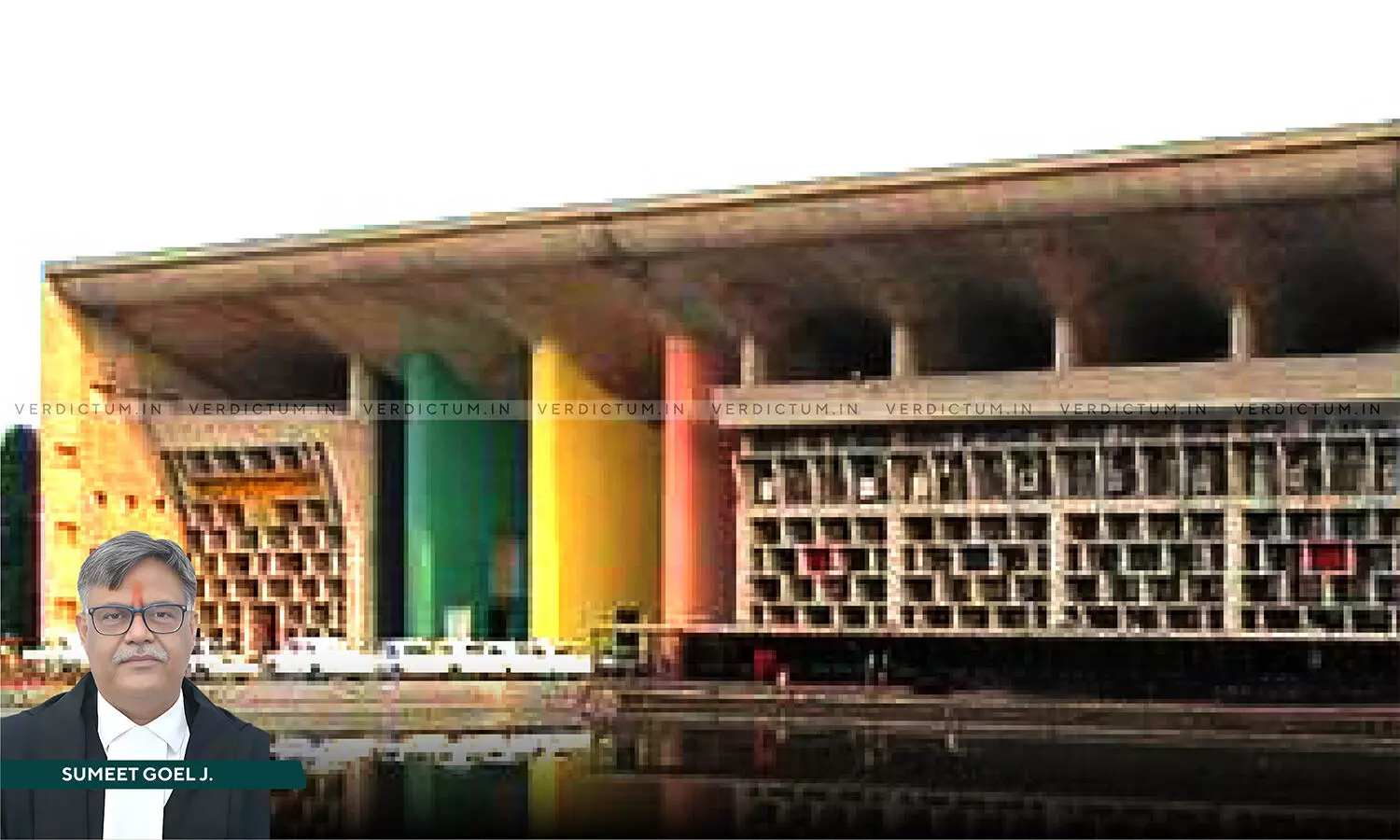
Justice Sumeet Goel, Punjab and Haryana High Court
“Unable To Turn A Nelson's Eye": P&H High Court Grants Interim Bail In NDPS Case Over Repeated Non-Appearance Of Police Witnesses, Orders Personal Appearance Of DGP
 |
|The Court held that undue trial delay caused by police witnesses evading non-bailable warrants can override the rigours of Section 37 NDPS Act, and directed the Director General of Police to personally appear and account for the systemic lapse.
The Punjab and Haryana High Court has granted interim regular bail to an accused in a commercial-quantity heroin case, holding that prolonged incarceration caused by the persistent non-appearance of prosecution witnesses, themselves serving police officials, despite repeated non-bailable warrants, constitutes a violation of the accused's fundamental right to a speedy trial that the Court "finds itself unable to turn a Nelson's eye" to.
The Court further held that where trial delay is attributable not to the accused but to the systemic failure of the prosecuting agency to produce its own official witnesses, conditional liberty can override the statutory embargo under Section 37 of the NDPS Act, 1985, even in cases involving commercial quantities of contraband, since the guarantee of a speedy trial under Article 21 of the Constitution of India cannot be rendered nugatory by institutional inertia within the prosecution's own ranks.
A Bench of Justice Sumeet Goel observed, “It has been repeatedly observed that official witnesses in NDPS cases — who, in most cases, comprise police personnel—are consistently failing to appear before the Court to tender their evidence, despite the issuance of bailable warrants and, in numerous instances, even non-bailable warrants…Senior police officials—in particular, at the helm of the police force at the district level, i.e. the concerned SSP/SP are also under a bounden duty to monitor the conduct of their subordinate police officials and ensure their presence for tendering evidence before the concerned trial Court. This exhibition of laxity and apathy by the police officials deserves redressal. This seeming abdication of duty by the senior police officials, by not paying any heed to this conduct of police officials, under their supervision, is, thus, a malady to which this Court finds itself unable to turn a nelson’s eye…”.
Advocate L.S. Sekhon appeared for the petitioner and Hemant Aggarwal, Deputy Advocate General appeared for the respondent.
The petitioner was arrested on March 28, 2025 in connection with the recovery of 2 kg 488 grams of heroin. The challan was presented on September 19, 2025, citing sixteen prosecution witnesses, none of whom had been examined till the date of the order. The petitioner's first bail petition had earlier been dismissed as withdrawn on January 14, 2026. By the time of the present petition, the petitioner had been in custody for over one year and five months.
The petitioner contended that the mandatory provisions of the NDPS Act had not been scrupulously complied with, that the trial was being unduly delayed for reasons not attributable to him, and that serving police officials cited as prosecution witnesses were repeatedly failing to appear despite non-bailable warrants. The State opposed the petition, relying on the seriousness of the allegations and the statutory rigours of Section 37 of the NDPS Act, placing on record a custody certificate dated August 24, 2025.
The Court examined zimni orders from November 20, 2025 through August 05, 2026, finding that trial had been persistently stalled on account of non-appearance of police-official witnesses despite repeated non-bailable warrants.
“…Alarmingly, there exist several cases where even bailable warrants remain unexecuted for extended periods, resulting in routine adjournments of trials under the NDPS Act solely on this count. This state of affairs reflects a deeply disturbing and systemic lapse in the prosecutorial mechanism, whereby the trial is stalled indefinitely due to the indifference or willful non-cooperation of official witnesses. Such conduct not only frustrates the right of the accused—whether incarcerated or on bail—to a speedy trial as enshrined under Article 21 of the Constitution of India, but also gravely undermines the administration of criminal justice. The abdication of duty by official witnesses, who are employees of the State, erodes public confidence in the justice delivery system and emboldens criminal elements by showcasing prosecutorial apathy. It sets a dangerous precedent where procedural laxity takes precedence over judicial efficacy. The resultant delay compromises deterrence and enables the recycling of narcotic offenders back into society during pendency of trial and obstructs the overarching objective of the NDPS Act—namely, the containment of the menace of drug trafficking and substance abuse. In effect, such dereliction by State officials, especially serving police officials, amounts to an affront to both rule of law and societal welfare…”, it said.
The petitioner was ordered released on interim regular bail till the next date of hearing, subject to furnishing bail/surety bonds to the satisfaction of the trial court among other conditions. The Director General of Police (Law and Order), Punjab, was directed to remain personally present in Court on the next date of hearing to explain the systemic failure of police-official witnesses to appear before the trial court despite repeated non-bailable warrants. The matter was directed to be listed on 21.09.2026 in the urgent cause list.
Cause Title: Naseeb Singh v. State of Punjab CRM-M-29778-2026
Appearances:
Petitioner: L.S. Sekhon, Advocate, M.S. Sweedel, G.S. Gill, Advocates.
Respondent: Hemant Aggarwal, Deputy Advocate General, Punjab.