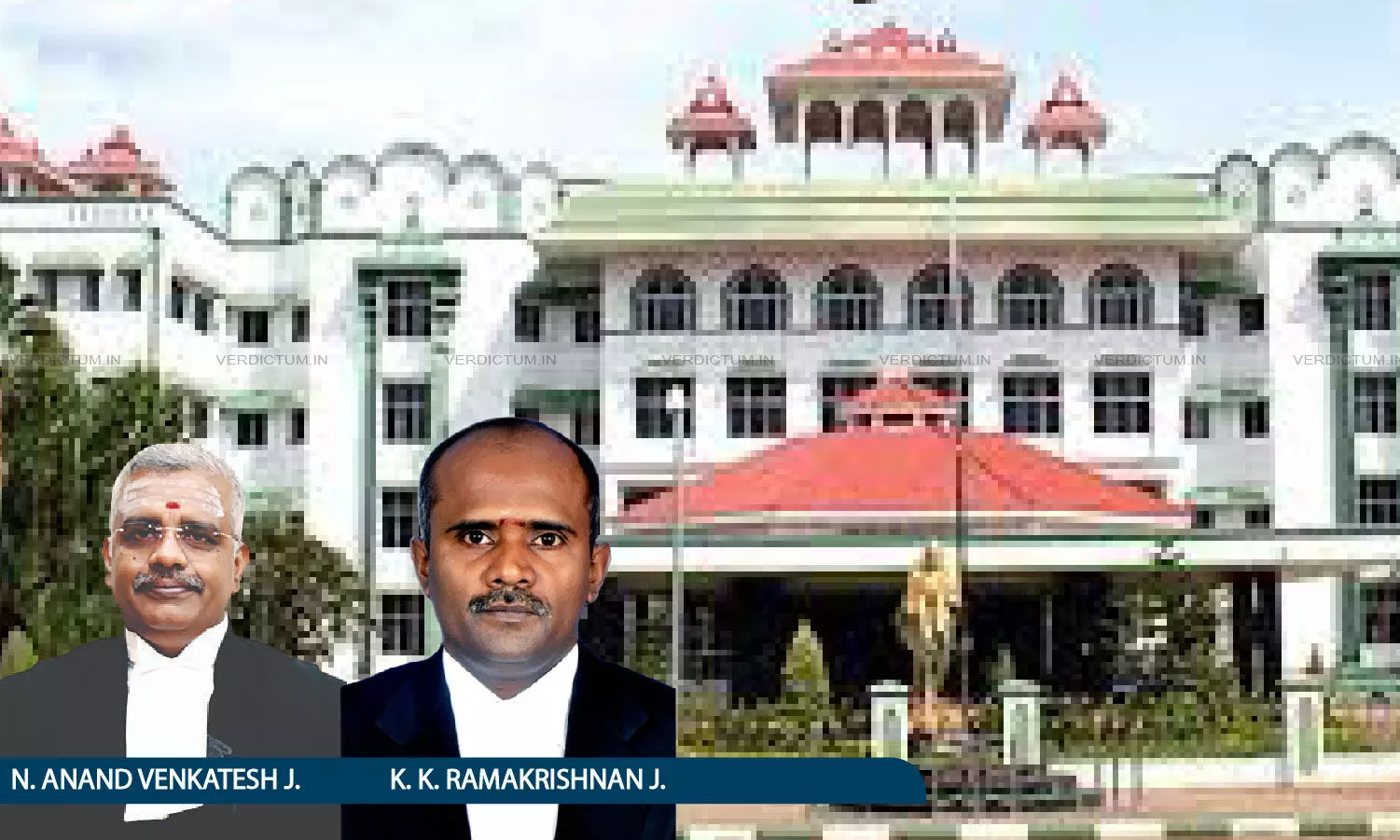
Justice N. Anand Venkatesh, Justice K. K. Ramakrishnan, Madras High Court
Guardians & Wards Act Is Religion-Neutral: Madras High Court Appoints Hindu Man As Legal Guardian Of "Muslim" Child
 |
|The Bench clarified that the child's paramount interest takes precedence over the diverse faiths of the parties.
The Madras High Court, Madurai Bench has held that the Guardians and Wards Act, 1890, is a religion-neutral legislation applicable to every person seeking to be appointed as a legal guardian.
The Court held that while Section 17 of the Act requires consideration of a minor's religion, such a factor cannot operate as a total bar to the appointment of a guardian from a different faith. Noting that the primary objective of the judiciary is to protect the welfare of the child, the Bench affirmed that individuals can be appointed as legal guardians regardless of their personal beliefs, provided the arrangement ensures the minor’s stability and well-being.
Justice N. Anand Venkatesh and Justice K.K. Ramakrishnan observed, “…While implementing the provisions of the Act, this Court is exercising its parens patriae jurisdiction in the best welfare of the child. The Guardians and Wards Act 1890, is religion-neutral and it will apply to every person desirous of being appointed as a guardian of a minor and religion becomes one of the consideration when the Court deals with the petition in line with Section 17 of the Act”.
Advocate J. Barathan appeared for the appellant and the respondent appeared in-person.
As per the facts, appellant, and his wife, a Hindu couple had been married since 2012 without children. They sought to adopt the third child of their neighbour, a Muslim woman struggling with economic hardship after the death of her husband.
With the mother's wholehearted consent, the couple began raising the female child, from the time of her birth on December 14, 2023. The child identified the appellant and his wife as her parents and her biological mother as an aunt.
The appellant filed a petition before the Family Court, Madurai, seeking to be appointed as the child's legal guardian. Although the biological mother consented, the Family Court dismissed the petition on September 29, 2025, on the grounds that the parties were of different religions and the appellants were considered "strangers" to the female child. The appellant subsequently challenged this dismissal before the High Court.
Therefore, the Court held that Section 8(a) of the Act permits any person desirous of being a guardian to apply for such status. Referencing the Supreme Court's decision in Shabnam Hashmi v. Union of India and Others (2014) 4 SCC 1, the Bench noted that personal beliefs cannot dictate the operation of an enabling statute designed for child welfare.
The Bench also drew upon the Islamic concept of "Kafala", which allows for the care and financial support of a child by a non-biological guardian. The Bench concluded that since the child had been cared for by the appellants since birth and the biological mother had reaffirmed her consent in open court, the legal guardianship was in the child’s best interest.
Accordingly, the Court set aside the Family Court’s order and officially appointed the appellant, as the legal guardian of the minor female child.
Cause Title: X v. Y C.M.A(MD)No. 423 of 2026
Appearances:
Appellant: J. Barathan, Advocate.
Respondent: Party-in-person.