Streedhana Remains Exclusive Property Of Wife With Full Decision-Making Autonomy: Madras High Court Directs Husband To Return Jewellery & Articles
 |
|The Bench noted that every article gifted by parents holds sentimental value and cannot be frittered away to a husband who rejects her, noted that the husband was still using the cupboard.
The Madras High Court has held that streedhana property belongs exclusively to the wife and cannot be treated as joint family property upon her marriage. The Bench noted that a woman must retain complete decision-making autonomy and absolute independence over her personal belongings, gold jewellery, and marital gifts.
Addressing the facts of the case, and the orders of the trial court in the cluster of cross matrimonial appeals, the Court set aside a family court order that had denied a woman the return of her personal belongings. The Division Bench directed the husband to return all listed jewels and streedhana articles within four weeks, or otherwise pay their current value with 7.5% interest per annum, while simultaneously upholding the dissolution of the marriage on grounds of continuous mental cruelty.
The Court noted that small articles gifted by parents possess immense sentimental value as reminders of her life prior to marriage. The Court declared that a wife is entitled to retain custody out of respect for her parents, and these articles cannot be left with a husband and relatives who neglected her and questioned the paternity of her child.
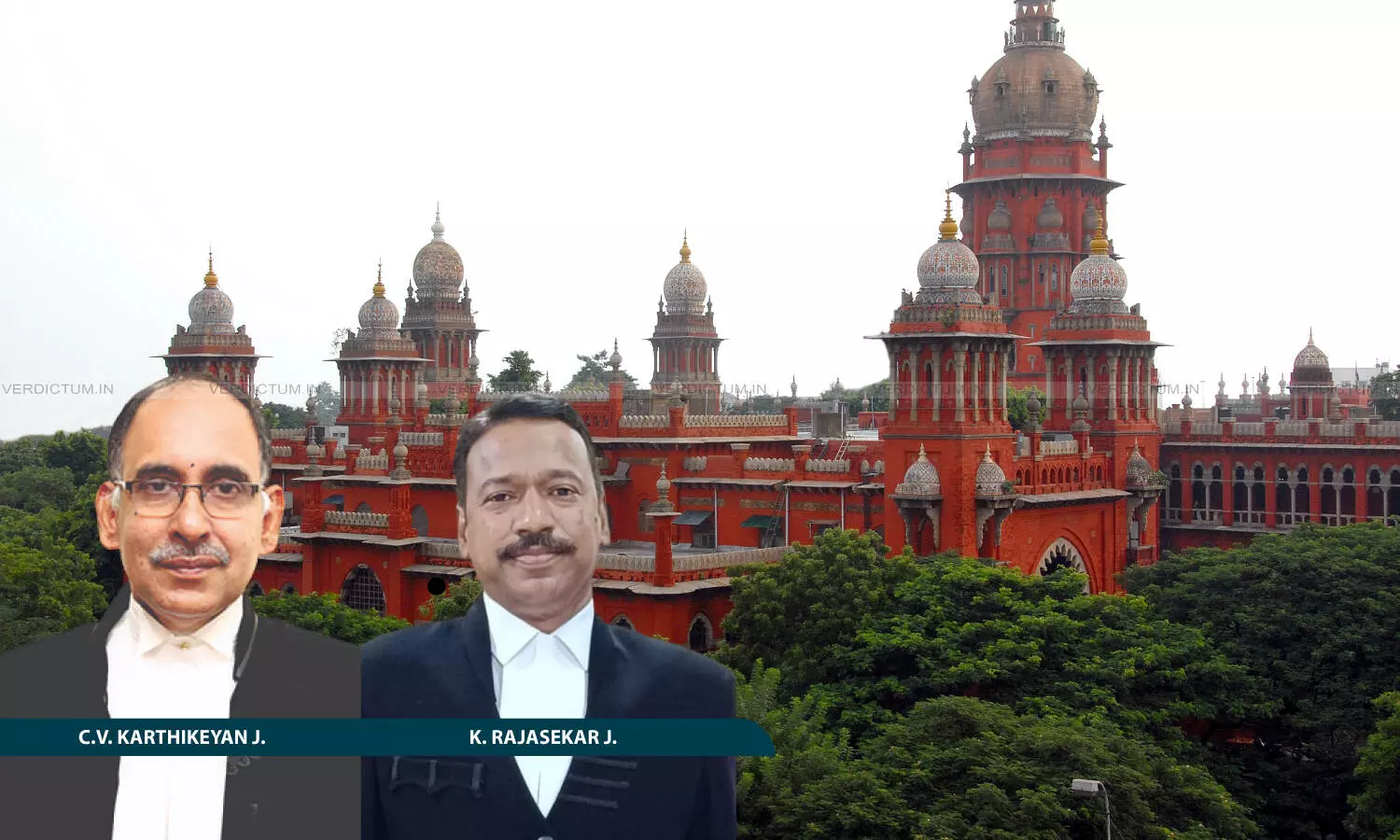
A Division Bench comprising Justice C.V. Karthikeyan and Justice K. Rajasekar in the lead matter, observed, “…The Trial Court had very correctly stated that streedhana property can never be stated to be the property of the joint family or the family to which a lady enters on marriage. It still remains her exclusive property. She should have autonomy to decide how to deal with the said property, with her jewels. It is not just independence but autonomy to take a decision as to the holding of the jewels and the other articles…”.
“…Naturally, she requires protection in her life. One protection which she would expect is for the articles given by her father to be returned to her…For every lady, any small article given by her parents, would be of immense value. It not only has the value attached to it as an article, but has a sentimental value. It is the only reminder of her life in her parents’ house, which memories she had taken to her marital house…”, the Bench further observed.
Advocate M. Arvind Kumar appeared for the appellant and Advocate Sanjay Pinto appeared for the respondent.
“…Once the marital relationship suffers, naturally she would expects the articles to be given back to her. They do not remind her of the marriage, but remind her of the love and affection bestowed on her by her parents. She has to retain custody out of her respect for her parents. The articles cannot be just frittered away by her to her husband, who has rejected her, and the relatives of her husband who had neglected her and who had even questioned the paternity of their own heir.”, the Bench had noted.
The brief facts of the case indicate that the marriage between the parties was solemnized on December 7, 2014, following which she (respondent) resided in a joint family environment. Right from the inception of the matrimonial alliance, she faced severe neglect, physical appearance shaming, restriction of movement, and financial deprivation from her husband and in-laws.
Furthermore, her streedhana jewellery was forcefully taken into the custody of her mother-in-law, and upon returning with her newborn child, her husband questioned the baby's paternity.
The trial court passed a common order on September 20, 2023, and allowed the wife's petition for dissolution of marriage on the ground of cruelty, but dismissed her application, for the return of her streedhana articles on the ground that she had temporary custody. It also dismissed the husband's petition for restitution of conjugal rights. Both parties subsequently preferred appeals before the High Court.
The Court extracted the ratio that a blanket denial by the husband regarding a detailed list of streedhana items is legally unsustainable. The Court rejected the husband's defense that the wife took the jewellery during her pregnancy, pointing out that she had left for delivery and had no reason to permanently vacate the home with all her belongings at that time.
It observed that the husband continued to use the cupboard gifted by her parents, indicating that the articles remained in his household. The Court concluded that cumulative neglect, bodily shaming, and questioning a child's paternity constitute severe mental cruelty, making any restitution of conjugal rights an exercise in futility.
“We again note that there was no specific denial about the correctness of the list of articles. The petitioner was not permitted to enter the marital house when she came back with the baby. She had gone for birth of the child. When she came back with the new born baby, the paternity was questioned. There was no occasion for her to take back all her jewels. The cupboard still remained in the house of the respondent. If she wanted to take back the jewels, she would have taken back them in the cupboard which was given to her. It is also admitted in evidence by the respondent that the cupboard is still used by him and his family member”, the Court said.
Consequentially, the Court dismissed the husband's appeals, thereby confirming the dissolution of marriage and the dismissal of the restitution petition. It directed the appellant to return all the jewels and articles listed in the annexure within four weeks, failing which the wife would be entitled to their current value along with interest at 7.5% per annum from the date of marriage until payment.
Cause Title: V v. S (Neutral Citation: 2026:MHC:2431)
Appearances:
Appellant: M. Arvind Kumar, Advocate.
Respondent: Sanjay Pinto, Advocate.
Click here to read/download the Judgment