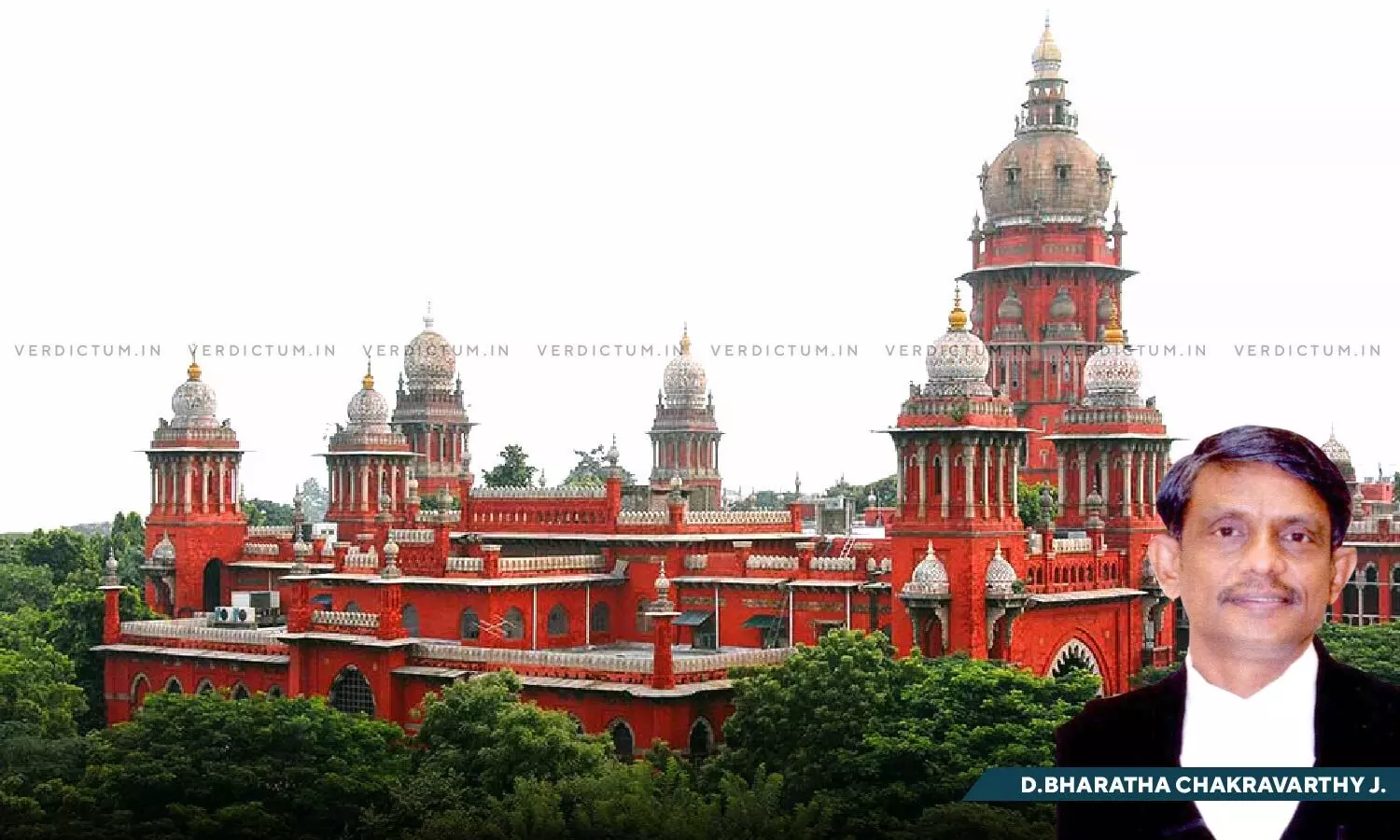
Justice D Bharatha Chakravarthy, Madras High Court
Whether It Is Patrilineal Or Matrilineal Makes No Difference: Madras High Court Allows Communal Status As SC/MBC/OBC Based On Mother's Nativity In Puducherry
 |
|The Bench in a batch of 29 petitions, said that deprivations and social stigma suffered by the child, not the parent's gender, is the real test for SC/MBC/OBC status.
The Madras High Court has held that a candidate seeking Scheduled Caste, Most Backward Class or Other Backward Class status in the Union Territory of Puducherry cannot be denied a community certificate merely because it is the mother, and not the father, who is a native of Puducherry, holding that "whether it is patrilineal or matrilineal makes no difference" once the child has been born, raised and has suffered the community's social disadvantages in Puducherry itself.
The Court held that the decisive test for conferring communal status is not the gender of the parent through whom nativity is traced, but whether the child has actually suffered the deprivations, indignities, humiliations and handicaps associated with that community while growing up in Puducherry, and rejected the Union Territory administration's reliance on an unstated assumption that Indian society is patriarchal as a basis for restricting the benefit to paternal lineage alone.
Also, the Court found the administration's underlying premise, that society is patriarchal and caste must therefore pass through the father absent express statutory provision, to be untenable in light of Articles 14, 15 and 16 of the Constitution, the 2005 amendment to the Hindu Succession Act conferring coparcenary rights on women, and the Supreme Court's recognition of women's dignity and autonomy in Joseph Shine v. Union of India.
A Bench of Justice D. Bharatha Chakravarthy observed, “It is not that the Government of Puducherry requires both parents to be from Puducherry. It is considered fair when a male marries a woman from another state, and the child is born in Puducherry and lives there; the benefit of reservation is granted. If only the female marries a person from another state, even if the male comes and lives in Puducherry and the child is born and brought up in the caste of the mother and the surroundings, the benefit is denied. The basis of reservation is only social disadvantage and the sufferings and stigma attached to the child; that is the primordial factor for conferring the benefit. Whether it is patrilineal or matrilineal makes no difference”.
Senior Advocate G. Masilamani appeared for the petitioner and R. Sreedhar, Additional Government Pleader appeared for the respondent.
The petitioners were candidates, or their parents where minors, seeking community certificates for admission to educational institutions or public employment in Puducherry. In each case, the candidate was born and continuously resided in Puducherry, was educated there, and had a mother who was a native origin-status holder of the relevant SC, MBC or OBC community, while the father, though of the same caste, was a migrant from another state (commonly neighbouring Tamil Nadu).
The Puducherry administration either refused fresh certificates or downgraded them to "migrant" status on reapplication, on the ground that origin status could be traced only through the father, relying on an administrative memorandum dated November 10, 2000 and on Supreme Court precedent holding that Scheduled Caste status does not travel with a person who migrates to another state.
The petitioners relied principally on the Madras High Court's earlier ruling in P. Jeya v. Union of India, which had struck down the 2000 memorandum restricting origin status to paternal residence as unconstitutional and restored an earlier 1995 memorandum permitting nativity through either parent, a ruling confirmed by a Division Bench and, on further appeal, given qualified affirmance by the Supreme Court, which upheld the operative direction while leaving the question of law open.
Multiple subsequent Division Bench rulings of the Madras High Court had, after the Supreme Court's 2023 disposal of Jeya's appeal, consistently directed the grant of certificates based on maternal nativity, while three earlier Division Bench decisions taking the contrary view had been rendered when a Supreme Court stay was still operative and continued reliance on the memorandum since invalidated. The Union Territory administration contended that two conflicting lines of Division Bench authority existed and that pending Special Leave Petitions before the Supreme Court on related questions counselled restraint.
The Court held that the contrary Division Bench rulings relied upon by the administration were all decided while the 2000 memorandum's invalidation remained under Supreme Court stay, and could not survive the subsequent dismissal of that appeal in 2023, after which Division Benches had uniformly ruled in favour of maternal-origin claims.
On the substantive question, the Court invoked the Supreme Court's ruling in Rameshbhai Dabhai Naik v. State of Gujarat & Others (2012) 3 SCC 400, which held that while a presumption of paternal caste may exist in inter-caste unions, it is rebuttable, and the true inquiry is whether the child was raised in and suffered the deprivations of the mother's community.
“At the outset, the stand taken by the Government of Puducherry that ours is a patriarchal society requires critical consideration. Reservation is intended to advance substantive equality and address historical injustices suffered by socially and economically backward castes. Thus, from a historical perspective, it has to be traced that Indian society has traditionally been patriarchal. However, in the teeth of Articles 14, 15 and 16 of the Constitution of India, there can be no assertion that society must continue to be treated as patriarchal or that, in the absence of a statutory provision, it should be presumed to be so. The society is driven as under by ‘Caste’, and it operates to a great extent in the minds of the people. Similarly, while sex is true, in that any person is born as male, female or intersex, gender stereotypes are based on stories and beliefs built over a period of time, and they are not necessarily true. The traditional belief that vamsam or lineage can only be patriarchal and that the woman takes the domicile of a man are all such stereotypes developed only because of a misogynistic society, compelling women to follow the same”, the Bench said.
The Court also rejected the administration's reliance on a 2025 Central Government communication advising an SLP against a contrary Madras High Court ruling, holding it was merely an inter-office communication and not a binding directive to disregard existing Division Bench rulings.
Accordingly, the Court set aside the impugned orders rejecting origin-status certificates in all 29 writ petitions and directed that the petitioners be granted community certificates as SC, MBC or OBC, as applicable, with native/origin status recorded on the basis of their mother's nativity, entitling them to reservation benefits in education and employment under the Union Territory administration. The Court clarified that the ruling would not preclude denial of certificates on the ground of a false caste claim or where the mother's own nativity claim is itself found to be false. No costs were awarded.
Cause Title: Thelagam v. The Union Territory of Puducherry and Ors. (Neutral Citation: 2026:MHC:3487)
Appearances:
Petitioners: G. Masilamani, Senior Counsel, Mani Sundargopal, B. Kaarvannan, V. Ajayakumar, M. Gnanasekar, Prakash Adiapadam, Stalin Abhimanyu, Parthiban Pathmanabane, K. Uthayanithi, S. Sathia Chandran and Kamala Kumar, Advocates.
Respondents: R. Sreedhar, Additional Government Pleader.