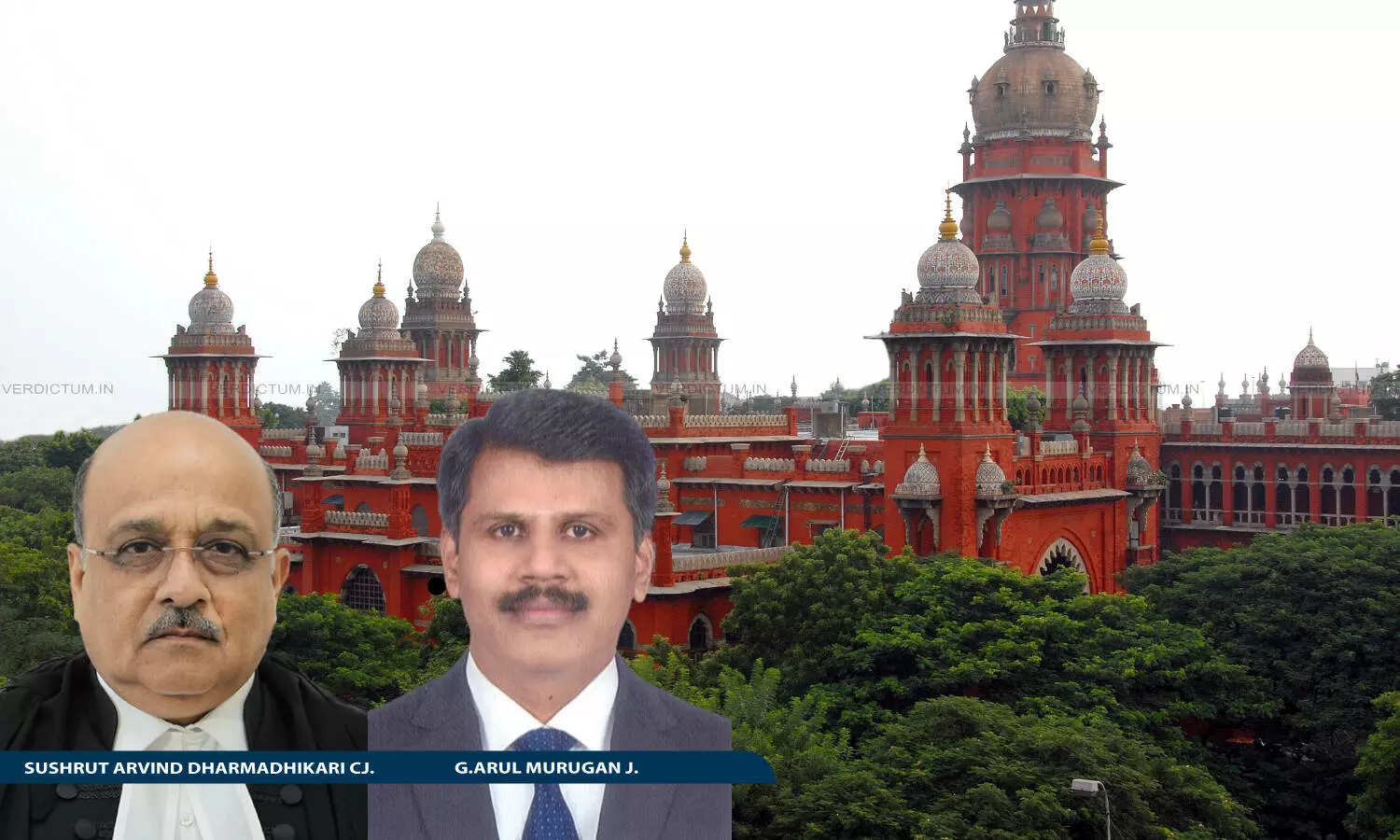
Chief Justice Sushrut Arvind Dharmadhikari, Justice G. Arul Murugan, Madras HC
Section 175(4) BNSS Safeguard Applies To Magistrate, Not Writ Court Acting On Statutory Agency’s Prima Facie Material: Madras High Court
 |
The Court dismissed a Former Minister’s review plea against its direction to register an FIR on Enforcement Directorate material concerning alleged irregularities in municipal recruitment.
The Madras High Court has held that the pre-investigation safeguard under Section 175(4) of the Bharatiya Nagarik Suraksha Sanhita, 2023 applies to a Magistrate considering a complaint under Section 175(3), and does not confer a general right of hearing in every proceeding that may lead to an investigation.
The Court dismissed a review application filed by former Tamil Nadu Minister K.N. Nehru against its earlier order directing the Directorate of Vigilance and Anti-Corruption (DVAC) to register a case and investigate material forwarded by the Enforcement Directorate concerning alleged irregularities in municipal recruitment.
The Court was considering two review applications and a contempt petition arising from its February 20, 2026 order directing registration of a case. The State withdrew its review after an FIR was registered, while the Minister pursued his challenge principally on the ground that he had not received an effective hearing.
A Division Bench of Chief Justice Sushrut Arvind Dharmadhikari and Justice G. Arul Murugan observed: “Section 175(4) of the BNSS stipulates the procedure a Magistrate must follow before directing an investigation on a complaint made under Section 175(3) of the BNSS. It requires the Magistrate to call for a report from the public servant's superior and consider his version. That is a specific safeguard built into a specific statutory procedure. It is not, in our view, a general right of pre-decisional hearing attaching itself to every proceeding, of whatever kind, that might in due course lead to a police investigation, and we do not think it applies to a writ court acting on information already forwarded by a statutory agency showing, prima facie, a cognizable offence.”
Advocate General Vijay Narayan, appeared for the State. Senior Advocates Siddarth Luthra and P.H. Arvindh Pandian appeared for the Minister, while Senior Counsel Siddhartha Dave and the State’s prosecuting counsel represented the investigating authorities.
Background
The Municipal Administration and Water Supply Department had invited applications for 2,538 posts and made appointments around July 2025. During a search in an unrelated bank-fraud case, the Enforcement Directorate allegedly found WhatsApp conversations, hall tickets, screenshots and other material suggesting irregularities in the recruitment.
The Enforcement Directorate forwarded approximately 232 pages of material to the Tamil Nadu Director General of Police on October 27, 2025, under Section 66(2) of the Prevention of Money Laundering Act, 2002.
After no action was taken, Rajya Sabha Member I.S. Inbadurai sought registration of an FIR. The High Court subsequently directed the DVAC to register a case on the information forwarded by the Enforcement Directorate and conduct an expeditious investigation.
The State and Nehru separately sought review of that order. Nehru argued that Section 175(4) BNSS entitled him to be heard before an investigation was directed against him. He also submitted that notice reached him only on the day the original writ petition was reserved for judgment.
Court’s Observations
Section 175(4) Is A Specific Magistrate-Led Procedure
Referring to XXX v. State of Kerala (2026), the Court observed that Section 175(4) BNSS prescribes a specific procedure for a Magistrate considering whether to direct an investigation against a public servant under Section 175(3). The Bench held that this safeguard could not be converted into a general right of pre-decisional hearing before every forum.
The Court observed that its earlier direction was issued in writ jurisdiction on information forwarded by the Enforcement Directorate under Section 66(2) of the PMLA. That material, according to the Bench, prima facie disclosed a cognizable offence.
Direction To Register FIR Is Not A Finding Of Guilt
The Court observed that its earlier order required only registration of a case and investigation. It had neither determined the Minister’s guilt nor treated the Enforcement Directorate’s allegations as proved.
The Bench stated: “Succinctly put, a direction to register an FIR is not a finding against anyone. It only starts the process of investigation, and it is during that investigation, and at trial if matters go that far, that the review applicant will have every opportunity to place his version and test the case against him. Being denied a hearing before that process even begins is not the kind of prejudice that calls for recalling an otherwise reasoned order.”
The Court further observed that the Minister received notice on February 4, 2026, whereas the judgment was pronounced on February 20, 2026. It held that he could have sought reopening of the hearing or placed his submissions before the Court during that interval.
Proposed Accused Has No General Pre-Investigation Hearing Right
Relying on Union of India v. W.N. Chadha (1993), the Court observed that the rule of audi alteram partem did not ordinarily require prior notice to a proposed accused when the investigating authority was only collecting material to determine whether a prima facie case existed.
The Court also relied on E. Sivakumar v. Union of India (2018), which held that an accused had no right to be heard at the investigation stage and that failure to implead or hear a person named as an accused did not, by itself, render the resulting writ-court judgment a nullity.
The Bench underscored: “Whether the proceeding is brought under the ordinary criminal law or under Article 226 of the Constitution of India makes no real difference to this principle, because what matters is the nature of the order, not the forum that passes it. A direction to register a case and investigate is, by its very character, a preliminary step. It settles nobody's guilt, and it need not await the version of every person who might eventually come to be investigated. The review applicant will have his say, in full, once the investigation reaches him.”
The Court consequently held that the Minister’s non-participation before the direction to register the FIR did not constitute prejudice warranting recall of the earlier order.
Review Petition Was Maintainable But Failed On Merits
The Court rejected the investigating authorities’ preliminary objection that review was barred merely because the original proceeding had been styled as a criminal writ petition.
The Bench observed that the earlier order had been passed under Article 226 and not by a criminal court exercising jurisdiction under the CrPC or BNSS. It held that Section 362 CrPC and Section 403 BNSS did not curtail the review power available under the Madras High Court Writ Rules, 2021.
The Court explained: “The order under review was not passed by a criminal court trying a criminal case; it was passed by this Court in the exercise of its jurisdiction under Article 226 of the Constitution of India, upon a petition that carries the title ‘W.P.(Crl.)’ only because Rule 3(7) of the Madras High Court Writ Rules, 2021 requires a petition whose cause of action relates to criminal proceedings to be so titled. Rule 1(4) of these Rules makes them applicable to every petition under Article 226 of the Constitution of India, drawing no distinction between one of a civil and one of a criminal complexion. Rule 29(1) of the Rules provides, in terms, that this Court may review its orders on the grounds mentioned in Order XLVII Rule 1 CPC.”
The Court therefore held that the Minister’s review application was maintainable under Rule 29. It nevertheless dismissed the application after finding that the facts did not establish a denial of hearing warranting recall.
Conclusion
The Court dismissed Nehru’s review application. It dismissed the State’s review as withdrawn after the Advocate General stated that an FIR had been registered and the investigation would proceed.
The Court also closed Inbadurai’s contempt petition because the direction to register a case had been complied with and the authorities assured it that the investigation would continue without further delay.
All connected applications were closed, and the Court made no order as to costs.
Cause Title: I.S. Inbadurai v. A.T. Durai Kumar and Connected Matters (Neutral Citation: 2026:MHC:4285)
Appearances
Petitioner: Advocate S. Tamilselvan for Advocate N. Inbanathan
Respondents: Advocate General Vijay Narayan, assisted by Special Government Pleader J. Lenin and Government Advocate Akash Srinanda; Senior Advocates Siddarth Luthra and P.H. Arvindh Pandian for Advocate Abishek Jenasenan; Senior Counsel Siddhartha Dave; Public Prosecutor John Sathiyan; Additional Public Prosecutor Arun Anbumani; Special Public Prosecutor V. Logesh