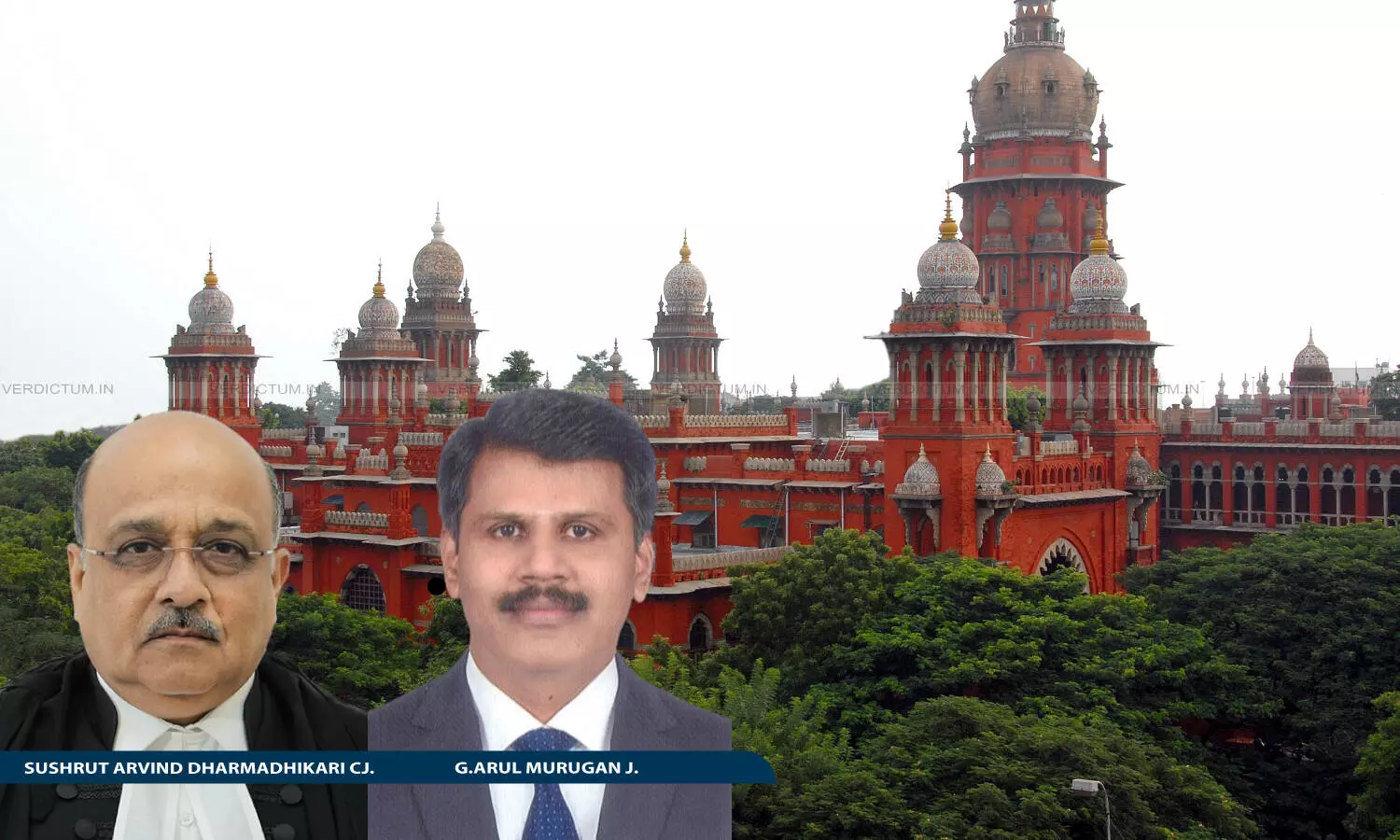
Chief Justice Sushrut Arvind Dharmadhikari, Justice G. Arul Murugan, Madras HC
Can’t Grant Relief That No Party Has Asked For: Madras High Court Sets Aside Direction Prohibiting Acquisition Of Elephants By Temples Or Private Individuals
 |
|The Madras High Court was considering the appeals where the appellant claimed that no prayer was made for the issuance of a direction to every temple not to acquire an elephant.
While observing that a Court cannot grant a relief that no party has asked for, particularly when granting it visits consequences on persons who were never given a chance to be heard, the Madras High Court has set aside a direction by a Single Judge requiring no further acquisition of elephants by temples or private individuals.
The High Court was considering the appeals filed under Clause 15 of the Letters Patent to set aside the order passed by the Single Judge on the ground that there was no prayer seeking a direction to the Hindu Religious and Charitable Endowments Department to instruct every temple in Tamil Nadu not to acquire an elephant, or a direction contemplating removal of elephants already with temples across the State.
The Bench comprising Chief Justice Sushrut Arvind Dharmadhikari and Justice G. Arul Murugan held, “A court cannot grant a relief that no party has asked for, particularly when granting it visits consequences on persons who were never given a chance to be heard. This is not a technicality. It is the very foundation of a fair hearing. However well-intentioned a direction may be, it cannot be sustained if it is passed against persons who were strangers to the proceeding and who had no opportunity to place their case before the court. This, in our view, is precisely what happened with paragraph 15 of the impugned order, so far as it concerns temples and the Hindu Religious and Charitable Endowments Department”, it noted.
“For the reasons stated above, we hold that the order dated 27.02.2023 in W.P.(MD)No.7655 of 2020, in so far as directions are issued to the Secretary, Environment and Forest Department, to cause an inspection of all temple and privately owned elephants; the direction treating the order of the First Bench as requiring no further acquisition of elephants by temples or private individuals; the observation that a call should be taken on shifting all captive elephants, temple-owned and privately owned, to Government Rehabilitation Camps; and the consequent direction to the Secretary, Hindu Religious and Charitable Endowments Department, to instruct all temples in Tamil Nadu not to acquire any elephant, cannot be sustained. These directions are set aside”, it added.
Senior Counsel A.K.Sriram represented the Appellant while Spl Government Pleader Mohammed Fayaz Ali represented the Respondent.
Factual Background
One S.G.M. Shaa @ Sheik Mohammed/first respondent, who had purchased a female elephant named "Lalitha" in the year 2000, applied to have her ownership transferred in his name. The Principal Chief Conservator of Forests and Chief Wildlife Warden rejected that request. Aggrieved, the first respondent filed a petition seeking quashing of the rejection order. The rejection order was upheld, but the first respondent was permitted to continue in custody of Lalitha, subject to the department's right to inspect her at any time and to move the Court again if circumstances so required.
Lalitha's health deteriorated, and she suffered further falls in January and February 2023. On being informed of her condition, the Single Judge, who had passed the earlier order, visited her personally along with certain animal welfare activists and found her in a distressing state, with multiple wounds and injuries. The case was listed the next day, "for being mentioned", and the impugned order came to be passed directing that her custody be handed over to the District Forest Officer and the District Level Captive Elephant Welfare Committee for treatment and a named veterinarian attend to her daily. The Secretary, Environment and Forest Department, was directed to inspect all temple and privately owned elephants in the State and the Secretary, Hindu Religious and Charitable Endowments Department, was asked to issue instructions to every temple in Tamil Nadu not to acquire any elephant.
Reasoning
The Bench, at the outset, reiterated that a court exercising writ jurisdiction must confine the relief it grants to what is pleaded and to the parties before it. Referring to the Tamil Nadu Captive Elephants (Management and Maintenance) Rules, 2011, which list twenty-six specific acts of cruelty that are prohibited, and Rule 15, which sets up State and District Level Welfare Committees to inspect records and review elephant welfare once every three months, the Bench noted that this is a comprehensive and carefully calibrated regulatory scheme.
The Bench observed that the Rule permits temples to hold elephants. It builds in permission requirements, housing norms, feeding norms, work limits, retirement rules, and a standing inspection machinery to make sure any captive elephant, wherever held, is properly cared for. “A validly made subordinate legislation of this kind has the force of law and continues to bind until it is set aside by a competent forum in appropriate proceedings, or amended by the rule-making authority itself. A court cannot, in the course of deciding an individual case, issue a direction that has the practical effect of overriding such Rule, without the Rules itself being under challenge and being found to be beyond the rule-making power or otherwise invalid”, it added.
The Bench was of the view that the directions issued by the Single Judge concerning Lalitha herself, her medical care, her retirement, the continuity of her mahout, and the protection of her surroundings from disturbance, were fully warranted on the facts placed before the Court and were well within the scope of the writ petition.
Affirming such directions, the Bench stated, “What we are unable to sustain is the leap from Lalitha's case to a State-wide pronouncement affecting every temple and every privately held elephant in Tamil Nadu, made without those temples being heard, without pleadings to support it, and in terms that go beyond both the order of the First Bench and the statutory Rules already in force.”
Cause Title: Arulmigu Sri Subramania Swami Thirukoil v. S.G.M. Shaa Alias Sheik Mohammed (Neutral Citation: 2026:MHC:3581)
Appearance
Appellant: Senior Counsel A.K.Sriram, Special Government Pleader R.Bharanidharan, Advocate Muthugeethayan
Respondent: Spl Government Pleader Mohammed Fayaz Ali