Can’t Convict Merely Because She Held Office When Irregularities Came To Light: Madhya Pradesh High Court Acquits Govt. Official In Corruption Case
 |
|The Madhya Pradesh High Court was considering a criminal appeal preferred against an order of conviction passed under the Prevention of Corruption Act.
While granting acquittal to a woman officer in a corruption case, the Madhya Pradesh High Court has held that a criminal court cannot convict a person merely because she held office during the period when irregularities came to light.
The High Court was considering a criminal appeal preferred under Section 374(2) of the Code of Criminal Procedure, 1973, against the judgment whereby the appellant was convicted under Section 13(1)(d) read with Section 13(2) of the Prevention of Corruption Act, 1988 (PC Act) read with Section 120-B of the Indian Penal Code, 1860 (IPC) on three counts. The conviction related to irregularities committed in relation to the missing of 110 transit passbooks, the failure to execute auction agreements in respect of 26 mines, and excess payments made towards advertisement charges.
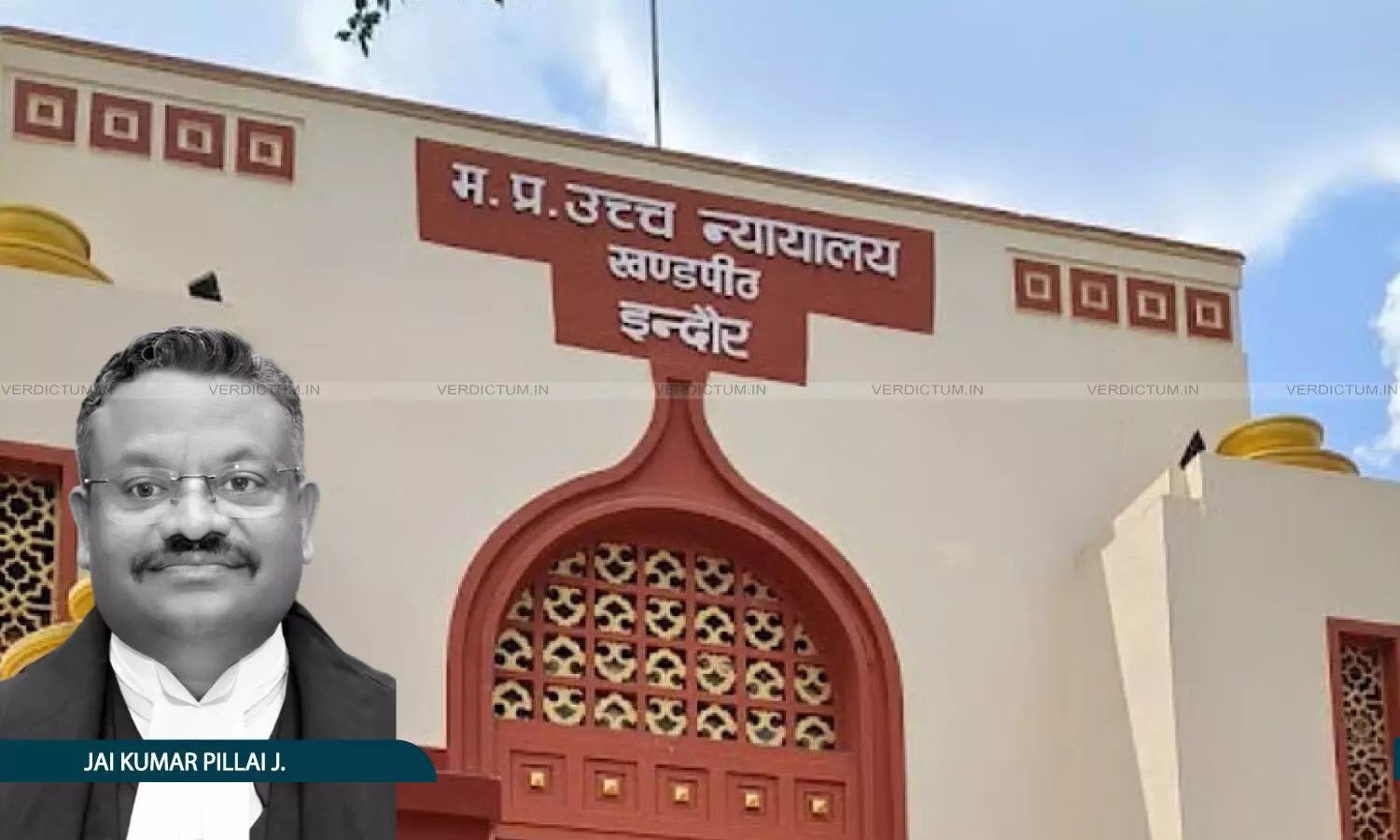
The Single Bench of Justice Jai Kumar Pillai held, “This Court further finds that a criminal court cannot convict a person merely because she held office during the period when irregularities came to light. The burden is always on the prosecution, and as laid down in J.A. Naidu and Others (supra), the accused is not required to prove her innocence. The prosecution has not been able to prove that the appellant obtained any pecuniary advantage for herself or for any other person, or that she intentionally caused wrongful loss to the State Exchequer. The evidence at most suggests administrative omission or supervisory inadequacy, which is not sufficient to constitute criminal misconduct in the absence of any dishonest intention.”
Senior Counsel Prakash Upadhyaya represented the Appellant while Advocate Lokendra Joshi represented the Respondent.
Factual Background
The Collector, Ujjain (M.P.) had directed an inquiry into the matter, and in pursuance thereof, a Committee was constituted. The Inquiry Officer found that the appellant, along with other co-accused persons, was responsible for the irregularities committed in the discharge of official duties as a 'public servant'. On the basis of the said inquiry, the then Chief Executive Officer, Janpad Panchayat, Ujjain (M.P.), lodged a complaint and a case came to be registered under Sections 406, 409, 467, 468, and 471 of the IPC, 1860. The appellant was posted as Chief Executive Officer (CEO), Janpad Panchayat, Ujjain from September 17, 2002 to October 14, 2003. The prosecution alleged that during her tenure, transit passbooks were irregularly dealt with, the auction duties in respect of 26 mines were not recorded from time to time, auction agreements were not executed, and advertisement bills were paid in excess of the prescribed bills.
Reasoning
The Bench noted that the Trial Court failed to consider that the appellant was exonerated in the departmental enquiry and was further promoted to a higher post. “This circumstance supports the defense that the matter, at most, discloses administrative irregularity and not criminal misconduct. Although departmental findings are not conclusive in a criminal trial, they cannot be ignored where the prosecution evidence itself falls short of proving dishonest intention”, it added.
On a perusal of the facts and evidence of the case, the Bench held that the same did not establish that the appellant was the custodian of the transit passbooks or had actual knowledge, possession, or control over their issuance or misuse. The evidence consistently placed the entire responsibility upon the accountants. The Bench also found that no letter was signed by the appellant sanctioning their issuance, no actual misuse was proved, and the alleged loss appeared to be based on assumption.
On the aspect of auction agreements and recovery of dues, the Bench noted that the evidence showed that the mandatory 25% of the balance bid amount was deposited during the appellant's tenure. It was further noticed that the proceedings for cancellation could only be initiated after the expiry of the three months (i.e., after October 8, 2003), whereas the appellant had been transferred on September 14, 2003. The Bench found that the appellant had issued notices to the successful bidders.
“At most, there could have been lapses in supervision, but considering the law laid down in C.K. Jaffer Sharif (supra), such lapses do not amount to criminal misconduct unless mens-rea and dishonest intention are proved. Regarding the advertisement expenditure, the bill payment was made under the directions of the Jila Panchayat. There was no evidence that the advertisement was fictitious, diverted, or used for personal gains”, it stated.
As per the Bench, even if there was excess payment, it would at most amount to an irregularity or deviation from departmental norms. “In the absence of proving dishonest intention or undue pecuniary advantage, criminal misconduct is not established”, it added.
Considering that the charge under Section 120-B of the IPC remained unproven, the Bench also held that the prosecution was unable to prove that the appellant obtained any pecuniary advantage for herself or for any other person, or that she intentionally caused wrongful loss to the State Exchequer. “The evidence at most suggests administrative omission or supervisory inadequacy, which is not sufficient to constitute criminal misconduct in the absence of any dishonest intention”, it mentioned.
Thus, holding that the prosecution failed to prove beyond a reasonable doubt that the appellant dishonestly abused her official position by causing wrongful loss to the State Exchequer or entered into a criminal conspiracy, the Bench allowed the criminal appeal and acquitted the appellant of all the charges.
Cause Title: Smt. Sabeena Ninama v. The State of Madhya Pradesh (Neutral Citation: 2026:MPHC-IND:23403)
Appearance
Appellant: Senior Counsel Prakash Upadhyaya, Advocates Aditya Singh, Kinjal Shrivastava
Respondent: Advocate Lokendra Joshi