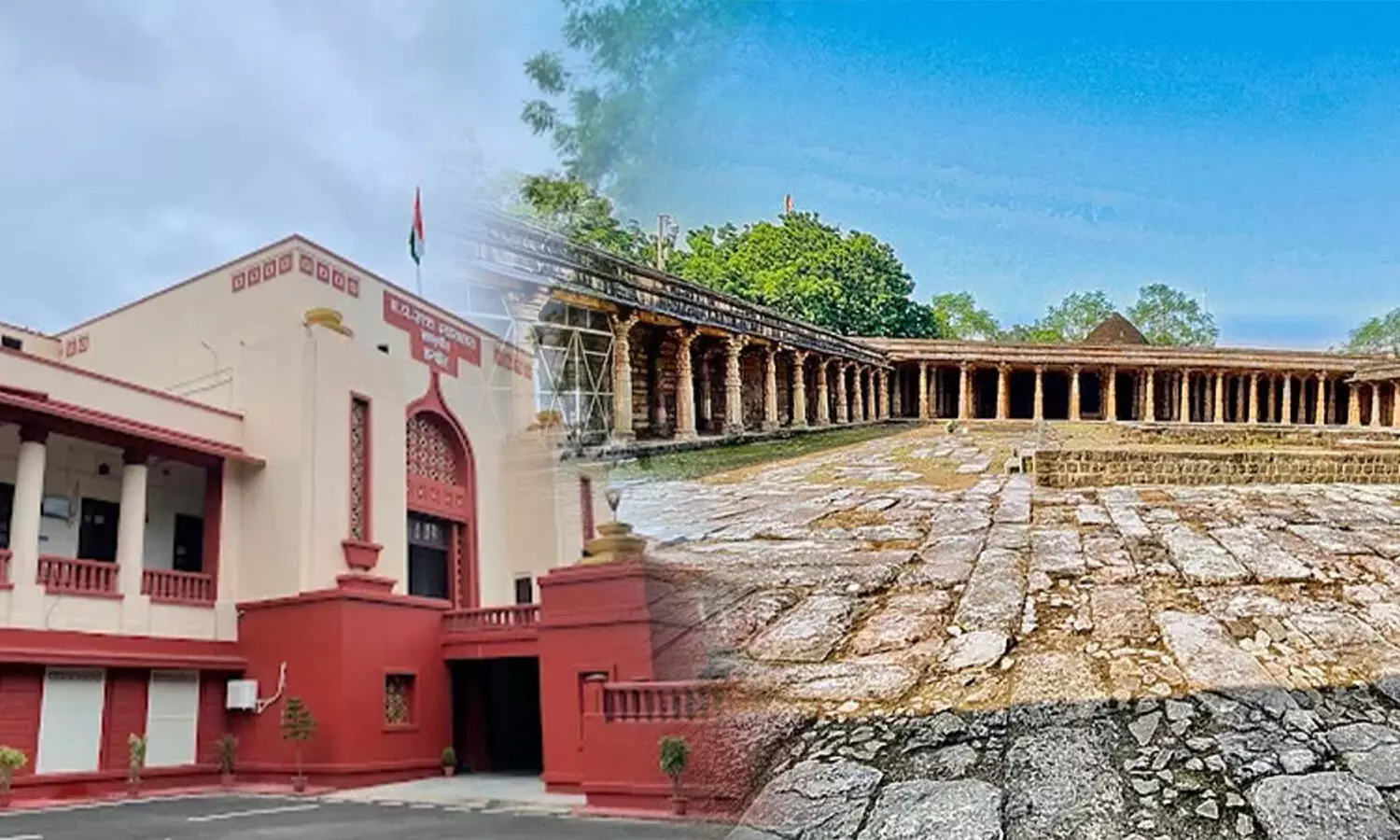
"Bhojshala Complex And Kamal Maula Mosque Is Held To Be Bhojshala With Temple Of Goddess Vagdevi": MP High Court Quashes ASI Circular Permitting Namaz
 |
|The Court held that the structure was originally a 11th-century Sanskrit learning center and Saraswati temple, ruling that historical modifications did not extinguish its primary religious character.
The Madhya Pradesh High Court has declared the disputed Bhojshala-Kamal Maula Mosque complex in Dhar as a protected monument with the character of a Hindu temple dedicated to Goddess Vagdevi (Saraswati).
The Court quashed the April 7, 2003, Archaeological Survey of India (ASI) order that had restricted Hindu worship to specific days and permitted Friday namaz for the Muslim community.
Relying on a comprehensive scientific survey by the ASI—which unearthed 94 sculptures and over 150 Sanskrit inscriptions—the Court found that the site was constructed by Raja Bhoj in 1034 A.D. and that the subsequent conversion into a mosque during the medieval period occurred via the reuse of temple materials without a valid Waqf dedication.
Consequently, the Court directed the Central Government and the ASI to manage the site as a temple and Sanskrit center, while suggesting the State allot alternative land for the construction of a mosque to ensure communal harmony.
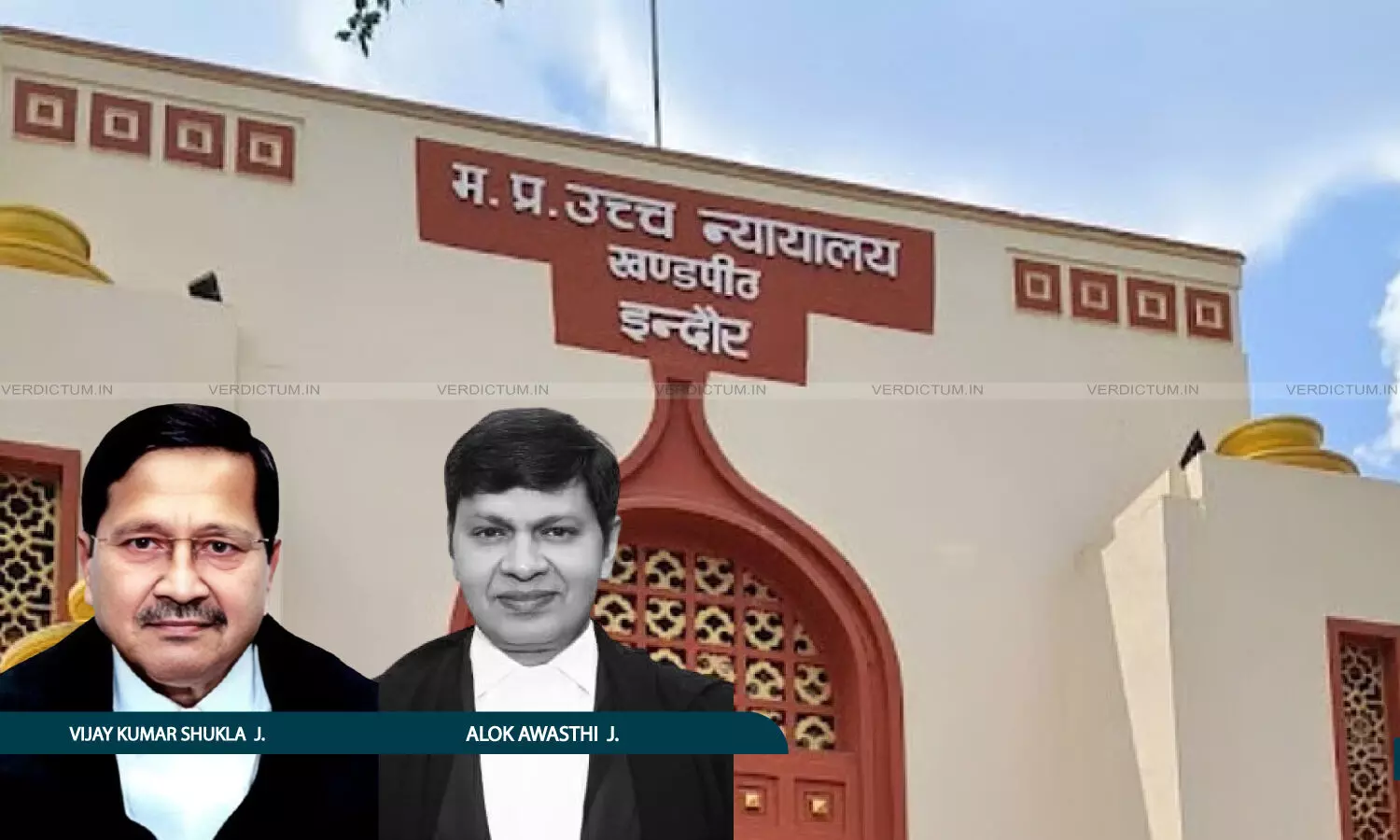
The Division Bench of Justice Vijay Kumar Shukla and Justice Alok Awasthi observed, "The disputed area of Bhojshala and Kamal Maula Mosque‘ is held to be a protected monument under 1958 Act with effect from 18.3.1904...The religious character of disputed area of the Bhojshala Complex and Kamal Maula Mosque is held to be a Bhojshala with a temple of goddess Vagdevi (Saraswati)...The impugned order dated 7.4.2003 passed by the Director, ASI (paragraph 3 of the said order) to the extent restricting right of Hindus to worship within the Bhojshala complex, in the property in question at land No.604 (Old No.313) and also permitting the prayer by the Muslim community are quashed."
Advocate Vishnu Shankar Jain for Hindu Front of Justice, Senior Advocate Salman Khurshid for the Respondents, with Advocate General Prashant Singh for the State of Madhya Pradesh.
Facts of the Case
Various petitions and the appeal concerned common issues pertaining to the claims for the performance of Hindu prayers, Muslim namaz, and prayers by the Jain Samaj within the "disputed area" of the Bhojshala and Kamal Maula Mosque situated at Dhar. In these petitions, the petitioners challenged the order dated April 7, 2003, issued by the Archaeological Survey of India (ASI). The challenge specifically contested the restriction placed upon the rights of Hindus to worship within the Bhojshala Complex—the "disputed area"—to specific days and timings.
Furthermore, the petitioners assailed the validity of the order that permitted the Muslim community to offer namaz on Fridays within the said "disputed area." While various petitions sought distinct reliefs, they all related substantively to the same disputed premises.
Contentions of the Parties
The Petitioners contended that property once vested in a deity remains so in perpetuity. He argued that a mosque cannot be legally constructed on non-Waqf land, nor can a structure built by demolishing a temple be termed a mosque. He further asserted that the destruction of this religious site violates the "right to life" and spiritual freedom guaranteed under Articles 21 and 25 of the Constitution. The petitioner maintained that the structure was built in 1034 A.D. by Raja Bhoj as a Sanskrit School and a temple for Goddess Vagdevi.
Under Islamic Law, a valid Waqf requires the dedicator to be the lawful owner. The counsel argued that since the land was never owned by Muslim rulers and was already vested in the Hindu deity, no valid Waqf was created. Consequently, the building remains a temple, and its description as a mosque in government records is a historical error. He concluded that the conversion of the temple was an act of "dehumanization" by invaders. He argued that under Article 13(1), any pre-constitutional practice that restricts Hindu worship or mandates the presence of a mosque on temple land must be declared void.
Per contra, the arguments advanced by the Respondents and interveners centered primarily on the legal maintainability of the petitions and the statutory protection of the site's religious character. It was contended that the petitions involved complex, disputed questions of fact and title that could not be adjudicated under the writ jurisdiction of Article 226. He argued that a civil suit, where evidence is tested through cross-examination, was the only appropriate remedy. Furthermore, a preliminary objection was raised regarding the petitioner’s locus standi, asserting that the petition failed to comply with High Court rules requiring the disclosure of the petitioner's social and professional antecedents.
It was emphasized that the law does not permit the adjudication of historical wrongs committed by past regimes. Furthermore, they argued that under the Places of Worship Act, 1991, the religious character of a site was frozen as of August 15, 1947, thereby barring any attempt to alter its status based on ancient claims. The respondents asserted that the site has been consistently recognized and used as a mosque and dargah for centuries. It was pointed out that historical Sanads (royal grants) and revenue records (Khasra entries) that officially designate the land as "Masjid." It was argued that the lineage of the caretakers and the continuous performance of namaz established long-standing customary and possessory rights. It was further noted that the structure contains essential Islamic architectural features—such as the Qubla, Mihrab, and Minbar—which confirm its established usage.
Finally, the interveners argued that the claim was barred by the Waqf Act, 1995, as the property had already been notified as Waqf land decades ago and was not challenged within the statutory limitation period. They contended that the ASI acts merely as a custodian of the protected monument and lacks the authority to change its religious character. The respondents concluded that the petitioner's case rested on faith and historical conjecture rather than legal proof, and therefore, the petitions were liable to be dismissed as not maintainable in a writ court.
The State of Madhya Pradesh argued that the High Court possesses wide jurisdiction under Article 226 to resolve this dispute, asserting that factual controversies do not bar judicial intervention when public order and constitutional rights are at stake. It was emphasized that the State, acting as a secular and welfare entity, seeks a final legal determination to replace the "temporary" 2003 arrangement, which has placed an immense administrative and security burden on the government due to recurring communal tensions.
Relying heavily on the principles of the Ayodhya judgment and the recent ASI scientific survey, it was contended that the presence of Paramara-period temple remains, mutilated Hindu sculptures, and Sanskrit inscriptions confirms the site's original character as a religious and educational complex associated with King Bhoja. Furthermore, the State dismissed the legal validity of the 1935 "Ailan" (notification), arguing it was a mere administrative order rather than legislative law and that, under Article 13 of the Constitution, it cannot override fundamental religious rights or preclude the Court from adjudicating the site's true historical and legal status.
Observations of the Court
The Court observed that the Bhojshala complex was originally constructed in 1034 A.D. by Raja Bhoj as a center for Sanskrit learning and a temple dedicated to Goddess Saraswati. It noted that the historical and architectural evidence, including Sanskrit inscriptions and temple motifs, clearly established the site's Hindu religious and educational character long before any subsequent modifications.
The Court rejected the legal validity of the 1935 "Ailan" (notification) issued by the Dhar State, which had recognized the area as a mosque. It held that since the site was already a protected monument under the 1904 Act, the Ruler lacked the authority to issue such an executive order. Furthermore, the Court determined that this order was an administrative arrangement that failed the constitutional tests of Articles 13 and 372, making it inconsistent with fundamental religious rights.
Regarding the Islamic claims, the Court found no evidence that a valid Waqf was ever created for the property. It noted that under Mahomedan Law, a mosque can only be built on land dedicated by its owner to the Almighty, but the historical material showed that the land remained vested in the deity. It concluded that the structural modifications used to convert the site into a mosque occurred much later, during the medieval period, and involved the reuse of temple materials.
The Court upheld the findings of the Archaeological Survey of India (ASI) scientific report, describing it as a rigorous and impartial multidisciplinary study. It observed that the discovery of 94 sculptures, including images of Ganesha, Vishnu, and Narasimha, along with over 150 Sanskrit inscriptions, conclusively proved the existence of a pre-existing Hindu temple. It dismissed allegations of institutional bias, noting that the survey team included experts from various communities and representatives from all contesting parties.
The Court also addressed the competing claims of the Jain community. It reasoned that since Jainism is legally and historically considered a branch of Hinduism, the presence of Jain Tirthankara figures alongside Hindu deities was natural. However, it clarified that there was no archaeological or historical material to suggest that the complex was ever a dedicated Jain temple. It held that whether the recovered idol was "Saraswati" or "Ambika," the site’s primary character remained that of the Bhojshala temple.
"In the aforementioned white marble statue of Amba (or Vidyadevi), several smaller figures are depicted alongside the central image. Among these some figure of a- Sadhak‖(spiritual seeker) or some figure of Jain Tirthankara seated in the―Padmasana‖ posture is also visible. As discussed previously, the presence of a Jain Tirthankara or a ―Sadhak‖ or ascetic seated in-Padmasana‖ in the background of the Hindu statue of goddess ―Saraswati‖ is entirely natural, given that Jainism is, in fact, a branch of Hinduism...In view of the aforesaid, there is no reason to disbelieve that the disputed area was Bhojshala, having a temple of Maa Saraswati", it said.
Finally, the Court quashed the 2003 ASI order that had restricted Hindu worship and allowed Muslim prayers at the site. It declared the entire complex to be a protected monument with the religious character of a temple.
The Court held, "We have noted the continuity of hindu worship at the site through regulated over time has never been extinguished. We record finding that historical literature placed established that the character of the disputed area was Bhojshala as a Centre of Sanskrit learning associated with Raja Bhoj of Parmar dynasty and the literature and architectural reference, including those connected with the period of Raja Bhoj indicate the existence of temple dedicated to the goddess Saraswati at Dhar."
Consequently, it directed the Government of India to manage the complex as a temple and Sanskrit center, while permitting the State to consider allotting alternative land to the Muslim community for the construction of a new mosque.
It said, "The Government of India and the ASI will take a decision for the purpose of administration and management of the affairs of the Bhojshala temple and Sanskrit learning within the property in question at Land No.604 (Old No.313) situated at Dhar, District Dhar and the ASI will continue to have overall administration and management of the property in accordance with the provisions of the Act 1958...The ASI shall have full supervisory control over the preservation, conservation and regulation of religious access."
Accordingly, the petitions filed by Hindu Front for Justice and Kuldeep Tiwari were allowed, and the petitions filed by Maulana Kamlauddin Welfare Society were dismissed.
The Supreme Court had refused to review the survey report, videography and objections made by the Maulana Kamaluddin Welfare Society in the dispute pertaining to the Bhojshala Temple-Kamal Maula Mosque.
Previously, in January 2026, the Supreme Court allowed Hindu prayers from sunrise to sunset on Basant Panchami on Friday at the disputed Bhojshala-Kamal Maula Mosque in Madhya Pradesh's Dhar district, while permitting Muslims to offer namaz from 1 pm to 3 pm on the day.
In May 2022, the High Court had issued notice in the matter.
Cause Title: Hindu Front For Justice (Regd. Trust No. 976) Through Its President Ms. Ranjana Agnihotri & Ors. v. Union Of India & Ors. and other connected matters [Neutral Citation: 2026:MPHC-IND:8805]
Appearances:
Petitioners: Senior Advocate Shobha Menon, Senior Advocate A.K. Chitale, Advocates Vishnu Shankar Jain, Manish Gupta, Dinesh.P.Rajdhar, Noor Ahmed Sheikh and others.
Respondents: Senior Advocate Salman Khurshid, Advocate General Prashant Singh, Additional Advocate General Nilesh Yadav, Additional Advocate General Rahul Sethi, Additional Advocate General Dhirendra S. Parmar, Additional Advocate General Ashish Yadav, Additional Advocate General Sonal Gupta and others.