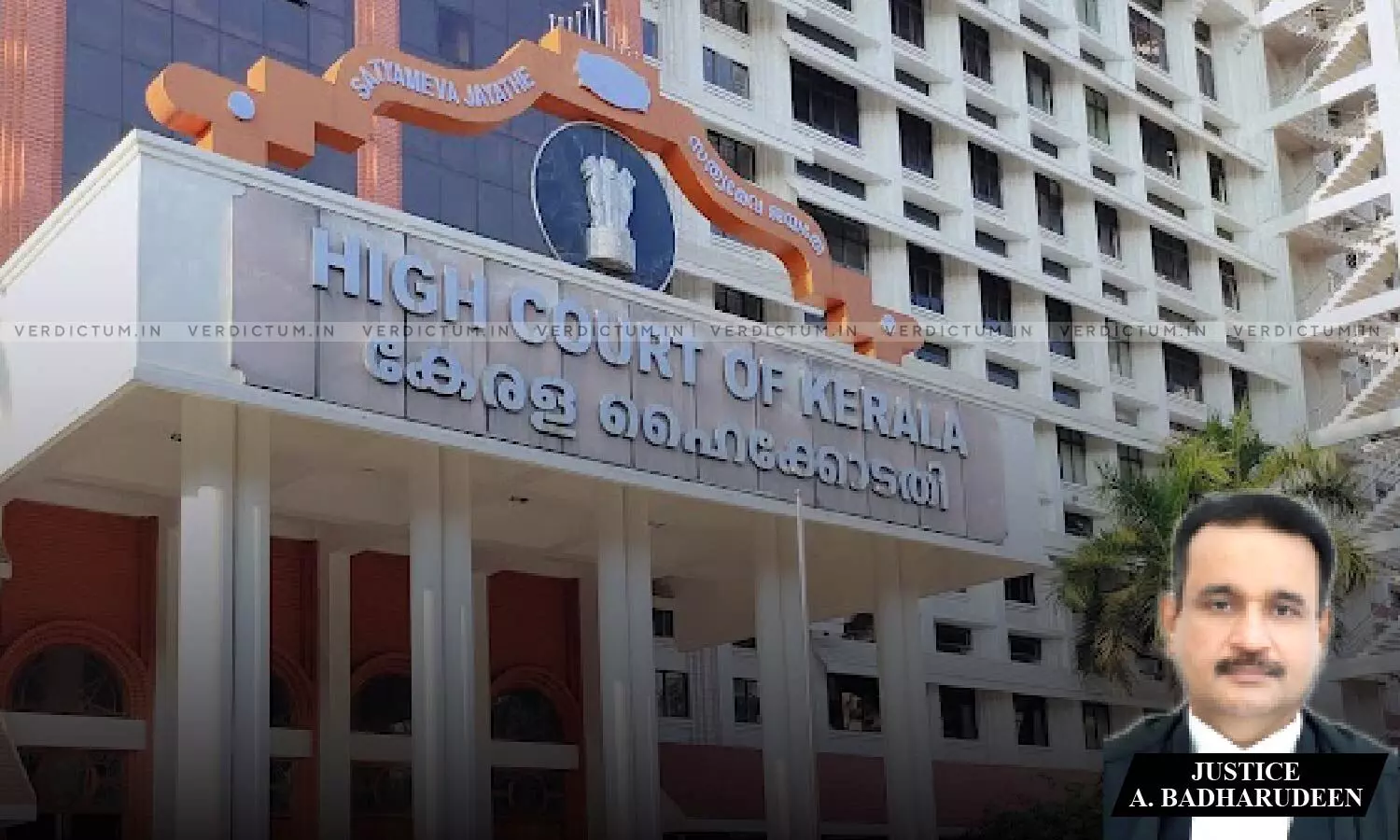
Justice A. Badharudeen, Kerala High Court
Notice Returned "Unclaimed" Amounts To Deemed Service U/S 138 NI Act If Sent To Correct Address Of Drawer: Kerala High Court Restores Conviction
 |
|The Court held that the complainant’s testimony established the transaction & execution of the cheque, and the accused failed to rebut the statutory presumption under Section 139 NI Act.
The Kerala High Court has held that a statutory demand notice issued under Section 138(b) of the Negotiable Instruments Act, 1881, cannot be treated as invalid merely because it was returned with the postal endorsement “unclaimed”, provided that the notice was sent to the correct known address of the cheque drawer.
Allowing a criminal appeal filed by the complainant, the Bench set aside the acquittal of the accused recorded by the Judicial First Class Magistrate Court, and convicted him for dishonour of a cheque under Section 138 of the NI Act.
The Bench reversed the Magistrate’s findings on three counts: holding that the demand notice returned as ‘unclaimed’ amounted to deemed service, that the complainant had sufficiently proved the loan transaction and cheque liability, and that the minor inconsistency regarding the parties’ relationship was insufficient to discredit the prosecution case.
Justice A. Badharudeen observed, “…issuance of notice in the known address of the drawer of the cheque would suffice the requirement of notice under Section 138(b) of the N.I Act. When notice was issued to the drawer of the cheque and the same returned with endorsement `unclaimed’, unless the accused is able to establish that the notice was not issued in his address by convincing evidence, return of the demand notice with endorsement `unclaimed' would suffice the requirement of issuance of notice as well as its deemed acceptance. In view of the above, the finding of the learned Magistrate in this regard is also liable to be reversed…”.
Vipin Narayan A., Senior Public Prosecutor appeared for the respondent.
The case arose from a complaint alleging that the accused had borrowed ₹90,000 from the complainant and issued a cheque towards repayment of the liability. The cheque was dishonoured due to insufficient funds. Subsequently, the complainant issued a statutory demand notice, but the notice was returned with the endorsement “unclaimed”.
The trial court had acquitted the accused, holding that there was no valid service of statutory notice and that the complainant failed to sufficiently establish the underlying transaction. Challenging the acquittal, the complainant approached the High Court.
Referring to the Supreme Court’s ruling in C.C. Alavi Haji v. Palapetty Muhammed, the Court noted that when a demand notice is dispatched by registered post to the correct address of the cheque drawer, the requirement of notice under Section 138(b) stands satisfied.
On the Magistrate’s finding regarding absence of legal notice in the case, the Bench said, “…the same appears to be patently illegal. In the instant case, when Ext.P5 notice (Ext.P3 is its office copy) was issued, the same was returned with endorsement `unclaimed’. This endorsement would indicate that the reason for return of the notice was refusal on the part of the accused/addressee to accept the same. It is pertinent to note that as pointed out by the complainant, when summons was issued to the accused in the address shown in the notice he had accepted the same and appeared before the court as a sequel thereof. In fact, issuance of notice under Section 138(b) of the N.I Act and acceptance of the same by the accused are two separate events, though service of notice is having relevance to count the limitation period for filing the complaint”, the Bench noted.
“…Regarding the anomaly in the evidence of PW1 by stating his relationship with that of the accused as a person known to him in the complaint and the accused as his friend during evidence, the same is of least significance since both versions only indicate the acquaintance between them to justify the transaction. Therefore the said finding of the learned Magistrate is also reversed…In the instant case, the evidence of PW1 proved the initial burden cast upon the complainant and therefore the complainant would very well get the presumption under Section 139 of the N.I Act, which was failed to be rebutted by the accused. Therefore, the accused found to have committed the offence punishable under Section 138 of he N.I Act”, the Bench noted.
Holding that the complainant was entitled to the statutory presumption under Section 139 of the NI Act and that the accused failed to rebut it, the Court found the accused guilty of the offence.
The High Court sentenced the accused to imprisonment till the rising of the court and imposed a fine of ₹1.30 lakh, with a default sentence of four months’ imprisonment.
Cause Title: Sreekumaran Namboodiri v. U.P. Mohammed & Anr. (Neutral Citation: 2026:KER:41753)
Appearances:
Respondent: M. Muhammed Shafi, A. Parvathi Menon, P. Sanjay, Advocates and Vipin Narayan. A, Senior Public Prosecutor.
Click here to read/download the Judgment