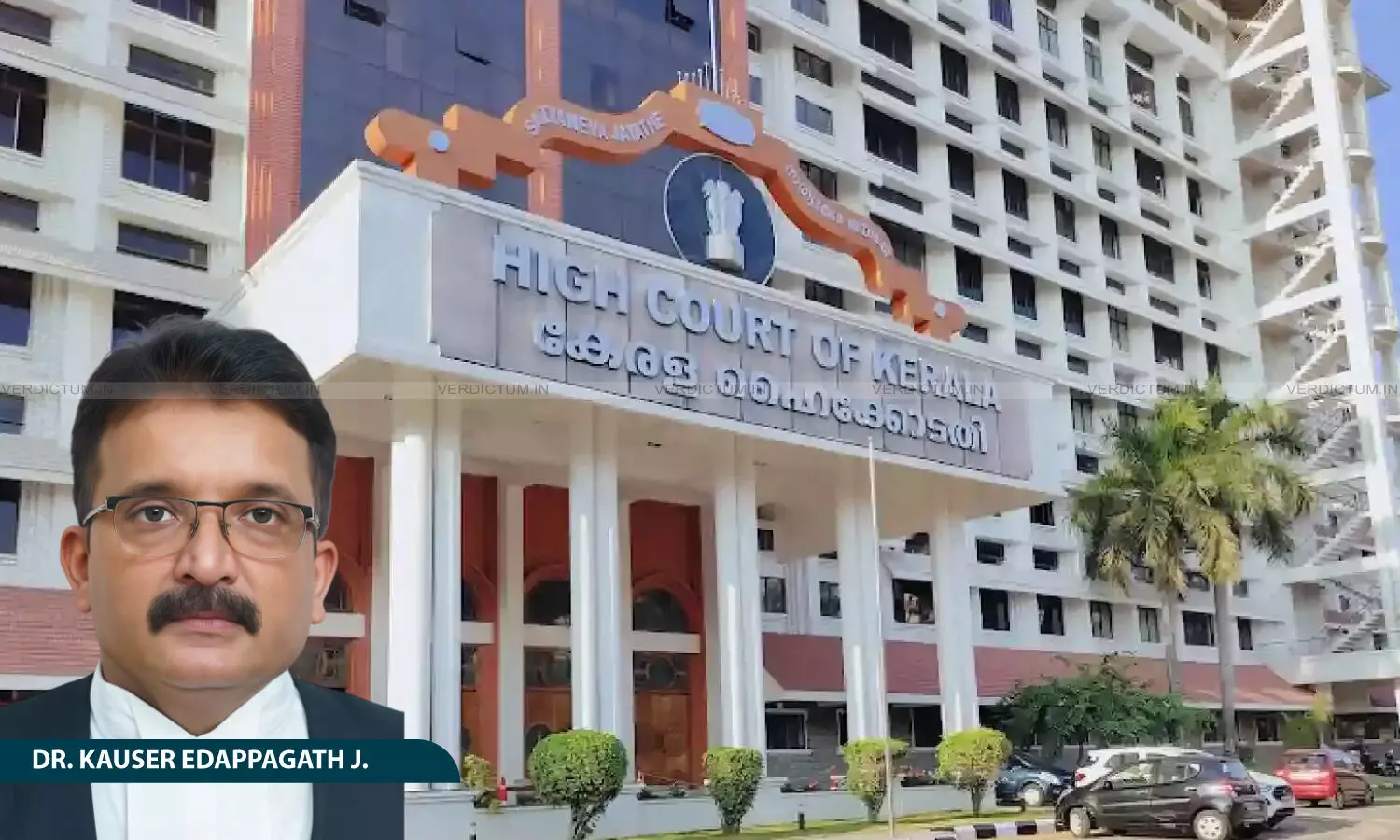
Grounds Of Arrest Must Be Communicated To Accused & Relative/Friend Before Transit Remand: Kerala High Court Grants Bail In NDPS Case
 |
|The Court held that production before the nearest Magistrate for transit remand is also a constitutional checkpoint for examining the legality of arrest under Article 22.
The Kerala High Court has held that when an arrested person is produced before a non-jurisdictional Magistrate for transit remand, the grounds of arrest must be communicated both to the arrestee and to his relative or friend before such production.
Finding non-compliance with Article 22(1) of the Constitution and Section 48 of the Bharatiya Nagarik Suraksha Sanhita, 2023, the Court allowed the regular bail applications filed by three accused in an NDPS case.
The Court was hearing regular bail applications filed by accused Nos. 4, 6 and 7 in a Narcotics Control Bureau case registered at Kochi for offences under Sections 8(c), 20(b)(ii)(C), 23, 25, 27A, 28 and 29 of the Narcotic Drugs and Psychotropic Substances Act, 1985.
A Bench of Justice Kauser Edappagath observed: “… when a person who is arrested is brought before a non-jurisdictional Magistrate even if only for the purpose of ordering a transit or transit remand, it is imperative that the grounds of arrest be communicated both to the aresstee and to his relative or friend, as mandated under Article 22(1) of the Constituiton and Sections 47 and 48 of the BNSS, prior to such production.”
Advocates N. Krishna Prasad and P. Mohamed Sabah appeared for the applicants; Special Prosecutor R. Vinu Raj appeared for the Narcotics Control Bureau.
Background
The prosecution case was that, on credible information, the NCB, Cochin Zonal Unit, initially seized 604 grams of Charas from the residence of accused No. 1. During interrogation, accused No. 1 allegedly disclosed that the contraband had been sourced from a Keralite drug trafficking gang based in Greater Noida, and that the remaining contraband was concealed in the rented premises of accused Nos. 4 and 5.
NCB officers from the Cochin and Delhi Zonal Units thereafter searched a flat in Greater Noida, where accused Nos. 4, 6, 7 and 8 were present, and allegedly recovered 36.735 kilograms of Hydroponic Cannabis and 3.942 kilograms of Charas. The applicants were apprehended in Delhi, produced before the Judicial First Class Magistrate, Patiala House Court, New Delhi, for transit warrant, brought to Kochi and then produced before the Sessions Court, Ernakulam.
Accused Nos. 4 and 7 contended that no intimation of arrest, as contemplated under Section 48 of the BNSS, was furnished to any relative or friend before their production before the Magistrate at New Delhi. Accused No. 6 disputed the time of his production and argued that the communication to his father was either after production or, even on the prosecution’s version, delayed by thirteen hours.
The NCB submitted that the grounds of arrest were furnished to the relatives of the accused before their production before the Magistrate at New Delhi. It further contended that, when an accused is arrested outside the jurisdiction where the crime is registered and produced before the nearest Magistrate only for transit remand, compliance with Article 22(1) and Sections 47 and 48 of the BNSS is required only before production before the jurisdictional Magistrate.
Court’s Observations
The Court observed that Article 21 guarantees personal liberty, while Article 22 operates as a constitutional check against arbitrary deprivation of liberty. It noted that Article 22(1) protects the right of the arrested person to be informed of the grounds of arrest and to consult and be defended by legal counsel, while Article 22(2) mandates production before a Magistrate within twenty-four hours.
The Court observed: “These protections are indispensable, for they ensure that liberty is not left vulnerable to unbridled executive power.”
Referring to Joginder Kumar v. State of U.P. (1994) and D.K. Basu v. State of West Bengal (1997), the Court noted that the right of an arrested person to have a relative, friend or nominated person informed is an essential facet of Articles 21 and 22(1).
The Court noted that the same constitutional safeguards earlier embodied in Section 50A of the Code of Criminal Procedure are now contained in Sections 47 and 48 of the BNSS.
The Court held: “Even apart from Section 48 of the BNSS, the right to intimate a relative or friend is integral to Article 22(1); the statutory provision merely reinforces it. The mandatory language of Section 48 underscores its compelling nature and leaves no scope for dilution.”
It referred to Pankaj Bansal v. Union of India (2024), Prabir Purkayastha v. State (NCT of Delhi) (2024), Vihaan Kumar v. State of Haryana (2025), Kasireddy Upender Reddy v. State of Andhra Pradesh (2025), and Mihir Rajesh Shah v. State of Maharashtra (2026), and recorded that failure to comply with the dual requirement of informing the arrestee and his relatives or friends would vitiate the arrest.
The Court rejected the NCB’s contention that compliance with Article 22(1) and Sections 47 and 48 of the BNSS could wait until production before the jurisdictional Magistrate. It held that production for transit remand before the nearest Magistrate is also a stage where the legality of arrest must be examined.
The Court observed: “A transit remand is nevertheless a remand and is handing over to police custody.”
Relying on Gautam Navlakha v. National Investigating Agency (2022), the Court held that transit remand amounts to police custody. It added that an arrested person cannot be handed over to police custody without the arrest being legitimised.
The Court held: “Essentially therefore, the Magistrate to whom the person is produced after the arrest-the mandatory requirement of ascertaining whether the very arrest is illegal cannot be shifted to the jurisdictional Magistrate.”
The Court noted that Section 58 read with Section 187 of the BNSS requires production before the nearest Magistrate, and not necessarily the jurisdictional Magistrate. It held that the same approach must inform the construction of Sections 47 and 48 of the BNSS.
The Court observed: “The contextual milieu arising from a construct of the above provisions is that the checks and balances as provided for in Article 22(1) will have to be met when the arrested person is produced before the Magistrate for the first time, i.e. the nearest Magistrate (who may or may not be a jurisdictional Magistrate) upon arrest and detention.”
The Court further held that the facilitative purpose of transit remand cannot dilute Article 22(1), since the first production before a Magistrate is the point at which the legality of arrest must be tested.
On facts, the Court found no material to establish that the relatives or friends of accused Nos. 4 and 7 were communicated the grounds of arrest before their production before the Magistrate at New Delhi.
The Court noted: “Significantly, the remand reports of the accused Nos. 4 and 7 contain no reference to any communication of the grounds of arrest to their relatives prior to their production before the Magistrate at New Delhi.”
It found that the relevant documents purported to show service on relatives who were admittedly in Kerala during the relevant period. The Court concluded that communication to the relatives of accused Nos. 4 and 7 occurred only after their production before the Magistrate at New Delhi.
As regards accused No. 6, the Court noted the dispute on the time of production before the Magistrate at New Delhi. The prosecution asserted that production took place at 6.45 p.m., while the accused asserted that it took place at 2.45 p.m. The father of accused No. 6 was admittedly informed through WhatsApp at 3.01 p.m.
The Court observed that the prosecution had placed no material on record, and that the case diary contained no entry, to substantiate its version of production at 6.45 p.m. Referring to Vihaan Kumar (2025), the Court held that when an arrested person alleges non-compliance with Article 22(1), the burden lies on the investigating agency to establish compliance.
The Court accordingly accepted the accused’s assertion that he was produced at 2.45 p.m. and held that the grounds of arrest were not communicated to his relative before production, thereby vitiating the arrest.
The Court also considered the prosecution’s argument on the two-hour rule explained in Mihir Rajesh Shah (2026). It noted that the issue in the present case was not non-furnishing of grounds of arrest to the arrestee, since the grounds had been furnished to accused No. 6 in writing at 2.20 a.m., but delayed intimation to his father.
The Court held: “The above judgment in no manner supports the prosecution.”
It further observed: “When the requirement of Sections 47 and 48 of the BNSS forms an integral part of Article 22(1), and when the connotations of “as soon as may be” in Article 22(1) remains unchanged, subject to the exceptions in the above judgment, on the sole ground that intimation to the father has been delayed by 13 hours admittedly, is itself an infraction of Article 22(1).”
Conclusion
The Court held that there was complete non-compliance with Article 22(1) of the Constitution read with Section 48 of the BNSS, since the grounds of arrest were not communicated to the relatives or friends of accused Nos. 4, 6 and 7 in the manner mandated by constitutional and statutory provisions. It held that their arrests stood vitiated and allowed the bail applications.
The applicants were directed to be released on bail on executing bonds of Rs.1,00,000 each with two solvent sureties each. The Court further directed them to cooperate with the investigation, appear before the investigating officer every Saturday and whenever required, not commit a similar offence, not contact or influence prosecution witnesses, not tamper with evidence, and not leave Kerala without the trial Court’s permission. Any application for deletion or modification of bail conditions, or for cancellation of bail on violation of conditions, was directed to be filed before the jurisdictional court.
Cause Title: Muhammed Ashfaq C v. Union of India and connected cases (Neutral Citation: 2026:KER:66077)
Appearances
Applicants: Advocates N. Krishna Prasad, Imam Grigorios Karat, A. Mohammed Faizal, P. Shanes Methar, Harkish Sreethu V.S., Arjun P.V., P. Mohamed Sabah, Libin Stanley, Saipooja, Sadik Ismayil, R. Gayathri, M. Mahin Hamza, Alwin Joseph, T.I. Safdarshah, Benson Ambrose and Rameesa P.A.
Respondents: Special Prosecutor R. Vinu Raj, NCB, with Advocates Anjaly Sagar A.A., Sangeeth Krishna G.S. and Ashok Poulo Paul; Senior Public Prosecutors V. Vinay and Aneeda Beegum.