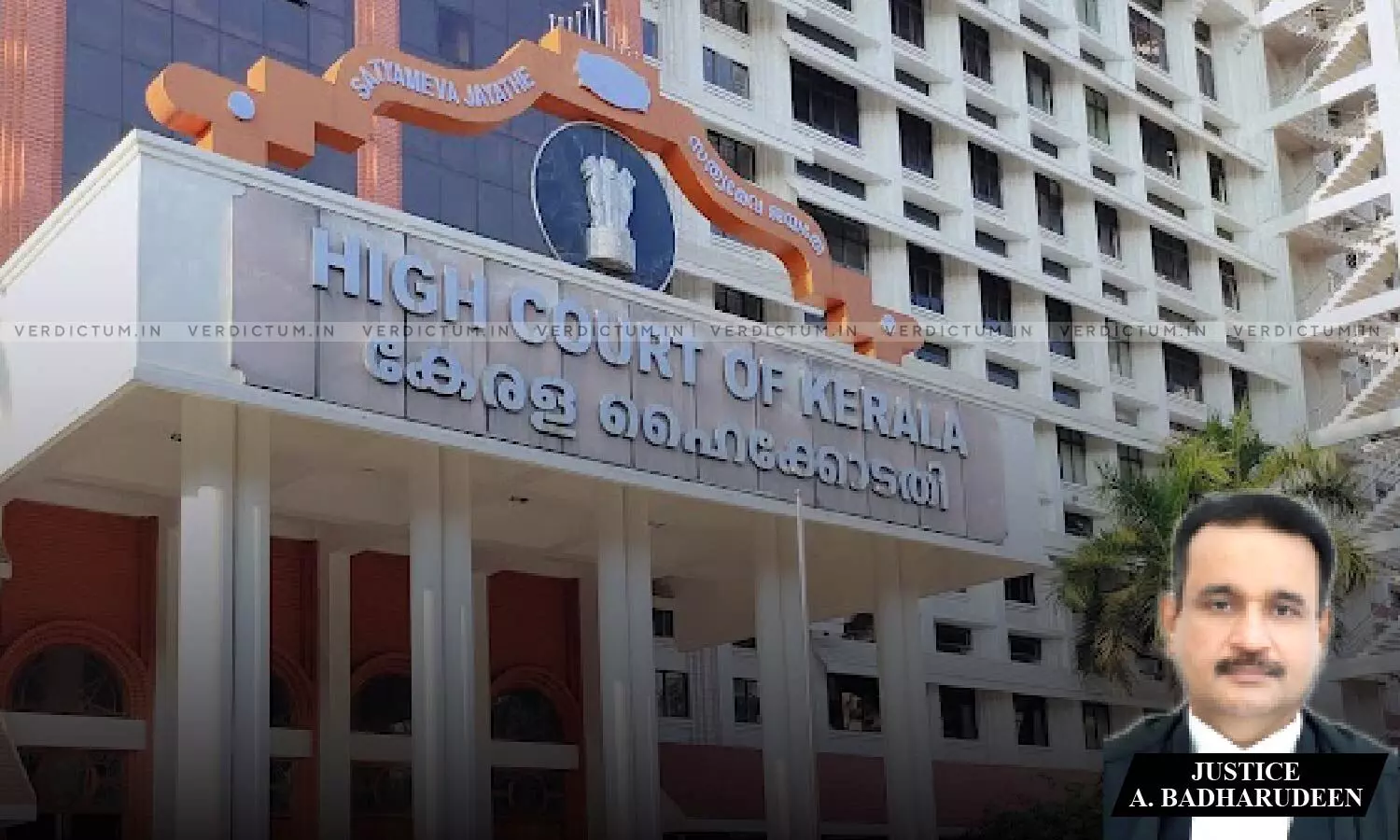
Justice A. Badharudeen, Kerala High Court
Forcibly Placing Vibrating Machine On Vaginal Orifice Constitutes Penetrative Sexual Assault: Kerala High Court
 |
|The Court confirmed the conviction of the appellant, holding that insertion “to any extent” under Section 3(b) of the POCSO Act and Section 375(b) IPC includes placing a vibrating machine on the vaginal orifice.
The Kerala High Court has held that forcibly placing a vibrating machine on the vaginal orifice, including the labia majora or vulva, is sufficient to constitute penetrative sexual assault under Section 3(b) of the POCSO Act and rape under Section 375(b) IPC.
The High Court dismissed the appeal filed by the accused and confirmed the conviction and sentence imposed by the Special Court, including the statutory minimum sentence of ten years’ rigorous imprisonment under Section 4(1) read with Section 3(b) of the POCSO Act.
The Court was hearing a criminal appeal challenging the conviction of the appellant for offences under Sections 376(1) read with 375(b), 354B and 506(i) IPC, and Section 4(1) read with Section 3(b) of the POCSO Act.
A Bench of Justice A. Badharudeen observed: “Here comes the significance of the statutory wording that ‘insert to any extent’. That means, placing a vibrating machine on the orifice of the vagina viz., labia majora, or vulva, by itself would be sufficient to find insertion of M.O1 on the vagina and the same is sufficient to hold that a person committed penetrative sexual assault as defined under Section 3(b) punishable under Section 4 of the POCSO Act. Similar is the position with regard to the offence of rape defined under Section 375(b) of the IPC.”
Advocate M.G. Sreejith appeared for the appellant, while Public Prosecutor Sajeev P.K. appeared for the State.
Background
The prosecution's case was that the appellant, who was working as a manager in a treatment centre, misused his authority and took the minor victim to a treatment room. It was alleged that he placed a vibrating machine fitted with an oval, penis-like attachment on her vagina in a vibrating condition after forcefully laying her on the treatment bed and lowering her clothes.
The Special Court convicted the appellant under Section 4(1) read with Section 3(b) of the POCSO Act, as well as Sections 376(1) read with 375(b), 354B and 506(i) IPC. No separate punishment was awarded for the IPC rape offence because of the bar under Section 42 of the POCSO Act.
The appellant challenged the conviction, arguing that there was a delay in lodging the FIR, a lack of medical or scientific corroboration, contradictions in the victim’s testimony, and the absence of proof of insertion.
Court’s Observations
The Court first examined the victim’s age. It noted that the SSLC book and birth certificate showed that she was below 18 years at the time of the occurrence.
Rejecting the argument that she was close to majority, the Court held: “Be it so, as admitted by the learned counsel for the appellant/accused and as found by the learned Special Judge, the victim was a minor, aged below 18 years, viz., a `child' as defined under Section 2(1)(d) of the POCSO Act.”
The Court considered the victim’s testimony in detail. It noted that the Special Court had conducted voir dire examination before recording her evidence and was satisfied that she was capable of understanding questions and giving rational answers.
The Court noted that the victim identified the vibrating machine and the attachment used in the offence.
The Bench stated: “It is relevant to note that PW1 identified the vibrating machine applied on her private part fitted with an instrument looking like a penis and also identified M.O2, the crescent shaped portion which had been altered. The accused did not dispute recovery of M.O1 and M.O2 by PW14 by preparing seizure mahazar, Ext.P16.”
The Court rejected the contention that delay of about two years in lodging the FIR was fatal. It accepted the Special Court’s reasoning that the victim had explained the delay by referring to threats and fear.
The Court observed: “In fact, the finding of the learned Special Judge holding the view that the delay was explained properly by the evidence of PW1 need not be interfered as it is perceptible that, a minor victim of sexual molestation, working under the domain of the accused persons might not be possible to disclose the same when threat was given by the 1st accused, who, in fact, was so powerful under the 2nd accused to do any damage to PW1.”
The Court had also noticed the trial court’s reliance on State of Punjab v. Gurmit Singh (1996) and Maharashtra v. Chandraprakash Kewal Chand Jain (1990) on appreciation of evidence in sexual offence cases.
The Court then considered the statutory language of Section 375 IPC and Section 3 of the POCSO Act. It noted that Section 375(b) IPC covers insertion “to any extent” of any object or body part, not being the penis, into the vagina, urethra or anus of a woman, and that Explanation 1 to Section 375 states that “vagina” includes labia majora.
The Court similarly noted that Section 3(b) of the POCSO Act covers insertion “to any extent” of any object or body part, not being the penis, into the vagina, urethra or anus of a child.
The Bench observed: “Thus under Section 3(b), insertion to any extent, any object or a part of the body, not being the penis, into the vagina, the urethra or anus of the child or makes the child to do so with him or any other person, would be sufficient to find that the accused committed penetrative sexual assault.”
Applying the provision, the Court stated: “Here M.O2 vibrator fixed with M.O1 penis like structure was placed on the vagina of the victim in vibrating mode. While so, PW1 felt the same as horrible and she resisted the same. Be it so, penetration of the vibrating machine on the vagina would happen, as the same was on the vibrating mode with the requisite power to penetrate.”
The Court held that the omission pointed out by the State Brief, regarding the victim not stating before police that the object was pressed on the vagina, did not help the appellant because the statutory phrase was “insert to any extent”.
The Court also held that the ingredients of offences under Sections 354B and 506(i) IPC were established from the evidence on record.
It stated: “Coming to the other offences, it is found that the ingredients for the offences punishable under Sections 354B and 506(i) of the IPC have also been established by the evidence on record. Therefore, the conviction for the said offences also does not warrant any interference.”
On sentence, the Court noted that the Special Court had imposed only the statutory minimum sentence of ten years’ rigorous imprisonment for the POCSO offence.
The Court held: “Section 3(b) read with Section 4(1) prescribes a punishment of not less than ten years, which may extend to imprisonment for life, and shall also be liable to fine. Therefore, the learned Special Judge has imposed only the statutory minimum sentence, and no further reduction in the sentence is legally permissible.”
Conclusion
The High Court dismissed the appeal and confirmed the conviction and sentence imposed by the Special Court. The Registry was directed to forward a copy of the judgment to the Special Court for information and further steps.
Cause Title: Joshy K.J. v. State of Kerala (Neutral Citation: 2026:KER:57121)
Appearances
Appellant: Advocates M.G. Sreejith, Vidyajith M., Bincy Jose, Rojin Devassy, Gopika K.V. and Gajendra Singh Rajpurohit (State Brief)
Respondent: Sajeev P.K., Public Prosecutor