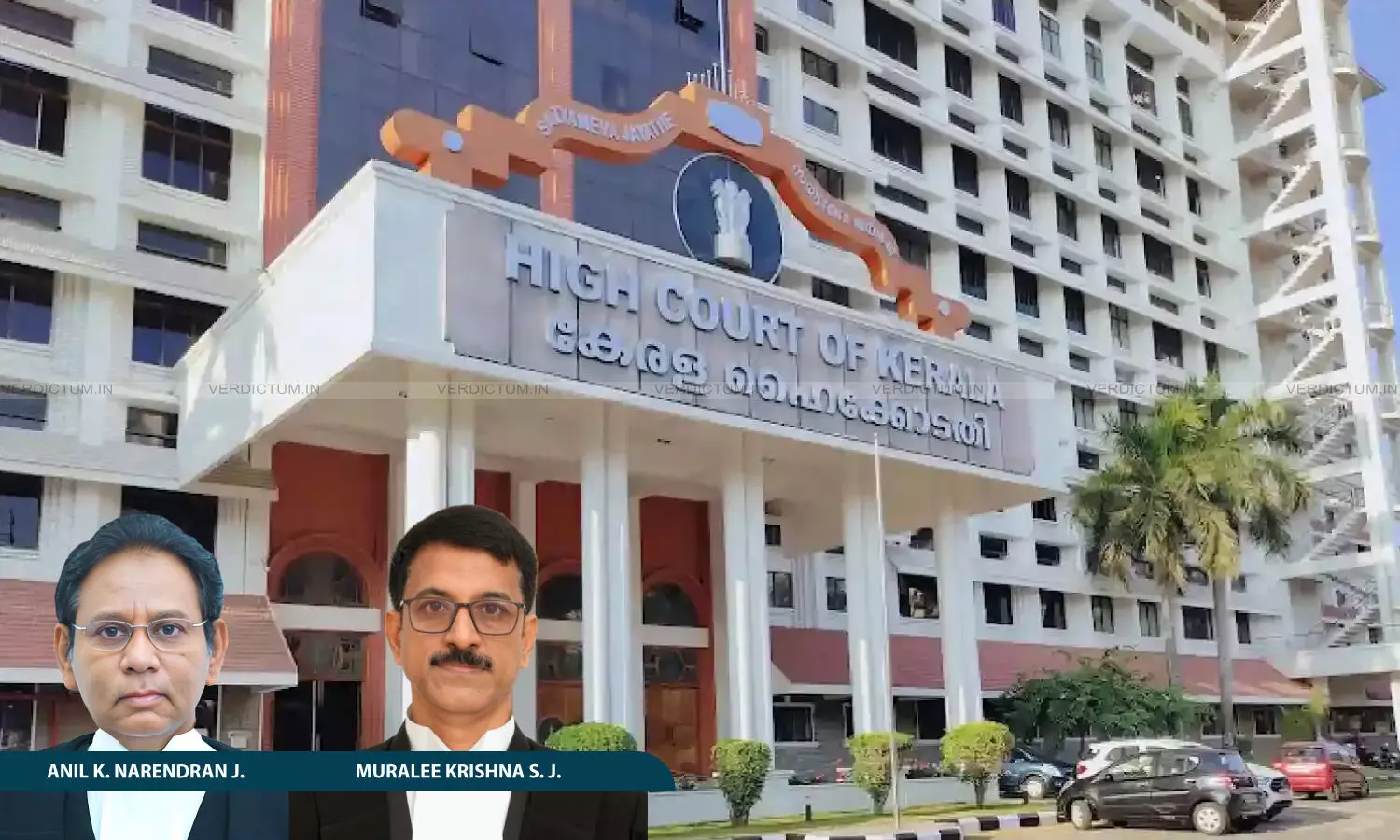
Justice Anil K. Narendran, Justice Muralee Krishna S., Kerala High Court
Courts Must Balance Accused’s Liberty & Nation's Safety: Kerala High Court Refuses Bail To Accused PFI Leaders In RSS Activist Sreenivasan Murder Case
 |
|The Court rejected their pleas based on parity and prolonged incarceration, finding that the material attributed distinct roles to each accused and disclosed a prima facie case under the Unlawful Activities (Prevention) Act, 1967.
The Kerala High Court, through two separate judgments, has refused bail to a national leader of the Popular Front of India and two alleged cadres in the case concerning the murder of RSS Activist Sreenivasan in Palakkad.
The Court found prima facie material connecting them to the alleged conspiracy and held that their custody of around four years did not justify bail, given the nature of the charges and the prescribed punishment.
The Court was hearing appeals under Section 21 of the National Investigation Agency Act, 2008 challenging separate orders of the Special Court for the Trial of NIA Cases, Ernakulam, which had rejected their applications for regular bail under Section 439 of the Code of Criminal Procedure, 1973.
A Bench of Justice Anil K. Narendran and Justice Muralee Krishna S. observed: “… the courts, while dispensing justice in cases under the UA (P) Act, should keep in mind not only the liberty of the accused but also the interests of the victims and their near and dear ones and above all the collective interests of the community and the safety of the nation.”
Senior Advocate Aditya Sondhi appeared for the appellants. Senior Advocate and Special Public Prosecutor for NIA Sasthamangalam S. Ajithkumar appeared for the respondents.
Background
The prosecution alleged that PFI leaders and members conspired to create terror and communal division, conducted reconnaissance of several Hindu leaders through the organisation’s alleged “Reporter Wing”, and selected Sreenivasan, described as a prominent Hindu leader, as their target. An assault team allegedly entered his shop and murdered him.
The Kerala Police initially filed a charge sheet against 44 persons for murder, criminal conspiracy and related offences. The National Investigation Agency subsequently took over the investigation after the case was treated as connected with scheduled offences under the Unlawful Activities (Prevention) Act, 1967.
The prosecution described one appellant as a national-level functionary of PFI’s Education Wing and Vice-President of the All India Imams Council. It alleged that he participated in the larger conspiracy, encouraged youths to join ISIS/Daesh, propagated its ideology, organised arms training and collected information about leaders of other communities.
The other two appellants were alleged to be active PFI cadres who had attended arms training and conspiracy meetings and travelled towards the scene with the assault team. The prosecution also alleged that they subsequently concealed clothes, vehicles and other material used during the incident.
The appellants contended that they had not been furnished written grounds of arrest, that the material did not disclose a prima facie case, and that they were entitled to parity with co-accused who had secured bail. They also relied on prolonged incarceration and the volume of witnesses, documents and forensic records to contend that the trial would not conclude soon.
Court’s Observations
The High Court relied on Pankaj Bansal v. Union of India (2024) and Ram Kishor Arora (2024) to hold that the requirement of furnishing written grounds of arrest was directed to operate prospectively. Since the appellants had been arrested in 2022, before the decision in Pankaj Bansal, the omission could not invalidate their arrests.
The Court held: “Therefore, non-communication of the grounds of arrest in writing is not a ground available to the appellant-2nd accused, who was arrested on 22.09.2022, to challenge his arrest as violative of Article 22(1) of the Constitution of India.”
The same reasoning was applied to the other two appellants, who had been arrested by the Kerala Police in 2022 and formally arrested by the NIA in 2023.
In the alleged PFI leader’s case, the Court noted that an earlier finding about the existence of prima facie material had been affirmed by the High Court and left undisturbed by the Supreme Court. In the absence of a material change in the factual or legal position, that satisfaction continued to operate against his renewed bail claim.
The material recorded by the Court included data allegedly recovered from a pen drive and mobile phone, witness statements concerning arms training and speeches, information about leaders of Hindu organisations, and communications with persons accused in other murder cases.
As regards the other two appellants, the Court referred to CCTV footage allegedly showing their movement towards the scene with the assault team, forensic reports concerning the victim’s DNA on their clothes, alleged bloodstains on the vehicles and the recovery of articles pursuant to their disclosures.
The Court observed: “When the materials placed before the court prima facie make out the offence under Chapter IV of the UA (P) Act, the Special Court cannot be found fault with in arriving at a conclusion that there are materials that prima facie show the involvement of the 19th and 20th accused in the conspiracy and destruction of evidence. The said finding of the Special Court is neither arbitrary nor illegal, warranting any interference in this Crl. Appeal.”
The appellants sought parity with co-accused described as members of a “Defence Team”, who had previously been granted bail. The Court distinguished their attributed roles and held that parity could not be determined merely because the accused faced charges arising from the same occurrence.
Referring to Ramesh Bhavan Rathod v. Vishanbhai Hirabhai Makwana (2021), Tarun Kumar (2024) and Shaheen Welfare Association (1996), the Court observed: “The principle of parity is based on the guarantee of positive equality before law enshrined in Article 14 of the Constitution of India. In deciding the aspect of parity, the role attached to the accused and their position in relation to the incident and the victims are of utmost importance. Parity is not the law.”
The Court consequently declined to extend the benefit granted to the alleged Defence Team members to the three appellants.
The Court considered Union of India v. K.A. Najeeb (2021), which permits constitutional courts to grant bail despite the restrictions under Section 43-D(5) of the UAPA where incarceration has exceeded a substantial part of the prescribed sentence and the trial is unlikely to conclude within a reasonable period.
Referring to Syed Iftikhar Andrabi (2026), however, the Court observed: “No reading of the decision of the Three-Judge Bench in K.A. Najeeb [(2021) 3 SCC 713] suggests that the mere passage of time, divorced from all surrounding circumstances, mechanically entitles an accused to release.”
The alleged PFI leader had undergone three years and eleven months in custody, while the other two appellants had undergone four years and four months. Considering the punishment of death or life imprisonment prescribed for the alleged offences, the Court held that their incarceration had not exceeded a substantial part of the prescribed sentence.
The Court also noted that the framing of charges had remained stayed under an interim Supreme Court order that was subsequently vacated. It further recorded the NIA’s submission that the Kerala Government had sanctioned two exclusive NIA Special Courts in Ernakulam to facilitate a speedy trial.
Conclusion
The High Court concluded that the bar under Section 43-D(5) of the UAPA applied, while their pleas concerning written grounds of arrest, parity, prolonged incarceration and delay in trial did not warrant their release.
The Court, accordingly, dismissed both appeals and upheld the Special Court’s refusal to grant bail to the three accused.
Cause Title: Ashraf @ Ashraf Moulavi v. Union of India and Another (2026:KER:64863); Abdul Kader and Another v. Union of India and Another (2026:KER:65804)
Appearances
Appellants: Senior Advocate Aditya Sondhi; Advocates E.A. Haris, P.P. Harris and Aagi Johny; Advocates E.A. Haris, P.P. Harris and Renjith B. Marar
Respondents: Senior Advocate and Special Public Prosecutor for NIA Sasthamangalam S. Ajithkumar; Advocate Sreenath Sasidharan