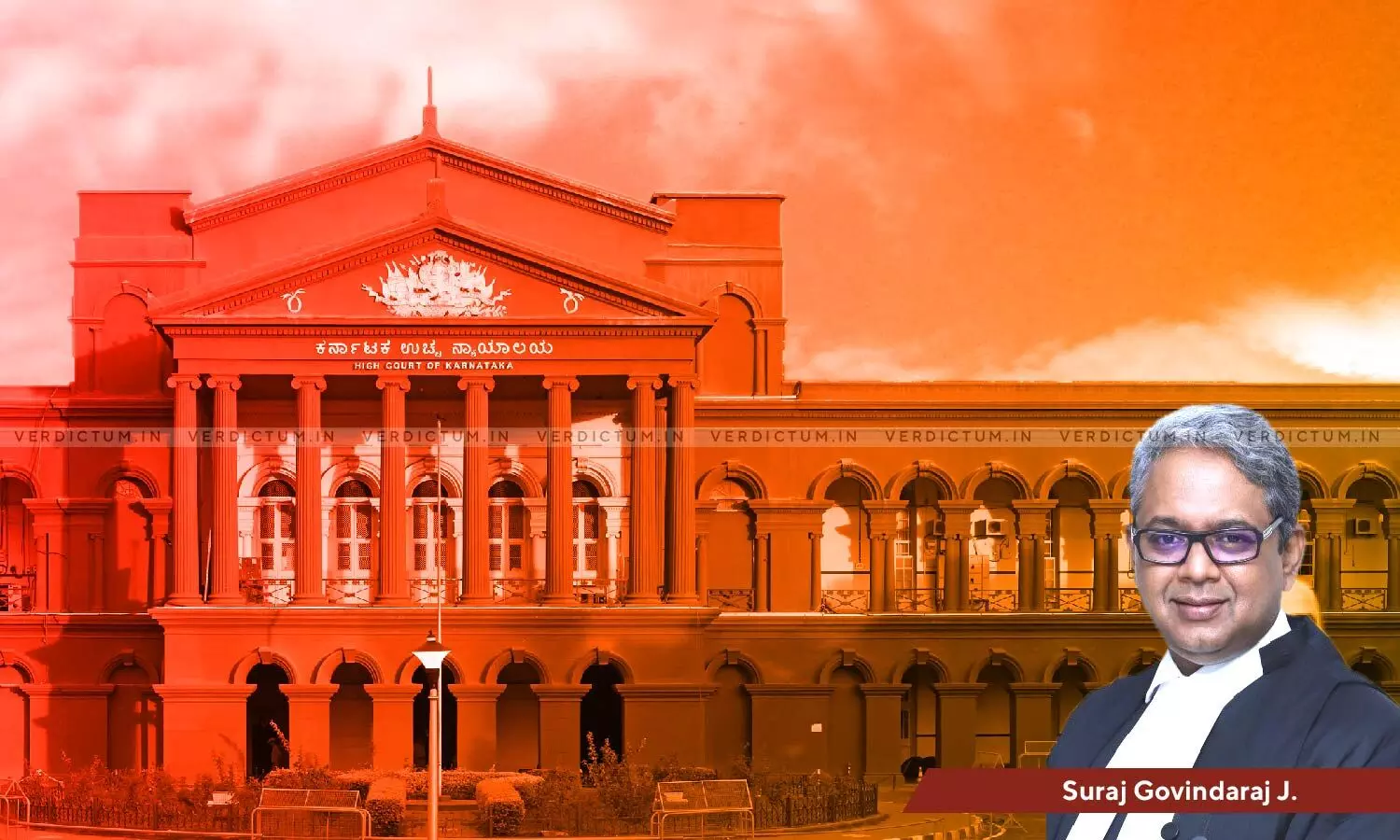
Justice Suraj Govindaraj, Karnataka High Court
Section 23 Senior Citizens Act| Transferor Need Not Be Aged 60+ On The Date Of Execution Of Transfer: Karnataka High Court
 |
|The Bench noted that it is sufficient that the applicant is a senior citizen i.e. sixty years of age or above, as on the date of filing of the application under Section 23 of the Maintenance and Welfare of Parents and Senior Citizens Act, 2007.
The Karnataka High Court has ruled that a marginal shortfall in a transferor's age at the time of filing an application under Section 23 of the Maintenance and Welfare of Parents and Senior Citizens Act, 2007, will not disentitle them from relief, provided they attain sixty years of age during the pendency of the proceedings.
Applying a liberal interpretation to advance the legislative intent, the Court held that insisting on strict compliance with the age threshold on the exact date of application or transfer would defeat the beneficial object of the statute, which aims to protect the elderly from neglect and financial insecurity.
A Single Judge Bench of Justice Suraj Govindaraj observed, “…the expression ‘senior citizen’ in Section 23 does not require the transferor to have been sixty years of age on the date of execution of the transfer; such a reading would negate the object of the Act. It is sufficient that the applicant is a senior citizen, that is, sixty years of age or above, as on the date of filing of the application under Section 23; and where there is only a marginal shortfall in age on that date, the requirement is satisfied if the applicant has attained the age of sixty by the date on which the matter is taken up for consideration. Tested on this standard, the shortfall in the age of Respondent No.3 on the date of the application does not disentitle him, him being a senior citizen well before the matter was considered”.
Advocate Sujayeendra Sridhar appeared for the petitioner and Mohammed Jafar Shah, AGA while Senior Advocate Dhananjay Joshi appeared as amicus curiae.
The petitioner, Tejaswini V., was married to D. Gopi, the son of Respondent No. 3, V. Dhanashekar. Owing to marital discord and neglect by her husband, Respondent No. 3 voluntarily executed a registered gift deed on October 14, 2020, conveying residential property to the petitioner and her minor son to secure their future.
Subsequently, on August 17, 2022, Respondent No. 3 filed an application under Section 23 of the Senior Citizens Act seeking cancellation of the gift deed, alleging that the petitioner had failed to provide him with basic amenities.
The petitioner contested the proceedings before the Tribunal of Maintenance and Welfare of Parents and Senior Citizens, arguing that Respondent No. 3 was only 59 years old on the date of the application and thus not a senior citizen under the Act. Furthermore, she contended that the gift deed contained no condition obligating her to maintain him. On December 15, 2023, the Maintenance Tribunal allowed the application and cancelled the gift deed. Aggrieved, the petitioner filed writ petition before the Karnataka High Court.
The Court rejected the preliminary objection regarding age, clarifying that the date of execution of the transfer is not the touchstone, and an applicant who turns sixty prior to the final disposal of the matter satisfies the statutory threshold. However, on the merits, the Court observed that Section 23 requires two mandatory prerequisites: the transfer must be subject to an express or implied condition of maintenance, and the transferee must have failed or refused to fulfill it.
The Court noted that the gift was executed to secure the neglected daughter-in-law and her minor child, making it the very opposite of a conditional gift for the donor's maintenance. The statutory obligation to maintain Respondent No. 3 lay upon his son under Section 2(a) of the Act, not upon the daughter-in-law. In the absence of a maintenance clause within the gift deed, the Tribunal lacked jurisdiction to invoke Section 23.
The Court allowed the writ petition and issued a writ of certiorari quashing the Tribunal’s order dated December 15, 2023. Further the registered gift deed dated October 14, 2020, executed in favour of the petitioner, was restored to its full legal force and effect. The Court clarified that Respondent No. 3 retains the liberty to pursue independent legal remedies against his son for maintenance.
Furthermore, noticing that the petitioner was allegedly married at 15 years of age, the Court directed the jurisdictional District Magistrate and Child Marriage Prohibition Officer to verify the facts and initiate appropriate legal proceedings under the Prohibition of Child Marriage Act, 2006.
Cause Title: Tejaswini V. v. The State of Karnataka & Ors. (Neutral Citation: 2026:KHC:46022)
Appearances:
Petitioner: Advocate Sujayeendra Sridhar.
Respondent: Additional Government Advocate Mohammed Jafar Shah, Senior Counsel Dhananjay Joshi, Amicus Curiae.